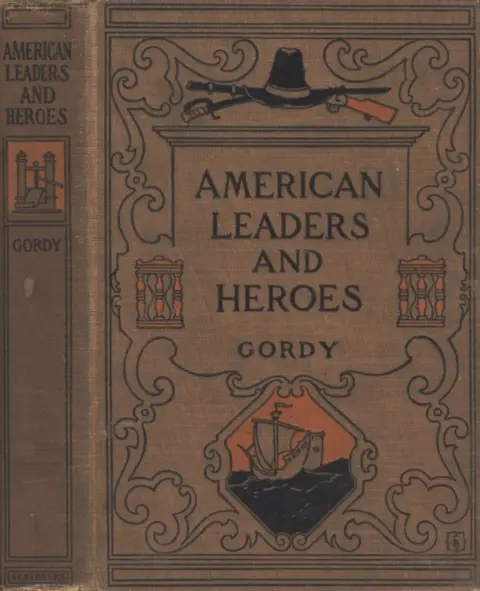
American Leaders and Heroes: A preliminary text-book in United States History
Wilbur F. (Wilbur Fisk) Gordy
THE CLASSIC COLLECTION · 1915
"Stories of Later American History" by Wilbur F. Gordy is a historical account written in the early 20th century. The book aims to present biographical narratives about key figures and events in American history that are essential for young students, particularly focusing on the time period following the Revolutionary War. It is designed to provide an engaging and vivid portrayal of America's past to help instill a sense of patriotism and understanding of the nation's development. The opening portion introduces the context surrounding the Stamp Act, a significant turning point that stirred revolutionary sentiments among the colonists. It highlights the growing unrest leading to Patrick Henry's rise as a powerful orator advocating for colonial rights. Patrick's tenacity is captured as he challenges the authority of the British Parliament, culminating in his famous speech that calls for liberty. The narrative emphasizes his early life, drawing connections between his personal struggles and eventual emergence as a leader during a pivotal moment in American history. This opening sets the stage for a rich exploration of influential characters and key events that shaped the United States.
Introduction adapted from the source catalogue; source summaries may be automatically generated.
Free to read · English · 60,230 words · No account needed
MAKE TIME FOR A GOOD BOOK
On by default. Untick to stop anonymous reading totals. Each page counts after 10 seconds in view. How this works.
Anonymous counting is on unless you have switched it off.
With this conviction, it has been the author's desire to make the story of the events concrete, dramatic, and lifelike by centring them about leaders, heroes, and other representative men, in such a way as to appeal to the imagination and to influence the ideals of the child. In so doing, he has made no attempt to write organized history--tracing out its intricate relations of cause and effect. At the same time, however, he has aimed to select his facts and events so carefully that the spirit of our national life and institutions, as well as many of the typical events of American history, may be presented.
It is confidently hoped that the fine illustrations and the attractive typographical features of the book will help to bring vividly before the mind of the child the events narrated in the text.
Another aid in making the stories vivid will, it is intended, be found in "Some Things to Think About." These and many similar questions, which the teacher can easily frame to fit the needs of her class, will help the pupil to make real the life of days gone by as well as to connect it with the present time and with his own life.
In conclusion, I wish to acknowledge my deep obligations to Mr. Forrest Morgan, of the Watkinson Library, Hartford, and to Miss Elizabeth P. Peck, of the Hartford Public High School, both of whom have read the manuscript and have made many valuable criticisms and suggestions.
HARTFORD, CONN.,
April 15, 1915.
Pioneers on the Overland Route, Westward
George III
Patrick Henry
Patrick Henry Delivering His Speech in the Virginia House of
Burgesses
William Pitt
St. John's Church, Richmond
Samuel Adams
Patriots in New York Destroying Stamps Intended for Use in
Connecticut
Faneuil Hall, Boston
Old South Church, Boston
The "Boston Tea Party"
Carpenters' Hall, Philadelphia
John Hancock
John Hancock's Home, Boston
A Minuteman
Old North Church
Paul Revere's Ride
Monument on Lexington Common Marking the Line of the Minutemen
Concord Bridge
President Langdon, the President of Harvard College, Praying for the
Bunker Hill Entrenching Party on Cambridge Common Just
Before Their Departure
Prescott at Bunker Hill
Bunker Hill Monument
George Washington
Washington, Henry, and Pendleton on the Way to Congress at
Philadelphia
The Washington Elm at Cambridge, under which Washington took Command
of the Army
Sir William Howe
Thomas Jefferson Looking Over the Rough Draught of the Declaration
of Independence
The Retreat from Long Island
Nathan Hale
British and Hessian Soldiers
Powder-Horn, Bullet-Flask, and Buckshot-Pouch Used in the Revolution
General Burgoyne Surrendering to General Gates
Marquis de Lafayette
Lafayette Offering His Services to Franklin
Winter at Valley Forge
Nathanael Greene
The Meeting of Greene and Gates upon Greene's Assuming Command
Daniel Morgan
Francis Marion
Marion Surprising a British Wagon-Train
John Paul Jones
Battle Between the Ranger and the Drake
The Fight Between the Bon Homme Richard and the Serapis
Daniel Boone
Boone's Escape from the Indians
Boonesborough
Boone Throwing Tobacco into the Eyes of the Indians Who Had Come to
Capture Him
James Robertson
Living-Room of the Early Settler
Grinding Indian Corn
A Kentucky Pioneer's Cabin
John Sevier
A Barbecue of 1780
Battle of King's Mountain
George Rogers Clark
Clark on the Way to Kaskaskia
Clark's Surprise at Kaskaskia
Wampum Peace Belt
Clark's Advance on Vincennes
George Washington
Washington's Home, Mount Vernon
Tribute Rendered to Washington at Trenton
Washington Taking the Oath of Office as First President, at Federal
Hall, New York City
Washington's Inaugural Chair
Eli Whitney
Whitney's Cotton-Gin
A Colonial Planter
A Slave Settlement
Thomas Jefferson
"Monticello," the Home of Jefferson
A Rice-Field in Louisiana
A Flatboat on the Ohio River
House in New Orleans Where Louis Philippe Stopped in 1798
A Public Building in New Orleans Built in 1794
Meriwether Lewis
William Clark
Buffalo Hunted by Indians
The Lewis and Clark Expedition Working Its Way Westward
Andrew Jackson
"The Hermitage," the Home of Andrew Jackson
Fighting the Seminole Indians, under Jackson
Robert Fulton
Fulton's First Experiment with Paddle-Wheels
The "Clermont" in Duplicate at the Hudson-Fulton Celebration, 1909
The Opening of the Erie Canal in 1825
The Ceremony Called "The Marriage of the Waters"
Erie Canal on the Right and Aqueduct over the Mohawk River, New York
"Tom Thumb," Peter Cooper's Locomotive Working Model, First Used
near Baltimore in 1830
Railroad Poster of 1843
Comparison of "DeWitt Clinton" Locomotive and Train, the First Train
Operated in New York, with a Modern Locomotive of the New
York Central R.R.
S.F.B. Morse
The First Telegraph Instrument
Modern Telegraph Office
The Operation of the Modern Railroad is Dependent upon the Telegraph
Sam Houston
Flag of the Republic of Texas
David Crockett
The Fight at the Alamo
John C. Fremont
Fremont's Expedition Crossing the Rocky Mountains
Kit Carson
Sutter's Mill
Placer-Mining in the Days of the California Gold Rush
John C. Calhoun
Calhoun's Office and Library
Henry Clay
The Birthplace of Henry Clay, near Richmond
The Schoolhouse in "the Slashes"
Daniel Webster
The Home of Daniel Webster, Marshfield, Mass.
Henry Clay Addressing the United States Senate in 1850
Abraham Lincoln
Lincoln's Birthplace
Lincoln Studying by Firelight
Lincoln Splitting Rails
Lincoln as a Boatman
Lincoln Visiting Wounded Soldiers
Robert E. Lee
Lee's Home at Arlington, Virginia
Jefferson Davis
Thomas J. Jackson
A Confederate Flag
J.E.B. Stuart
Confederate Soldiers
Union Soldiers
Ulysses S. Grant
Grant's Birthplace, Point Pleasant, Ohio
General and Mrs. Grant with Their Son at City Point, Virginia
William Tecumseh Sherman
Sherman's March to the Sea
Philip H. Sheridan
Sheridan Rallying His Troops
The McLean House Where Lee Surrendered
General Lee on His Horse, Traveller
Cotton-Field in Blossom
A Wheat-Field
Grain-Elevators at Buffalo
Cattle on the Western Plains
Iron Smelters
Iron Ore Ready for Shipment
Your reading position is saved on this browser. Take it to another device with a library code. Reading pages adapt to text, rather than matching a printed edition.
Wilbur F. (Wilbur Fisk) Gordy
BEHIND THE BOOK
This eBook is for the use of anyone anywhere in the United States and most other parts of the world at no cost and with almost no restrictions whatsoever. You may copy it, give it away or re-use it under the terms of the Project Gutenberg License included with this eBook or online at www.gutenberg.org. If you are not located in the United States, you will have to check the laws of the country where you are located before using this eBook. Read the source licence.
The original source file, including credits and licence, is retained by this library. Request an original-format copy at no charge. Please include the book title and Project Gutenberg identifier #18618.
KEEP YOUR CURIOSITY GOING
Cécile Tormay

Moritz Busch
John L. Ransom
Frances Wright
Cécile Tormay

Mabel Potter Daggett