THE CLASSIC COLLECTION✦An outlaw’s diary: the CommuneCLASSIC FREE BOOKS
An outlaw’s diary: the Commune
Cécile Tormay
THE CLASSIC COLLECTION · 1882
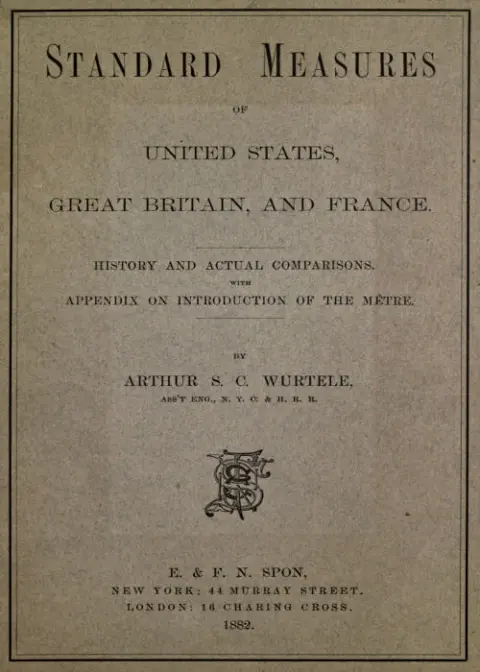
"Standard Measures of United States, Great Britain and France" by Arthur S. C. Wurtele is a scientific publication written in the early 1880s. The book explores the various systems of measurement used in the U.S., Great Britain, and France, focusing on the historical evolution and practical comparisons of standard units of length. In his work, Wurtele delves into the complexities and inconsistencies associated with measurements such as yards, meters, and toises. He provides a thorough historical account of how standards were established and refined over time in each country. Through extensive comparisons, Wurtele highlights the discrepancies between different standards while emphasizing the importance of context, such as material composition and temperature, in achieving measurement accuracy. The book concludes with a critical assessment of the practicalities of adopting the metric system in the U.S., arguing for the value of existing standards in everyday life and commerce.
Introduction adapted from the source catalogue; source summaries may be automatically generated.
Free to read · English · 4,897 words · No account needed
MAKE TIME FOR A GOOD BOOK
On by default. Untick to stop anonymous reading totals. Each page counts after 10 seconds in view. How this works.
Anonymous counting is on unless you have switched it off.
Measurer. Mid. Lat. Arc. Length. B.--Svanberg, Sweden +66° 20´ 10·0´´ 1° 37´ 19·6´´ 593,277 feet A.--Maupertuis, Sweden +66° 19´ 37·0´´ 0° 57´ 30·4´´ 351,832 “ A.--Struve, Russia +58° 17´ 37·0´´ 3° 35´ 5·2´´ 1,309,742 “ B.--Struve and Tenner, Russia +56° 3´ 55·5´´ 8° 2´ 28·9´´ 2,937,439 “ B.--Bessel and Bayer, Prussia +54° 58´ 26·0´´ 1° 30´ 29·0´´ 551,073 “ B.--Schumacher, Denmark +54° 8´ 13·7´´ 1° 31´ 53·3´´ 559,121 “ A, B.--Ganss, Hanover +52° 32´ 16·6´´ 2° 0´ 57·4´´ 736,425 “ A.--Roy and Kater, England +52° 35´ 45·0´´ 3° 57´ 13·1´´ 1,442,953 “ B.-- “ “ “ +52° 2´ 19·0´´ 2° 50´ 23·5´´ 1,036,409 “ A.--Lacaille and Cassini, France +46° 52´ 2·0´´ 8° 20´ 0·3´´ 3,040,605 “ A, B.--Delambre and Mechin, France +44° 51´ 2·5´´ 12° 22´ 12·7´´ 4,509,832 “ A.--Boscovich, Rome +42° 59´ ·0´´ 2° 9´ 47·0´´ 787,919 “ A.--Mason and Dixon, America +39° 12´ ·0´´ 1° 28´ 45·0´´ 538,100 “ A, B.--Lambton, India +16° 8´ 21·5´´ 15° 57´ 40·7´´ 5,794,598 “ A, B.--Lambton and Everest, India +12° 32´ 20·8´´ 1° 34´ 56·4´´ 574,318 “ A, B.--Lacondamine, Peru - 1° 31´ 0·4´´ 3° 7´ 3·5´´ 1,131,050 “ A.--Lacaille, Cape Good Hope -33° 18´ 30·0´´ 1° 13´ 17·5´´ 445,506 “ B.--Maclear, “ “ -35° 43´ 20·0´´ 3° 34´ 34·7´´ 1,301,993 “ A.--Plana and Cartessi, Piedmont -------------- 1° 7´ 31·1´´ ------------
The following different lengths of the mètre have been obtained:
As adopted by France, 1801 443·296 lignes. According to Delambre 443·264 “ “ Bessel 443·33394 “ “ Airy 443·32387 “ “ Clarke 443·36146 “ From Peru Meridian 443·440 “
The length of a pendulum vibrating 100,000 times in a mean solar day was determined in numerous careful experiments by Biot, Arago, and Mathieu, in mètres of 443·296 lignes, as follows:
Dunkirk 56·67 lat. Cent. 0 above sea 0·7419076 mètres. Paris 54·26 “ 65 “ 0·7418870 “ “ by Borda 54·26 “ 0 “ 0·7416274 “ Bordeau 49·82 “ 0 “ 0·7412615 “ Formentera 42·96 “ 196 “ 0·7412061 “
Borda also determined the length of the seconds pendulum at Paris, in
vacuo:
First result 440·5595 lignes = 0·9938267 mètre. Second result “ “ = 0·9938460 “ As given by Ganot “ “ = 0·9935 “
In 1812 the système usuelle was established, of which the unit was one third of the mètre, with the old name of pied, and duodecimally divided into pouces and lignes.
This system continued in use till 1840, when it was abolished by law, and the names of pied, pouce, and ligne forbidden under penalties. So the mètre, decimally divided, remains the only legal measure of length in France.
In 1832, under resolution of Congress, Mr. Hassler compared the different standard yards in America, with the following results, using the yard between the twenty-seventh and sixty-third inches on the scale made of bronze by Troughton, of London, for the United States Coast Survey, as the reference, that being identical with Sir George Schuckburg’s standard:
Troughton Scale, mid. yard 36·0000000 inches. “ “ between platinum points 35·9989758 “ Jones yard in State Department 35·9990285 “ Iron yard in Engineer Department 35·9987760 “ Brass yard, Albany, Sec. of State 36·0002465 “ Gilbert yard, University of Virginia 35·9952318 “
In 1856 the Troughton standard bronze scale was compared with the bronze standard yard No. 11, which was sent over by Airy as a copy of the English imperial standard, as restored after destruction of the original standard by fire in 1834, and the United States standard was found to be longer by 0·00085 inch.
Later comparisons by J. E. Hilgard, of the Coast Survey, of the bronze standard No. 11 with the imperial standard yard, at the British Standards Office, gave No. 11 as 0·000088 shorter than the imperial standard.
Your reading position is saved on this browser. Take it to another device with a library code. Reading pages adapt to text, rather than matching a printed edition.
BEHIND THE BOOK
This eBook is for the use of anyone anywhere in the United States and most other parts of the world at no cost and with almost no restrictions whatsoever. You may copy it, give it away or re-use it under the terms of the Project Gutenberg License included with this eBook or online at www.gutenberg.org. If you are not located in the United States, you will have to check the laws of the country where you are located before using this eBook. Read the source licence.
The original source file, including credits and licence, is retained by this library. Request an original-format copy at no charge. Please include the book title and Project Gutenberg identifier #54208.
KEEP YOUR CURIOSITY GOING
Cécile Tormay

Moritz Busch
John L. Ransom
Frances Wright
Cécile Tormay

Mabel Potter Daggett