THE CLASSIC COLLECTION✦An outlaw’s diary: the CommuneCLASSIC FREE BOOKS
An outlaw’s diary: the Commune
Cécile Tormay
THE CLASSIC COLLECTION · 1882
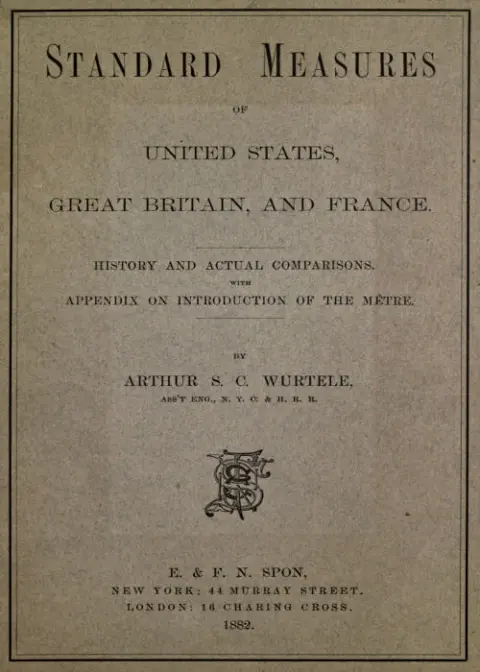
"Standard Measures of United States, Great Britain and France" by Arthur S. C. Wurtele is a scientific publication written in the early 1880s. The book explores the various systems of measurement used in the U.S., Great Britain, and France, focusing on the historical evolution and practical comparisons of standard units of length. In his work, Wurtele delves into the complexities and inconsistencies associated with measurements such as yards, meters, and toises. He provides a thorough historical account of how standards were established and refined over time in each country. Through extensive comparisons, Wurtele highlights the discrepancies between different standards while emphasizing the importance of context, such as material composition and temperature, in achieving measurement accuracy. The book concludes with a critical assessment of the practicalities of adopting the metric system in the U.S., arguing for the value of existing standards in everyday life and commerce.
Introduction adapted from the source catalogue; source summaries may be automatically generated.
Free to read · English · 4,897 words · No account needed
MAKE TIME FOR A GOOD BOOK
On by default. Untick to stop anonymous reading totals. Each page counts after 10 seconds in view. How this works.
Anonymous counting is on unless you have switched it off.
Operations were commenced in 1792, and carried on with great accuracy to completion in 1799; Delambre working between Dunkirk and Paris, and Mechin between Paris and Barcelona.
The distance measured from Dunkirk to Barcelona was 9° 40´ 24·24´´ of arc, or 1,075,059 mètres, as reduced to the new standard.
The “toise de Peru” was the standard used in the work at a temperature of
13° R.
Two base-lines were measured with Borda’s compensating bars of brass and platinum; one at Melun, near Paris, 6076 toises long, and the second at Perpignan, 6028 toises long, and though over 900,000 mètres apart, the calculated length differed by only 10 pouces.
This meridian was afterward, in 1806, extended by Gen. Roy to Greenwich, on the north, and by Biot and Arago to Formentera, on the south. The results, as given by Laplace in centesimal degrees and mètres, are as follows:
Greenwich 57·19753° ·0 mètres. Pantheon, Paris 54·27431° 292,719·3 “ Formentera 42·96178° 1,423,636·1 “
The middle of the arc being 50·079655° Cent., or 45° 4´ 18·0822´´ Sexa., and the middle degree centesimal being very nearly 100,000 mètres.
The determination of the final result of these geodetic measurements was referred to a committee of 20 members; 9 named by the French Government, and the others by the governments of Holland, Savoy, Denmark, Spain, Tuscany, and of the Cisalpine, Ligurian, and Swiss republics, on the invitation of France.
This committee established the meridian quadrant at 5,130,740 toises; making the mètre 0·513074 of the toise, or 36·9413 pouces, or 443·296 lignes, and the toise 1·94903659 mètres.
Iron standard mètre bars, 12 in number were made by Borda, also 2 of platinum and 4 standard toise bars.
The 12 standard iron mètre bars were sent to different countries, after being verified by the French Government, and on the 2d of November, 1801, the mètrical système was legalized by France, and the standard unit of length declared to be the ten millionth part of a meridian quadrant of the earth, as defined by the distance at a temperature of 0° Centigrade (32° F.) between two points on a platinum bar in the keeping of the Academy of Science at Paris. This standard bar is used only once every ten years for exact comparisons, as stated by Dr. F. A. P. Barnard.
About 1837 Bessel, by a combination of 11 measured arcs of meridian, deduced the quadrant of meridian as 5,131,179·81 toises instead of 5,130,740 toises, as fixed by law. This would make to quadrant 10,000,565·278 legal mètres, or would increase the mètre length from 443·296 lignes to 443·334 lignes, agreeing very nearly with result obtained by Airy in 1830, from a combination of 13 measured arcs.
The following are the measured arcs used by Bessel and Airy; the combinations being indicated by initial letters, A and B.
Your reading position is saved on this browser. Take it to another device with a library code. Reading pages adapt to text, rather than matching a printed edition.
BEHIND THE BOOK
This eBook is for the use of anyone anywhere in the United States and most other parts of the world at no cost and with almost no restrictions whatsoever. You may copy it, give it away or re-use it under the terms of the Project Gutenberg License included with this eBook or online at www.gutenberg.org. If you are not located in the United States, you will have to check the laws of the country where you are located before using this eBook. Read the source licence.
The original source file, including credits and licence, is retained by this library. Request an original-format copy at no charge. Please include the book title and Project Gutenberg identifier #54208.
KEEP YOUR CURIOSITY GOING
Cécile Tormay

Moritz Busch
John L. Ransom
Frances Wright
Cécile Tormay

Mabel Potter Daggett