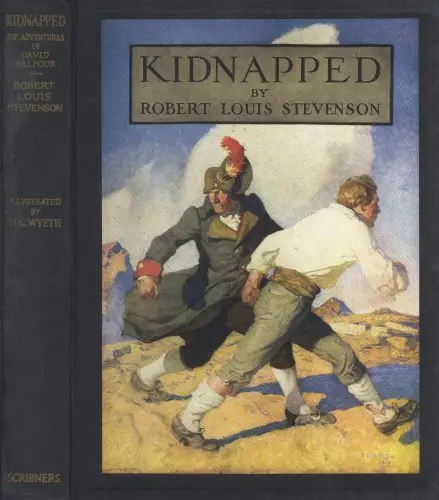
Vailima Letters Being Correspondence Addressed by Robert Louis Stevenson to Sidney Colvin, November 1890-October 1894
Robert Louis Stevenson
THE CLASSIC COLLECTION · 1897
"St. Ives: Being the Adventures of a French Prisoner in England" by Robert Louis Stevenson is a novel written during the late 19th century. The story follows the experiences of the protagonist, Anne de Keroual de St. Yves, a French soldier who becomes a prisoner during the Napoleonic Wars. The narrative revolves around his life in an Edinburgh prison, where he navigates the complexities of captivity, interacts with fellow prisoners, and forms a budding romance with a young Englishwoman named Flora. The opening of "St. Ives" introduces the protagonist as he reflects on his situation after being captured and imprisoned. Through his observations of the other prisoners and life in the castle, he reveals a balance of humor and despair, highlighting the absurdity of his circumstances. His interactions with the English officers, his attempts to maintain a sense of dignity, and the camaraderie developed among the imprisoned soldiers shape his character. In particular, his infatuation with Flora, a young woman who visits the prison, becomes a central theme, illustrating the conflict between his noble birth and the humiliation of his current status. The beginning sets the stage for a tale of resilience, love, and the quest for identity amidst adversity.
Introduction adapted from the source catalogue; source summaries may be automatically generated.
Free to read · English · 104,674 words · No account needed
MAKE TIME FOR A GOOD BOOK
On by default. Untick to stop anonymous reading totals. Each page counts after 10 seconds in view. How this works.
Anonymous counting is on unless you have switched it off.
I was half an hour at least in the society of these distressing bipeds, and alone with my own reflections and necessities. I was in great pain of my flayed hands, and had nothing to treat them with; I was hungry and thirsty, and had nothing to eat or to drink; I was thoroughly tired, and there was no place for me to sit. To be sure there was the floor, but nothing could be imagined less inviting.
At the sound of approaching footsteps, my good-humour was restored. The key rattled in the lock, and Master Ronald entered, closed the door behind him, and leaned his back to it.
‘I say, you know!’ he said, and shook a sullen young head.
‘I know it’s a liberty,’ said I.
‘It’s infernally awkward: my position is infernally embarrassing,’ said
he.
‘Well,’ said I, ‘and what do you think of mine?’
This seemed to pose him entirely, and he remained gazing upon me with a convincing air of youth and innocence. I could have laughed, but I was not so inhumane.
‘I am in your hands,’ said I, with a little gesture. ‘You must do with me what you think right.’
‘Ah, yes!’ he cried: ‘if I knew!’
‘You see,’ said I, ‘it would be different if you had received your commission. Properly speaking, you are not yet a combatant; I have ceased to be one; and I think it arguable that we are just in the position of one ordinary gentleman to another, where friendship usually comes before the law. Observe, I only say arguable. For God’s sake, don’t think I wish to dictate an opinion. These are the sort of nasty little businesses, inseparable from war, which every gentleman must decide for himself. If I were in your place—’
‘Ay, what would you do, then?’ says he.
‘Upon my word, I do not know,’ said I. ‘Hesitate, as you are doing, I
believe.’
‘I will tell you,’ he said. ‘I have a kinsman, and it is what he would think, that I am thinking. It is General Graham of Lynedoch—Sir Thomas Graham. I scarcely know him, but I believe I admire him more than I do God.’
‘I admire him a good deal myself,’ said I, ‘and have good reason to. I have fought with him, been beaten, and run away. Veni, victus sum, evasi.’
‘What!’ he cried. ‘You were at Barossa?’
Your reading position is saved on this browser. Take it to another device with a library code. Reading pages adapt to text, rather than matching a printed edition.
Robert Louis Stevenson

Robert Louis Stevenson

Robert Louis Stevenson
BEHIND THE BOOK
This eBook is for the use of anyone anywhere in the United States and most other parts of the world at no cost and with almost no restrictions whatsoever. You may copy it, give it away or re-use it under the terms of the Project Gutenberg License included with this eBook or online at www.gutenberg.org. If you are not located in the United States, you will have to check the laws of the country where you are located before using this eBook. Read the source licence.
The original source file, including credits and licence, is retained by this library. Request an original-format copy at no charge. Please include the book title and Project Gutenberg identifier #322.
KEEP YOUR CURIOSITY GOING
Cécile Tormay

Moritz Busch
Coulson Kernahan
John L. Ransom

Maurice Baring
Frances Wright