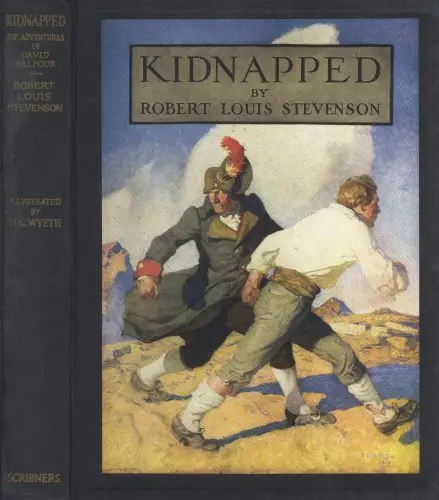
Vailima Letters Being Correspondence Addressed by Robert Louis Stevenson to Sidney Colvin, November 1890-October 1894
Robert Louis Stevenson
THE CLASSIC COLLECTION · 1897
"St. Ives: Being the Adventures of a French Prisoner in England" by Robert Louis Stevenson is a novel written during the late 19th century. The story follows the experiences of the protagonist, Anne de Keroual de St. Yves, a French soldier who becomes a prisoner during the Napoleonic Wars. The narrative revolves around his life in an Edinburgh prison, where he navigates the complexities of captivity, interacts with fellow prisoners, and forms a budding romance with a young Englishwoman named Flora. The opening of "St. Ives" introduces the protagonist as he reflects on his situation after being captured and imprisoned. Through his observations of the other prisoners and life in the castle, he reveals a balance of humor and despair, highlighting the absurdity of his circumstances. His interactions with the English officers, his attempts to maintain a sense of dignity, and the camaraderie developed among the imprisoned soldiers shape his character. In particular, his infatuation with Flora, a young woman who visits the prison, becomes a central theme, illustrating the conflict between his noble birth and the humiliation of his current status. The beginning sets the stage for a tale of resilience, love, and the quest for identity amidst adversity.
Introduction adapted from the source catalogue; source summaries may be automatically generated.
Free to read · English · 104,674 words · No account needed
MAKE TIME FOR A GOOD BOOK
On by default. Untick to stop anonymous reading totals. Each page counts after 10 seconds in view. How this works.
Anonymous counting is on unless you have switched it off.
‘Well, I wish he may prove all right!’ continued the lawyer, with certainly the worst-inspired jocularity in the world. ‘I know nothing by him! He may be a swell mobsman for me with his aliases. You must put your memory on the rack, Major, and when ye’ve remembered when and where ye met him, be sure ye tell me.’
‘I will not fail, sir,’ said Chevenix.
‘Seek to him!’ cried Robbie, waving his hand as he departed.
The Major, as soon as we were alone, turned upon me his impassive
countenance.
‘Well,’ he said, ‘you have courage.’
‘It is undoubted as your honour, sir,’ I returned, bowing.
‘Did you expect to meet me, may I ask?’ said he.
‘You saw, at least, that I courted the presentation,’ said I.
‘And you were not afraid?’ said Chevenix.
‘I was perfectly at ease. I knew I was dealing with a gentleman. Be
that your epitaph.’
‘Well, there are some other people looking for you,’ he said, ‘who will make no bones about the point of honour. The police, my dear sir, are simply agog about you.’
‘And I think that that was coarse,’ said I.
‘You have seen Miss Gilchrist?’ he inquired, changing the subject.
‘With whom, I am led to understand, we are on a footing of rivalry?’ I asked. ‘Yes, I have seen her.’
‘And I was just seeking her,’ he replied.
I was conscious of a certain thrill of temper; so, I suppose, was he. We looked each other up and down.
‘The situation is original,’ he resumed.
‘Quite,’ said I. ‘But let me tell you frankly you are blowing a cold coal. I owe you so much for your kindness to the prisoner Champdivers.’
‘Meaning that the lady’s affections are more advantageously disposed of?’ he asked, with a sneer. ‘Thank you, I am sure. And, since you have given me a lead, just hear a word of good advice in your turn. Is it fair, is it delicate, is it like a gentleman, to compromise the young lady by attentions which (as you know very well) can come to nothing?’
I was utterly unable to find words in answer.
‘Excuse me if I cut this interview short,’ he went on. ‘It seems to me doomed to come to nothing, and there is more attractive metal.’
‘Yes,’ I replied, ‘as you say, it cannot amount to much. You are impotent, bound hand and foot in honour. You know me to be a man falsely accused, and even if you did not know it, from your position as my rival you have only the choice to stand quite still or to be infamous.’
Your reading position is saved on this browser. Take it to another device with a library code. Reading pages adapt to text, rather than matching a printed edition.
Robert Louis Stevenson

Robert Louis Stevenson

Robert Louis Stevenson
BEHIND THE BOOK
This eBook is for the use of anyone anywhere in the United States and most other parts of the world at no cost and with almost no restrictions whatsoever. You may copy it, give it away or re-use it under the terms of the Project Gutenberg License included with this eBook or online at www.gutenberg.org. If you are not located in the United States, you will have to check the laws of the country where you are located before using this eBook. Read the source licence.
The original source file, including credits and licence, is retained by this library. Request an original-format copy at no charge. Please include the book title and Project Gutenberg identifier #322.
KEEP YOUR CURIOSITY GOING
Cécile Tormay

Moritz Busch
Coulson Kernahan
John L. Ransom

Maurice Baring
Frances Wright