THE CLASSIC COLLECTION✦Stories from the Faerie QueeneCLASSIC FREE BOOKS
Stories from the Faerie Queene
Mary Macleod & Edmund Spenser
THE CLASSIC COLLECTION · 1909
"Spenser's Faerie Queene, Vol. 1 (of 2): Books I-III" by Edmund Spenser is an epic poem first published in 1590. This monumental work of over 36,000 lines follows knights on quests that examine different virtues—Holiness, Temperance, and Chastity. Written in Spenser's invented verse form, the Spenserian stanza, the poem operates as elaborate allegory, praising Queen Elizabeth I while aiming to "fashion a gentleman or noble person in virtuous and gentle discipline." Each knight faces trials, temptations, and perils in adventures filled with monsters, wizards, and enchantments.
Introduction adapted from the source catalogue; source summaries may be automatically generated.
Free to read · English · 154,410 words · No account needed
MAKE TIME FOR A GOOD BOOK
On by default. Untick to stop anonymous reading totals. Each page counts after 10 seconds in view. How this works.
Anonymous counting is on unless you have switched it off.
The roofe hereof was arched ouer head, xlvi And deckt with flowers and herbars daintily; Two goodly Beacons, set in watches stead, Therein gaue light, and flam’d continually: For they of liuing fire most subtilly Were made, and set in siluer sockets bright, Couer’d with lids deuiz’d of substance sly, That readily they shut and open might. O who can tell the prayses of that makers might!
Ne can I tell, ne can I stay to tell xlvii This parts great workmanship, and wondrous powre, That all this other worlds worke doth excell, And likest is vnto that heauenly towre, That God hath built for his owne blessed bowre. Therein were diuerse roomes, and diuerse stages, But three the chiefest, and of greatest powre, In which there dwelt three honorable sages, The wisest men, I weene, that liued in their ages.
Not he, whom Greece, the Nourse of all good arts, xlviii By Phœbus doome, the wisest thought aliue, Might be compar’d to these[754] by many parts: Nor that sage Pylian syre, which did suruiue Three ages, such as mortall men contriue, By whose aduise old Priams cittie fell, With these in praise of pollicies mote striue. These three in these three roomes did sundry dwell, And counselled faire Alma, how to gouerne well.
The first of them could things to come foresee: xlix The next could of things present best aduize; The third things past could keepe in memoree, So that no time, nor reason[755] could arize, But that the same could one of these comprize. For thy the first did in the forepart sit, That nought mote hinder his quicke preiudize: He had a sharpe foresight, and working wit, That neuer idle was, ne once could[756] rest a whit.
His chamber was dispainted all within, l With sundry colours, in the which were writ Infinite shapes of things dispersed thin; Some such as in the world were neuer yit, Ne can deuized be of mortall wit; Some daily seene, and knowen by their names, Such as in idle fantasies doe flit: Infernall Hags, Centaurs, feendes, Hippodames, Apes, Lions, Ægles, Owles, fooles, louers, children, Dames.
And all the chamber filled was with flyes, li Which buzzed all about, and made such sound, That they encombred all mens eares and eyes, Like many swarmes of Bees assembled round, After their hiues with honny do abound: All those were idle thoughts and fantasies, Deuices, dreames, opinions vnsound, Shewes, visions, sooth-sayes, and prophesies; And all that fained is, as leasings, tales, and lies.
Your reading position is saved on this browser. Take it to another device with a library code. Reading pages adapt to text, rather than matching a printed edition.
Mary Macleod & Edmund Spenser
Edmund Spenser
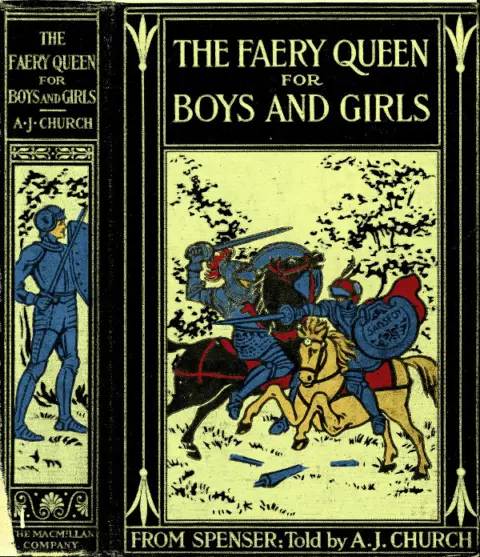
Alfred John Church & Edmund Spenser
BEHIND THE BOOK
This eBook is for the use of anyone anywhere in the United States and most other parts of the world at no cost and with almost no restrictions whatsoever. You may copy it, give it away or re-use it under the terms of the Project Gutenberg License included with this eBook or online at www.gutenberg.org. If you are not located in the United States, you will have to check the laws of the country where you are located before using this eBook. Read the source licence.
The original source file, including credits and licence, is retained by this library. Request an original-format copy at no charge. Please include the book title and Project Gutenberg identifier #70717.
KEEP YOUR CURIOSITY GOING

Eric Mackay
Edmund Gosse
Sophia Margaretta Hensley
Gilbert Parker
George MacDonald

Elizabeth Bibesco