THE CLASSIC COLLECTION✦Stories from the Faerie QueeneCLASSIC FREE BOOKS
Stories from the Faerie Queene
Mary Macleod & Edmund Spenser
THE CLASSIC COLLECTION · 1909
"Spenser's Faerie Queene, Vol. 1 (of 2): Books I-III" by Edmund Spenser is an epic poem first published in 1590. This monumental work of over 36,000 lines follows knights on quests that examine different virtues—Holiness, Temperance, and Chastity. Written in Spenser's invented verse form, the Spenserian stanza, the poem operates as elaborate allegory, praising Queen Elizabeth I while aiming to "fashion a gentleman or noble person in virtuous and gentle discipline." Each knight faces trials, temptations, and perils in adventures filled with monsters, wizards, and enchantments.
Introduction adapted from the source catalogue; source summaries may be automatically generated.
Free to read · English · 154,410 words · No account needed
MAKE TIME FOR A GOOD BOOK
On by default. Untick to stop anonymous reading totals. Each page counts after 10 seconds in view. How this works.
Anonymous counting is on unless you have switched it off.
Aiming not at a reprint but a true text, I have not hesitated to depart from 1596 wherever I believed it to be in error and the error the printer’s. But it is no part of an editor’s duty to correct, though he may indicate, mistakes made by the author himself. There are many such in the Faerie Queene.
(1) There are mistakes of fact, of literary allusion, of quantity
in classical names, hardly to be avoided by a poet writing far from
libraries.
(2) There are confusions of personages, or of names of personages, within the poem itself. Sir Guyon is confused with the Redcrosse Knight in III. ii. 4, and with Prince Arthur in II. viii. 48 (but not in 1609); Æmylia with Pœana in IV. ix. Arg.; Calepine with Calidore in VI. vi. 17; while over Serena Spenser’s confusion becomes comical--he calls her Crispina in VI. iii. 23,[1] and Matilda in VI. v. Arg.
(3) Some lines are hypermetrical; some are short by a foot; and there are two or three broken lines. One of these last (III. iv. 39, l. 7) is certainly intentional, and all may be so; the supposed example of Virgil may have influenced Spenser in this.
(4) Imperfect rhymes and concords are numerous, especially in Books IV,
V, and VI.
(5) There is one form of imperfect rhyme so singular as to deserve a fuller discussion. Its nature will be best seen in an example:--
‘Like two faire marble pillours they were seene, Which doe the temple of the Gods support, (2) Whom all the people decke with girlands greene, And honour in their festiuall resort; (4) Those same with stately grace, and princely port (5) She taught to tread, when she her selfe would grace, But with the wooddie Nymphes when she did play, (7) Or when the flying Libbard she did chace, She could them nimbly moue, and after fly apace.’
(II. iii. 28.)
Here ‘play’ in l. 7 is rhymed to ‘support’, ‘resort’, ‘port’: ‘sport’ is the obvious correction. There are, in all, nine instances of this singularity in the Faerie Queene. I subjoin them all, citing the rhyme-words only: the number following each word shows the line that it ends:--
1. day (2), dismay (4), way (5), chace (7) (II. ii. 7) 2. make (6), bold (8), told (9) (II. ii. 42) 3. support (2), resort (4), port (5), play (7) (II. iii. 28) 4. leaue (2), cleaue (4), bereaue (5), vpreare (7) (II. viii. 29) 5. spyde (6), law (8), draw (9) (III. vi. 40) 6. enclose (2), plaine (4), Maine (5), complaine (7) (III. vii. 34) 7. times (6), equipage (8), parentage (9) (IV. xi. 17) 8. place (2), aread (4), dread (5), read (7) (V. Proem 11) 9. desyre (2), entyre (4), yre (5), meed (7) (V. xi. 61)
Your reading position is saved on this browser. Take it to another device with a library code. Reading pages adapt to text, rather than matching a printed edition.
Mary Macleod & Edmund Spenser
Edmund Spenser
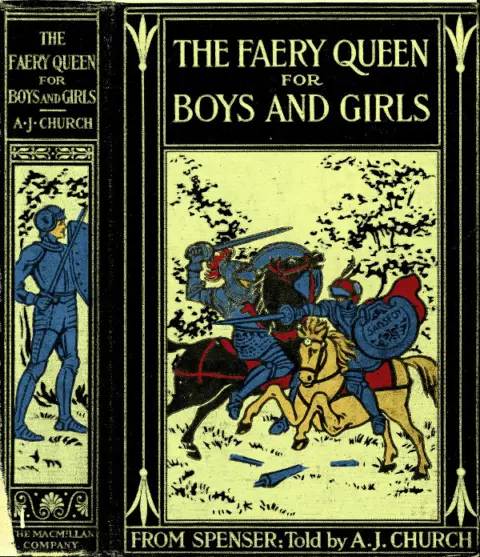
Alfred John Church & Edmund Spenser
BEHIND THE BOOK
This eBook is for the use of anyone anywhere in the United States and most other parts of the world at no cost and with almost no restrictions whatsoever. You may copy it, give it away or re-use it under the terms of the Project Gutenberg License included with this eBook or online at www.gutenberg.org. If you are not located in the United States, you will have to check the laws of the country where you are located before using this eBook. Read the source licence.
The original source file, including credits and licence, is retained by this library. Request an original-format copy at no charge. Please include the book title and Project Gutenberg identifier #70717.
KEEP YOUR CURIOSITY GOING

Eric Mackay
Edmund Gosse
Sophia Margaretta Hensley
Gilbert Parker
George MacDonald

Elizabeth Bibesco