THE CLASSIC COLLECTION✦The Span o’ Life: A Tale of Louisbourg & QuebecCLASSIC FREE BOOKS
The Span o’ Life: A Tale of Louisbourg & Quebec
William McLennan & Jean N. (Jean Newton) McIlwraith
THE CLASSIC COLLECTION · 1897
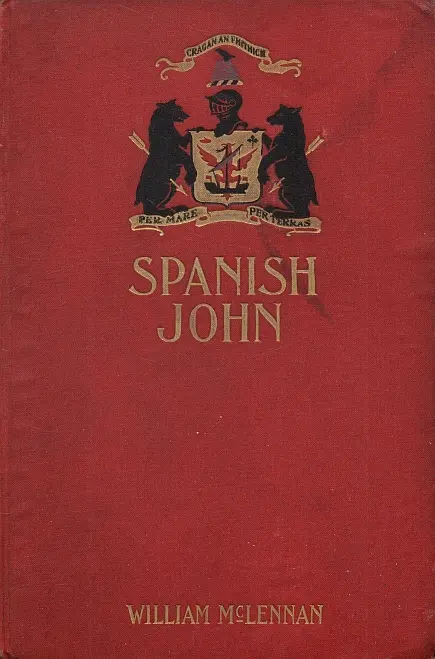
"Spanish John" by William McLennan is a historical novel written in the late 19th century. The narrative revolves around Colonel John McDonell, affectionately known as "Spanish John," detailing his early life and adventures as a young lieutenant in the Regiment Irlandia during the tumultuous times of the 18th century in Europe. The story interweaves themes of duty, heritage, and the contrasting life choices between the pursuit of military glory versus a religious or scholarly path. The opening of "Spanish John" introduces us to a young McDonell, who is on the brink of leaving home to pursue his studies at the Scots College in Rome. His family discussions reveal a breadth of kinship ties and expectations, particularly highlighting the tension between his Uncle Scottos, who desires him to become a soldier, and his father, who wishes for him to study and remain close to home. McDonell's journey begins with the affection of family members, but the narrative hints at the larger, adventure-filled life that lies ahead—a life filled with historical figures, military exploits, and the rich tapestry of 18th-century Europe. Within this setting, relationships with mentors and companions are formed, laying the groundwork for both conflict and camaraderie in his pursuit of identity and purpose within the tumult of his time.
Introduction adapted from the source catalogue; source summaries may be automatically generated.
Free to read · English · 53,556 words · No account needed
MAKE TIME FOR A GOOD BOOK
On by default. Untick to stop anonymous reading totals. Each page counts after 10 seconds in view. How this works.
Anonymous counting is on unless you have switched it off.
There were one or two ragged creatures near by watching us as we landed, but though we shouted to them and made signs, they not only refused to come to our aid, but made off amongst the rocks as we advanced.
"Well, Giovannini, is your heart bursting with pride over your country and countrymen?" asked Father O'Rourke, in Italian, as we struggled and panted with our loads over the rough track up the hillside under the hot spring sun.
"Indeed, this is none of my country, thank God! This only belongs to the McKenzies," said I, ashamed somewhat of the reception we had met.
"Oh, indeed! and to what particular tribe of cattle do they belong?"
he asked.
I stopped short in my way and dropped my portmanteau, determined to put an end to his nonsense at once.
"Now, Father O'Rourke--" I began, but he interrupted me with:
"Captain Lynch, if you please, Mr. McDonell, and your superior, remember, as regards rank!" drawing himself up to his full height. He looked so droll standing there in his fine uniform, with his sword and cocked hat and bag wig quite à la mode de Paris, that I could not help bursting out laughing.
He waited until I was done, and then said, very gravely, "Well, 'pon my word! but I'm rejoiced that I've found my way to your funny-bone at last. But if the sight of a fist like this and a foot like that are the only approaches to a Highlander's sense of humour--and I am bound to apply the back of the one and the toe of the other whenever I am forced to a jest--I take it, my better part is to make poor Captain Lynch a sad dog like yourself."
"Mr. McKenzie," he ran on, addressing our guide, who, it was plain to see, was much puzzled at our behaviour, "are you much given to humour in these parts?"
"No sir," he answered, "none that I ever heard of."
"Then why in the name of the Isle of Man did you take up with that creature you brought on board ship?"
Seeing the poor man was bewildered, I explained that his companion,
Mr. Graeme, was meant.
"Och, him---he would just be coming to Colin Dearg with the others
after the battle."
"Is that old Colin Dearg, Laggy?" I asked.
"None other," he answered; "and it is to him, very probable, that
Ardloch will be sending you."
Ardloch, I explained to Father O'Rourke, was a Mr. McKenzie, to whose place we were bound, and Colin Dearg, or Red Colin, another, both staunch Jacobites.
Your reading position is saved on this browser. Take it to another device with a library code. Reading pages adapt to text, rather than matching a printed edition.
William McLennan & Jean N. (Jean Newton) McIlwraith
BEHIND THE BOOK
This eBook is for the use of anyone anywhere in the United States and most other parts of the world at no cost and with almost no restrictions whatsoever. You may copy it, give it away or re-use it under the terms of the Project Gutenberg License included with this eBook or online at www.gutenberg.org. If you are not located in the United States, you will have to check the laws of the country where you are located before using this eBook. Read the source licence.
The original source file, including credits and licence, is retained by this library. Request an original-format copy at no charge. Please include the book title and Project Gutenberg identifier #61224.
KEEP YOUR CURIOSITY GOING
Cécile Tormay

Moritz Busch
Coulson Kernahan
John L. Ransom

Maurice Baring
Frances Wright