THE CLASSIC COLLECTION✦The Span o’ Life: A Tale of Louisbourg & QuebecCLASSIC FREE BOOKS
The Span o’ Life: A Tale of Louisbourg & Quebec
William McLennan & Jean N. (Jean Newton) McIlwraith
THE CLASSIC COLLECTION · 1897
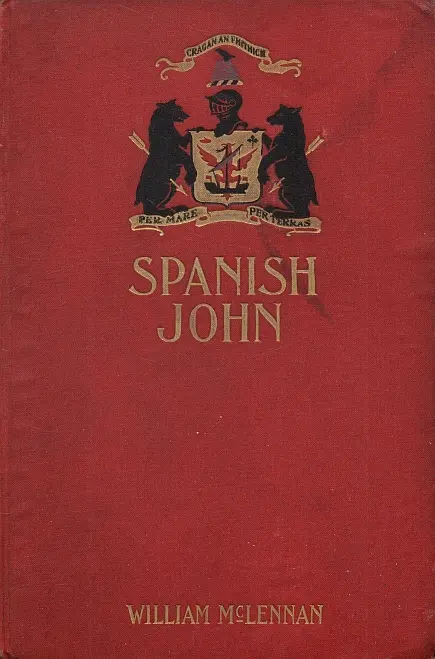
"Spanish John" by William McLennan is a historical novel written in the late 19th century. The narrative revolves around Colonel John McDonell, affectionately known as "Spanish John," detailing his early life and adventures as a young lieutenant in the Regiment Irlandia during the tumultuous times of the 18th century in Europe. The story interweaves themes of duty, heritage, and the contrasting life choices between the pursuit of military glory versus a religious or scholarly path. The opening of "Spanish John" introduces us to a young McDonell, who is on the brink of leaving home to pursue his studies at the Scots College in Rome. His family discussions reveal a breadth of kinship ties and expectations, particularly highlighting the tension between his Uncle Scottos, who desires him to become a soldier, and his father, who wishes for him to study and remain close to home. McDonell's journey begins with the affection of family members, but the narrative hints at the larger, adventure-filled life that lies ahead—a life filled with historical figures, military exploits, and the rich tapestry of 18th-century Europe. Within this setting, relationships with mentors and companions are formed, laying the groundwork for both conflict and camaraderie in his pursuit of identity and purpose within the tumult of his time.
Introduction adapted from the source catalogue; source summaries may be automatically generated.
Free to read · English · 53,556 words · No account needed
MAKE TIME FOR A GOOD BOOK
On by default. Untick to stop anonymous reading totals. Each page counts after 10 seconds in view. How this works.
Anonymous counting is on unless you have switched it off.
This was as unpleasant a piece of news as I could well receive, and though I could not quarrel with it, I at least could resent the manner of its conveyance, so I turned upon my informant at once: "Perhaps this is an example of your 'suaviter in modo,' Father O'Rourke; if so, I'll be obliged if you'll put things in plain, sensible English, as between gentlemen."
"Oh, very well, Mr. John McDonell of Scottos--do you think it sounds better to say that his Royal Highness has not ordinary common taste in choosing his companions, and if you follow him, you must be hail-fellow-well-met with a blackguard like Creach, who happens just now to be in his favour?"
"'Pon my soul, Father O'Rourke, you are the most provoking man I ever met! If you wore a sword, I'd make you answer for this!" I roared, beside myself with anger.
"Oh, I can waggle a sword, if need be," he answered, very cool, "but I was thankful it wasn't a sword but a calabash of good chianti I had strapped on me the night I fell in with you after Velletri. There, there, Giovannini; 'tis nothing to make such a pother about, only you and I are too old friends to quarrel over such gentry as Mr. Creach."
"But it wasn't Mr. Creach, Father. I never would have lost my temper over him; I thought you were poking fun at me."
"Ah, Mr. Lieutenant, in humour, like in file-firing, a sense of
direction is a great thing."
And so we made it all up again, and with Angus we had the chanti and fruit which the Rector had thoughtfully provided in my chamber.
At four o'clock I took my way to the secret entrance of the Santi Apostoli, found the familiar passage and a lackey awaiting me in the garden to conduct me to the Duke.
He was then about nineteen, though I did not think he appeared much my elder save in his manner, which was that of a Prince, though most lively and engaging. He soon opened the reason of the visit.
"Mr. McDonell," he said, "I am sure you are faithful and can be
trusted."
"Your Royal Highness," I answered, "my people have been true to you and yours for generations, and it would ill become me to have any principles other than those we have always held. You can count on me to the very end."
"I was sure of it," he answered, smiling, holding out both his hands, which I grasped with emotion. "Now to business," and he civilly invited me to be seated in an embrasure of a window.
Your reading position is saved on this browser. Take it to another device with a library code. Reading pages adapt to text, rather than matching a printed edition.
William McLennan & Jean N. (Jean Newton) McIlwraith
BEHIND THE BOOK
This eBook is for the use of anyone anywhere in the United States and most other parts of the world at no cost and with almost no restrictions whatsoever. You may copy it, give it away or re-use it under the terms of the Project Gutenberg License included with this eBook or online at www.gutenberg.org. If you are not located in the United States, you will have to check the laws of the country where you are located before using this eBook. Read the source licence.
The original source file, including credits and licence, is retained by this library. Request an original-format copy at no charge. Please include the book title and Project Gutenberg identifier #61224.
KEEP YOUR CURIOSITY GOING
Cécile Tormay

Moritz Busch
Coulson Kernahan
John L. Ransom

Maurice Baring
Frances Wright