THE CLASSIC COLLECTION✦The Span o’ Life: A Tale of Louisbourg & QuebecCLASSIC FREE BOOKS
The Span o’ Life: A Tale of Louisbourg & Quebec
William McLennan & Jean N. (Jean Newton) McIlwraith
THE CLASSIC COLLECTION · 1897
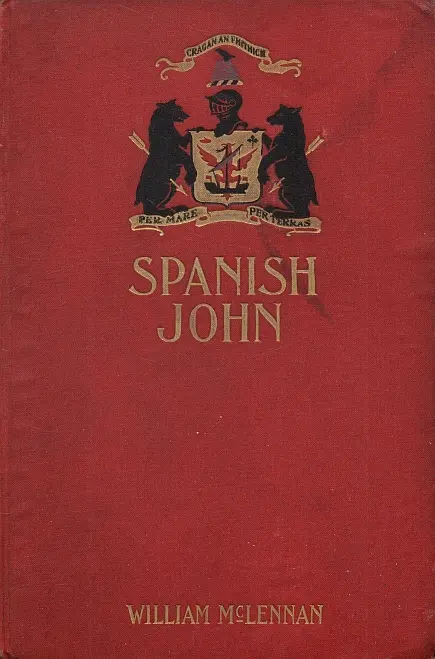
"Spanish John" by William McLennan is a historical novel written in the late 19th century. The narrative revolves around Colonel John McDonell, affectionately known as "Spanish John," detailing his early life and adventures as a young lieutenant in the Regiment Irlandia during the tumultuous times of the 18th century in Europe. The story interweaves themes of duty, heritage, and the contrasting life choices between the pursuit of military glory versus a religious or scholarly path. The opening of "Spanish John" introduces us to a young McDonell, who is on the brink of leaving home to pursue his studies at the Scots College in Rome. His family discussions reveal a breadth of kinship ties and expectations, particularly highlighting the tension between his Uncle Scottos, who desires him to become a soldier, and his father, who wishes for him to study and remain close to home. McDonell's journey begins with the affection of family members, but the narrative hints at the larger, adventure-filled life that lies ahead—a life filled with historical figures, military exploits, and the rich tapestry of 18th-century Europe. Within this setting, relationships with mentors and companions are formed, laying the groundwork for both conflict and camaraderie in his pursuit of identity and purpose within the tumult of his time.
Introduction adapted from the source catalogue; source summaries may be automatically generated.
Free to read · English · 53,556 words · No account needed
MAKE TIME FOR A GOOD BOOK
On by default. Untick to stop anonymous reading totals. Each page counts after 10 seconds in view. How this works.
Anonymous counting is on unless you have switched it off.
I did not hesitate a moment--indeed, hesitation has seldom been one of my faults--but making my way across the room, I stepped close to him and said, in as calm a tone as I could command: "Captain Creach, I am surprised to see you in Rome!"
The three gentlemen all faced me at my speech, and Creach, without a change in his wicked face, said: "Young sir, is your address intended for me?"
"I spoke to you by name, sir," I said, with distinctness.
"Then am I famous, indeed," said he, laughing lightly.
"You may laugh, Captain Creach," said I, and was going on, but he
interrupted me, speaking very civilly, but angering me all the more
for it:
"I see by your dress you are of the Scots College, young gentleman"--for, as usual, I had on my purple soutane with its crimson sash, and over it my black, sleeveless soprano, with my three-cornered hat under my arm--"but there is one lesson you have not as yet learned, and that is, how to address a gentleman. I am not Captain Creach, as you imagine, but Captain Graeme, late of the Hungarian service, and, to the best of my belief, this is the first time I have ever had the honour of addressing you."
He was so quiet and cool that I was dumfounded; but I knew he was lying, though I had never heard a gentleman lie before.
"Not Captain Creach? Not Captain Creach?" I stammered.
"No, sir, 'Not Captain Creach,'" he repeated, mocking me, whereat some of the gentlemen laughed, but one of them broke in with:
"Damn it! this comes of bringing brats where they have no business. Creach! You little fool! This is no more Creach than you are. This is Captain Graeme, late of the Imperial service. There, beg his pardon now, and don't put your foot in it again, like a wise lad," and his tone was kind, though his words were rough.
"Your pardon, sir," I said, "but this is Captain Creach, of the Regiment Irlandia; I have reason to know him only too well."
"Here, MacDonnell," called out my new acquaintance, "this bantling of yours is doing you no credit; come here and smooth him down."
The Colonel rose, frowning, and came over to where we formed a centre, Creach standing on one foot and tapping the other with his long, fashionable cane.
"What's the matter?" he said, severely.
"Colonel MacDonnell," I cried, "may I say a word to you in private?" and seeing I was in deadly earnest, he took me into an anteroom and bade me speak.
Your reading position is saved on this browser. Take it to another device with a library code. Reading pages adapt to text, rather than matching a printed edition.
William McLennan & Jean N. (Jean Newton) McIlwraith
BEHIND THE BOOK
This eBook is for the use of anyone anywhere in the United States and most other parts of the world at no cost and with almost no restrictions whatsoever. You may copy it, give it away or re-use it under the terms of the Project Gutenberg License included with this eBook or online at www.gutenberg.org. If you are not located in the United States, you will have to check the laws of the country where you are located before using this eBook. Read the source licence.
The original source file, including credits and licence, is retained by this library. Request an original-format copy at no charge. Please include the book title and Project Gutenberg identifier #61224.
KEEP YOUR CURIOSITY GOING
Cécile Tormay

Moritz Busch
Coulson Kernahan
John L. Ransom

Maurice Baring
Frances Wright