THE CLASSIC COLLECTION✦The Life of Mrs. Robert Louis StevensonCLASSIC FREE BOOKS
The Life of Mrs. Robert Louis Stevenson
Nellie Van de Grift Sanchez
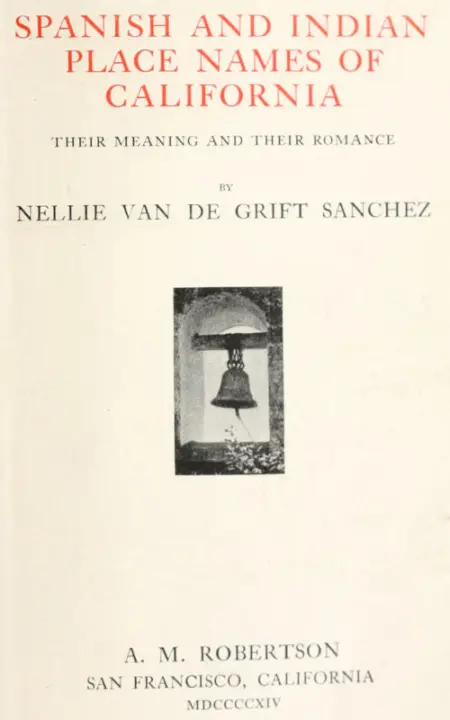
THE CLASSIC COLLECTION · 1914
"Spanish and Indian Place Names of California: Their Meaning and Their Romance" by Nellie Van de Grift Sanchez is a historical reference work written in the early 20th century. This volume explores the origins and meanings of California's Spanish and Indian place names, intertwining them with captivating historical anecdotes and cultural narratives to contextualize the legacy of early explorers and settlers. The work aims to serve both as an informative guide for tourists and a resource for educational purposes. At the start of this reference work, the author introduces the purpose and intent behind compiling the stories and meanings of California’s diverse place names. Sanchez articulates the importance of preserving this heritage, emphasizing the romantic historical backdrop that these names convey. She acknowledges the challenges in tracing the origins of many names, particularly those of Indian descent, and highlights the differences in naming conventions between Spanish explorers and local indigenous tribes. The introduction sets the stage for a deeper exploration of specific regions, beginning with San Diego, and promises a wealth of fascinating tales connected to California's geographical names.
Introduction adapted from the source catalogue; source summaries may be automatically generated.
Free to read · English · 62,377 words · No account needed
MAKE TIME FOR A GOOD BOOK
On by default. Untick to stop anonymous reading totals. Each page counts after 10 seconds in view. How this works.
Anonymous counting is on unless you have switched it off.
Verde (green), twelve miles from San Luís Obispo.
Verdugo (a surname in this case). See page 85.
Los Vergeles (flower gardens, beautiful orchards).
Vicente Point (Point Vincent). See page 85.
Viento (wind), is in San Bernardino County.
Las Vírgenes (the virgins). See page 341.
Vista (view), in San Diego County.
Bella Vista (beautiful view).
Buena Vista (good view).
Chula Vista (charming view). See page 42.
Vista Grande (large view), is in San Matéo County.
Monte Vista (mountain view). Improper construction. It should be Vista del Monte (view of the mountain).
Río Vista (river view). See page 289. Improper construction. It should be Vista del Río (view of the river).
Vizcaíno Cape, named for the celebrated Spanish explorer Sebastián Vizcaíno, who touched at various points on the California coast in the year 1602.
Volcán (volcano).
Wahtoque is an Indian word meaning “pine nut,” the name of a place near
Fresno.
Wawona, an Indian word of disputed meaning. See page 334.
Weitchpec, near Hoopa valley, Humboldt County. “The Weitspekan family consisted of the Yurok tribe alone, inhabiting the lower Klamath River and adjacent coast. The name is adapted from Weitspekw, the name of a spring in the village. At the site of the present post-office of Weitchpec was one of the most populous Yurok villages, and one of only two or three at which both the Deerskin dance and the Jumping dance were held.”—(A. L. Kroeber in Handbook of American Indians.)
Las Yeguas (the mares), referring to a pasture where mares were kept.
Yerba Buena (good herb). See page 205.
Yokohl, in Tulare County. This was the name of a Yokuts tribe formerly living on the Kaweah River, Tulare County.
Yolo. See page 268.
Yorba (a surname). This was the name of one of Captain Fages’ original Catalán volunteers. Yorba is near Los Ángeles.
Yosemite (grizzly bear). See page 321.
Yreka. See page 258.
Yuba. See page 266.
Yucaipe, in San Bernardino County, is an Indian place name.
Zamora, probably named for the province of the same name in the ancient kingdom of León, in Spain. There is an old proverb about this place which says: “No se ganó Zamora en una hora” (Zamora was not taken in an hour), the same idea as expressed in “Rome was not built in a day.”
Zapatero Creek (shoemaker creek).
Las Calabazas means “the squashes” or “the gourds,” particularly with reference to the wild gourds that grow in that locality.—(Mr. Charles F. Lummis.)
El Chorro (the gushing stream), is the name of a creek near San Luís Obispo, and was so named from a waterfall on its course.
Your reading position is saved on this browser. Take it to another device with a library code. Reading pages adapt to text, rather than matching a printed edition.
BEHIND THE BOOK
This eBook is for the use of anyone anywhere in the United States and most other parts of the world at no cost and with almost no restrictions whatsoever. You may copy it, give it away or re-use it under the terms of the Project Gutenberg License included with this eBook or online at www.gutenberg.org. If you are not located in the United States, you will have to check the laws of the country where you are located before using this eBook. Read the source licence.
The original source file, including credits and licence, is retained by this library. Request an original-format copy at no charge. Please include the book title and Project Gutenberg identifier #59251.
KEEP YOUR CURIOSITY GOING
Cécile Tormay

Moritz Busch
John L. Ransom
Frances Wright
Cécile Tormay

Mabel Potter Daggett