THE CLASSIC COLLECTION✦The Life of Mrs. Robert Louis StevensonCLASSIC FREE BOOKS
The Life of Mrs. Robert Louis Stevenson
Nellie Van de Grift Sanchez
THE CLASSIC COLLECTION · 1914
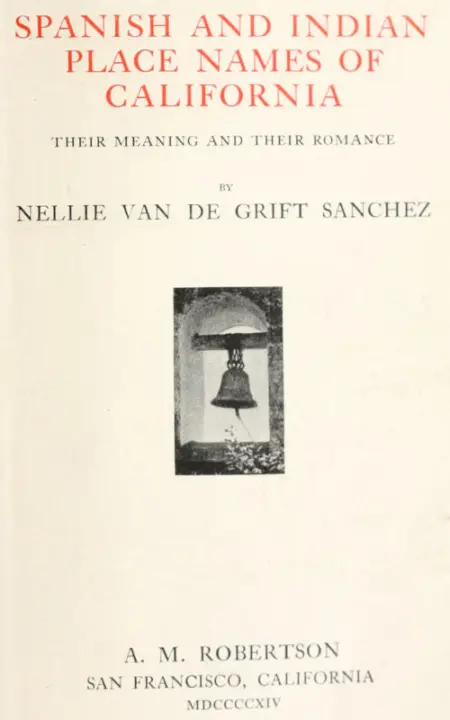
"Spanish and Indian Place Names of California: Their Meaning and Their Romance" by Nellie Van de Grift Sanchez is a historical reference work written in the early 20th century. This volume explores the origins and meanings of California's Spanish and Indian place names, intertwining them with captivating historical anecdotes and cultural narratives to contextualize the legacy of early explorers and settlers. The work aims to serve both as an informative guide for tourists and a resource for educational purposes. At the start of this reference work, the author introduces the purpose and intent behind compiling the stories and meanings of California’s diverse place names. Sanchez articulates the importance of preserving this heritage, emphasizing the romantic historical backdrop that these names convey. She acknowledges the challenges in tracing the origins of many names, particularly those of Indian descent, and highlights the differences in naming conventions between Spanish explorers and local indigenous tribes. The introduction sets the stage for a deeper exploration of specific regions, beginning with San Diego, and promises a wealth of fascinating tales connected to California's geographical names.
Introduction adapted from the source catalogue; source summaries may be automatically generated.
Free to read · English · 62,377 words · No account needed
MAKE TIME FOR A GOOD BOOK
On by default. Untick to stop anonymous reading totals. Each page counts after 10 seconds in view. How this works.
Anonymous counting is on unless you have switched it off.
Trampas (traps, snares), perhaps named in reference to traps which were in common use among the Indians to catch game, as well as their human enemies. In Contra Costa County.
Tranquillón Mountain is in Santa Bárbara County. Tranquillón is a mixture of two kinds of grain, such as wheat and rye, called in English “mastlin,” or “maslin.”
Tres Ojos de Agua (three springs of water).
Tres Pinos. See page 163.
Trigo (wheat), is 128 miles from Stockton.
Trinity County. See page 257.
Trinidad Bay and town. See page 257.
Triunfo (triumph), is in Los Ángeles County.
Trópico (tropical), near Los Ángeles.
Truckee. See page 305.
Tulare (place of rushes). See page 281.
Tularcitos (little rushes, little Tulare ranch).
Tulucay Rancho, near Napa State Hospital, is derived from the Indian
word tuluka (red).
Tunitas is a place near San Francisco on the Ocean Shore Road. The tunita is a beach plant sometimes called the “beach apple.” Tuna is the Spanish name for the common cactus known as “prickly pear.”
Tuolumne. See page 315.
Tustín (a surname), a place in Orange County, near Santa Ana. Fernando Tustín was one of the early settlers, and came to California in 1845.
Ukiah. See page 262.
Usal, in Mendocino County. This is an Indian word, derived from yosal, or yusal, the name of a tribe of Pomos, living on the coast from Usal northward.
Las Uvas (the grapes). See page 163.
Vacaville. See page 289.
Valencia Peak, near San Luís Obispo. Valencia is a surname.
Valle (valley).
Vallecito (little valley) is the name of places in Calaveras and San Diego Counties. See page 334.
Los Vallecitos de San Marcos (the little valleys of St. Mark).
Vallejo (a surname). See pages 236 and 341.
Valle Mar (sea valley), on the Ocean Shore, near San Francisco. Improper construction. It should be Valle del Mar (valley of the sea).
Valle de San Felipe (valley of St. Philip).
Dos Valles (two valleys).
Valle de San José (valley of St. Joseph).
Valle Verde (green valley). See page 85.
Valle Vista (valley view). See page 85. Improper construction. It should be Vista del Valle (view of the valley).
Vega, an open plain, or tract of level land. Vega is also a surname.
Las Vegas (the meadows). Fremont refers to the vegas of the Southern Central Valley in these terms: “We encamped in the midst of another very large basin, at a camping ground called Las Vegas, a term which the Spaniards use to signify fertile or marshy plains, in contradistinction to llanos, which they apply to dry and sterile plains.”
Vega del Río del Pájaro (plain of the river of the bird).
Venado (deer), is in Colusa County.
Ventura (fortune). See page 113.
Verano (summer), is west of Napa.
Your reading position is saved on this browser. Take it to another device with a library code. Reading pages adapt to text, rather than matching a printed edition.
BEHIND THE BOOK
This eBook is for the use of anyone anywhere in the United States and most other parts of the world at no cost and with almost no restrictions whatsoever. You may copy it, give it away or re-use it under the terms of the Project Gutenberg License included with this eBook or online at www.gutenberg.org. If you are not located in the United States, you will have to check the laws of the country where you are located before using this eBook. Read the source licence.
The original source file, including credits and licence, is retained by this library. Request an original-format copy at no charge. Please include the book title and Project Gutenberg identifier #59251.
KEEP YOUR CURIOSITY GOING
Cécile Tormay

Moritz Busch
John L. Ransom
Frances Wright
Cécile Tormay

Mabel Potter Daggett