THE CLASSIC COLLECTION✦The Life of Mrs. Robert Louis StevensonCLASSIC FREE BOOKS
The Life of Mrs. Robert Louis Stevenson
Nellie Van de Grift Sanchez
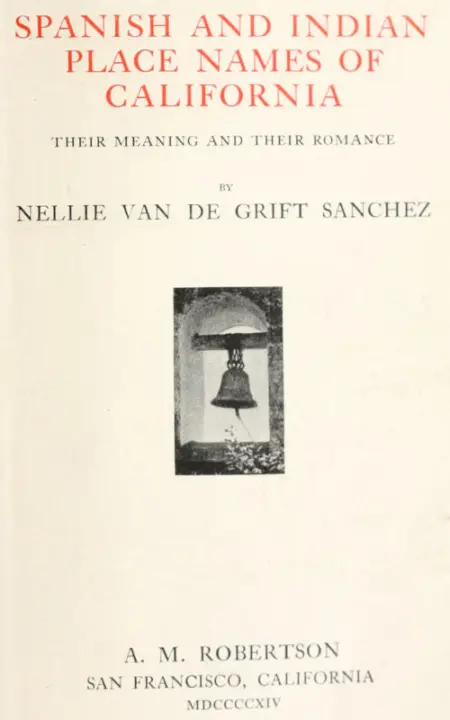
THE CLASSIC COLLECTION · 1914
"Spanish and Indian Place Names of California: Their Meaning and Their Romance" by Nellie Van de Grift Sanchez is a historical reference work written in the early 20th century. This volume explores the origins and meanings of California's Spanish and Indian place names, intertwining them with captivating historical anecdotes and cultural narratives to contextualize the legacy of early explorers and settlers. The work aims to serve both as an informative guide for tourists and a resource for educational purposes. At the start of this reference work, the author introduces the purpose and intent behind compiling the stories and meanings of California’s diverse place names. Sanchez articulates the importance of preserving this heritage, emphasizing the romantic historical backdrop that these names convey. She acknowledges the challenges in tracing the origins of many names, particularly those of Indian descent, and highlights the differences in naming conventions between Spanish explorers and local indigenous tribes. The introduction sets the stage for a deeper exploration of specific regions, beginning with San Diego, and promises a wealth of fascinating tales connected to California's geographical names.
Introduction adapted from the source catalogue; source summaries may be automatically generated.
Free to read · English · 62,377 words · No account needed
MAKE TIME FOR A GOOD BOOK
On by default. Untick to stop anonymous reading totals. Each page counts after 10 seconds in view. How this works.
Anonymous counting is on unless you have switched it off.
Agua (water), is in very common use in referring to springs, usually accompanied by a qualifying adjective. See page 339. This word is usually mispronounced by Spanish Americans.
Agua Amargosa (bitter water). See page 154.
Agua Caliente (hot water, hot spring). See pages 76 and 259.
Agua Cayendo (falling water).
Agua Dulce (sweet water, fresh water).
Agua Fria (cold water, cold spring).
Agua Hedionda (stinking water, sulphur spring).
Aguaje del Centinela (water hole, or watering place of the sentinel), the title of a land grant.
Agua del Medio (middle spring).
Aguajito (little water hole). Near Monterey, in a delightful little glen, there were a number of these springs, or water holes, where the women were in the habit of doing the town washing, kneeling upon the ground and washing the clothing directly in the springs. This place was called Los Aguajitos (the water holes), by the Spanish residents, and “washerwoman’s canyon” by the Americans. In the pastoral days of California, entire families climbed into their ox-carts, made with solid wooden wheels, and, provided with a liberal lunch basket, made a picnic of “blue Monday” under the green trees of Los Aguajitos canyon. See page 339.
Agua Mansa (still water, smooth-running current). One writer, for what reason does not appear, defines this as “house water.” This place is in Southern California, near Colton.
Agua Puerca (dirty or muddy water).
Agua Puerca y las Trancas (muddy water and the bars, or stiles). This was the peculiar title of a land grant, based, no doubt, upon some trivial circumstance now forgotten. One writer has translated it as “water fit for pigs and Frenchmen,” a gratuitous insult to the French people of which the Spaniards were not guilty. This writer evidently mistook the word puerca (muddy or dirty) for puerca (sow), and by some strange twist of the imagination, seems to have taken trancas to mean Frenchmen!
Agua Tibia (tepid or warm water, warm spring). See page 36.
Agua de Vida (water of life).
Aguilar (the place of eagles).
Las Águilas (the eagles). Real de las Águilas means the “camp of the
eagles.”
Ahwanee (an Indian place name), popularly but not authentically translated as “a deep or grassy valley,” is the name of a place in Madera County.
“A-wa-ni was the name of a large village standing directly at the foot of Yosemite Fall.”—(Powers’ Tribes of California.)
Alameda (an avenue shaded by trees, or a cottonwood grove). This word is derived from álamo, a poplar tree known in the West as cottonwood. See pages 208 and 339.
Los Alamitos (the little cottonwoods). See page 76.
Álamo (cottonwood). See page 227.
Los Álamos (the cottonwoods). See page 105.
Los Álamos y Agua Caliente (the cottonwoods and hot spring), the title
of a land grant.
Your reading position is saved on this browser. Take it to another device with a library code. Reading pages adapt to text, rather than matching a printed edition.
BEHIND THE BOOK
This eBook is for the use of anyone anywhere in the United States and most other parts of the world at no cost and with almost no restrictions whatsoever. You may copy it, give it away or re-use it under the terms of the Project Gutenberg License included with this eBook or online at www.gutenberg.org. If you are not located in the United States, you will have to check the laws of the country where you are located before using this eBook. Read the source licence.
The original source file, including credits and licence, is retained by this library. Request an original-format copy at no charge. Please include the book title and Project Gutenberg identifier #59251.
KEEP YOUR CURIOSITY GOING
Cécile Tormay

Moritz Busch
John L. Ransom
Frances Wright
Cécile Tormay

Mabel Potter Daggett