THE CLASSIC COLLECTION✦The Life of Mrs. Robert Louis StevensonCLASSIC FREE BOOKS
The Life of Mrs. Robert Louis Stevenson
Nellie Van de Grift Sanchez
THE CLASSIC COLLECTION · 1914
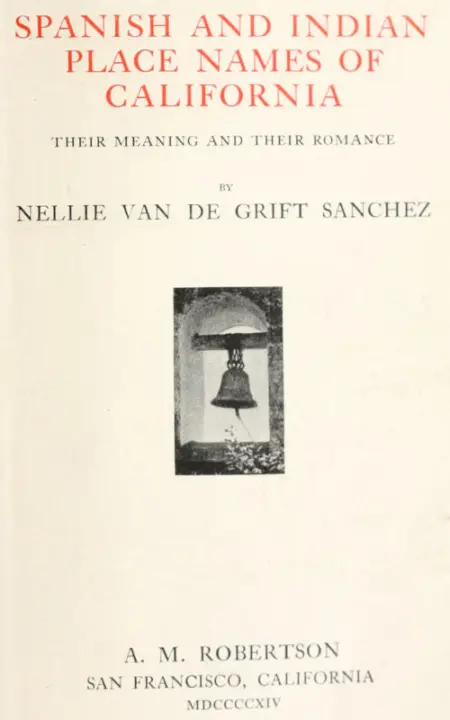
"Spanish and Indian Place Names of California: Their Meaning and Their Romance" by Nellie Van de Grift Sanchez is a historical reference work written in the early 20th century. This volume explores the origins and meanings of California's Spanish and Indian place names, intertwining them with captivating historical anecdotes and cultural narratives to contextualize the legacy of early explorers and settlers. The work aims to serve both as an informative guide for tourists and a resource for educational purposes. At the start of this reference work, the author introduces the purpose and intent behind compiling the stories and meanings of California’s diverse place names. Sanchez articulates the importance of preserving this heritage, emphasizing the romantic historical backdrop that these names convey. She acknowledges the challenges in tracing the origins of many names, particularly those of Indian descent, and highlights the differences in naming conventions between Spanish explorers and local indigenous tribes. The introduction sets the stage for a deeper exploration of specific regions, beginning with San Diego, and promises a wealth of fascinating tales connected to California's geographical names.
Introduction adapted from the source catalogue; source summaries may be automatically generated.
Free to read · English · 62,377 words · No account needed
MAKE TIME FOR A GOOD BOOK
On by default. Untick to stop anonymous reading totals. Each page counts after 10 seconds in view. How this works.
Anonymous counting is on unless you have switched it off.
G has two sounds. Before e and i it has the sound of strongly aspirated h. Examples, German´, pronounced Hare-mahn´, and giro, pronounced hee´ro. In all other cases it sounds like g in go. Examples, Gaviota, Goleta, Guadalupe, Granada. In gue and gui the u is regularly silent; exceptions to this rule are marked by the diaeresis, as in Argüello, pronounced Ar-gwayl´yo, or in Spanish-American, Ar-gway´yo.
H is silent except in the combined character ch. Example, La Honda, pronounced La On´dah, with long o, as in hope.
J has the sound of strongly aspirated h. Examples, Pájaro, pronounced Pah´hah-ro, and San José, pronounced San Ho-say´. This letter is one of the worst stumbling-blocks in the pronunciation of Spanish names.
Ll has the sound of the letters lli in the English million, but in many parts of Spanish-America it is pronounced like y in beyond. The latter is not considered an elegant pronunciation. Example, Vallejo, properly pronounced Val-yay´ho, but in Spanish-American, Va-yay´ho.
N has the sound of the letters ni in the English pinion. Example, Cañada, pronounced Can-yah´dthah.
Q only occurs before ue and ui, and sounds like k, the following u being always silent. Example, San Quintín, pronounced San Keen-teen´.
S has the hissing sound of s in say, base, and is never pronounced like sh as in mansion, or z as in rose. Thus in Santa Rosa the s is sharply hissed and is not pronounced as Santa Roza.
Z is sounded in Spanish-America like sharply hissed s, as in say or base. Example, Zamora, pronounced Sah-mo´rah.
A peculiarity of pronunciation common to almost all Spaniards is the confusion of the b and the v so that one can hardly be distinguished from the other. Vowel sounds are pronounced shortly and crisply, never with the drawling circumflex sound sometimes heard in English. Without going into the complications of the division of syllables, it may be stated that the fundamental principle is to make syllables end in a vowel as far as possible; examples, Do-lo-res (not Do-lor-es), Sa-li-nas (not Sal-in-as).
All words ending in n or s or a vowel are regularly accented on the next to the last syllable; examples, Sausalíto, Altúras, cómen. All others are accented on the last syllable; examples, San Rafael´, Avenal´. In words following the above rules no mark is used, but in the exceptions, which are many, the stress must be indicated by the written accent. Examples, Portolá, Jolón, Álamo, Los Ángeles.
Your reading position is saved on this browser. Take it to another device with a library code. Reading pages adapt to text, rather than matching a printed edition.
BEHIND THE BOOK
This eBook is for the use of anyone anywhere in the United States and most other parts of the world at no cost and with almost no restrictions whatsoever. You may copy it, give it away or re-use it under the terms of the Project Gutenberg License included with this eBook or online at www.gutenberg.org. If you are not located in the United States, you will have to check the laws of the country where you are located before using this eBook. Read the source licence.
The original source file, including credits and licence, is retained by this library. Request an original-format copy at no charge. Please include the book title and Project Gutenberg identifier #59251.
KEEP YOUR CURIOSITY GOING
Cécile Tormay

Moritz Busch
John L. Ransom
Frances Wright
Cécile Tormay

Mabel Potter Daggett