THE CLASSIC COLLECTION✦A History of French Literature Short Histories of the Literatures of the World: II.CLASSIC FREE BOOKS
A History of French Literature Short Histories of the Literatures of the World: II.
Edward Dowden
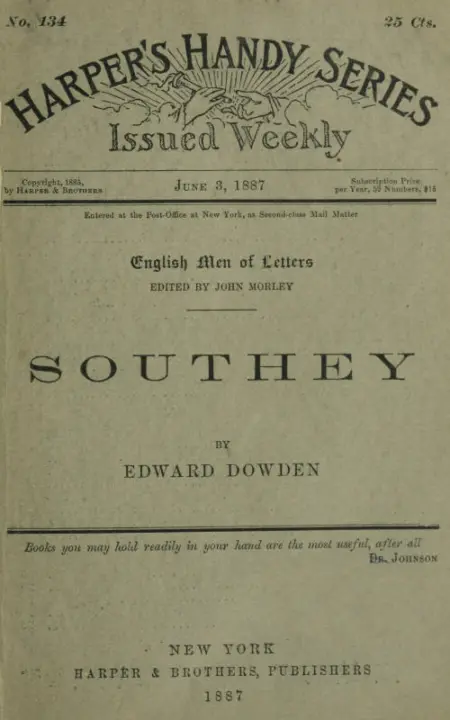
THE CLASSIC COLLECTION · 1885
"Southey" by Edward Dowden is a biographical account written in the late 19th century. The work delves into the life of Robert Southey, one of the prominent poets of the Romantic era and the poet laureate of England. The biography captures Southey's literary journey, influences, and personal experiences, emphasizing his dedication to literature and his role within the cultural tapestry of his time. At the start of the narrative, Dowden introduces readers to Southey's childhood, revealing how deeply entrenched he was in literature from a young age. The opening details Southey's family background, including his father's life as a linen-draper and the influence of his nurturing mother, as well as significant early experiences that shaped his literary aspirations. Through captivating anecdotes, we learn about his initial struggles with education, the personalities who impacted him, and the budding love of poetry that became a defining element of his identity. The beginning sets the stage for a deeper exploration of Southey’s character and contributions to literature in the subsequent chapters.
Introduction adapted from the source catalogue; source summaries may be automatically generated.
Free to read · English · 62,396 words · No account needed
MAKE TIME FOR A GOOD BOOK
On by default. Untick to stop anonymous reading totals. Each page counts after 10 seconds in view. How this works.
Anonymous counting is on unless you have switched it off.
A young step-child of Oxford visited Keswick in the winter of 1811-12, and sought the acquaintance of the author of Thalaba. Had Southey been as intolerant or as unsympathetic as some have represented him, he could not have endured the society of one so alien in opinion and so outspoken as Shelley. But courtesy, if it were nothing more, was at least part of Southey’s self-respect; his intolerance towards persons was, in truth, towards a certain ideal, a certain group of opinions; when hand touched hand and eye met eye, all intolerance vanished, and he was open to every gracious attraction of character and manner. There was much in Shelley that could not fail to interest Southey; both loved poetry, and both felt the proud, secluded grandeur of Landor’s verse; both loved men, and thought the world wants mending, though their plans of reform might differ. That Shelley was a rebel expelled from Oxford did not shock Southey, who himself had been expelled from Westminster and rejected at Christ Church. Shelley’s opinions were crude and violent, but their spirit was generous, and such opinions held by a youth in his teens generally mean no more than that his brain is working and his heart ardent. Shelley’s rash marriage reminded Southey of another marriage, celebrated at Bristol some fifteen years ago, which proved that rashness is not always folly. The young man’s admiration of Thalaba spoke well for him; and certainly during the earlier weeks of their intercourse there was on Shelley’s part a becoming deference to one so much his superior in years and in learning, deference to one who had achieved much while Shelley still only dreamed of achievement. Southey thought he saw in the revolutionary enthusiast an image of his former self. “Here,” he says, “is a man at Keswick who acts upon me as my own ghost would do. He is just what I was in 1794. His name is Shelley, son to the member for Shoreham.... At present he has got to the Pantheistic stage of philosophy, and in the course of a week I expect he will be a Berkeleyan, for I have put him upon a course of Berkeley. It has surprised him a good deal to meet, for the first time in his life, with a man who perfectly understands him and does him full justice. I tell him that all the difference between us is that he is nineteen and I am thirty-seven; and I daresay it will not be very long before I shall succeed in convincing him that he may be a true philosopher and do a great deal of good with 6000l. a year; the thought of which troubles him a great deal more at present than ever the want of sixpence (for I have known such a want) did me.” There were other differences between Robert Southey and the inconstant star that passed by Greta Hall than that of years. Southey had quickly learned to put a bound to his desires, and within that bound to work out for himself a possession of measureless worth. It seemed to him part of a man’s virtue to adhere loyally to the bond signed for each of us when we enter life. Is our knowledge limited—then let us strive within those limits. Can we never lay hands on the absolute good—then let us cherish the good things that are ours. Do we hold our dearest possessions on a limited tenure—that is hard, but is it not in the bond? How faint a loyalty is his who merely yields obedience perforce! let us rather cast in our will, unadulterated and whole, with that of our divine Leader; sursum corda—there is a heaven above. But Shelley—the nympholept of some radiant ante-natal sphere—fled through his brief years ever in pursuit of his lost lady of light; and for him loyalty to the bond of life seemed to mean a readiness to forget all things, however cherished, so soon as they had fulfilled their service of speeding him on towards the unattainable. It could not but be that men living under rules so diverse should before long find themselves far asunder. But they parted in 1812 in no spirit of ill-will. Southey was already a state-pensioner and a champion of the party of order in the Quarterly Review; this did not prevent the young apostle of liberty and fraternity from entering his doors, and enjoying Mrs. Southey’s tea-cakes. Irish affairs were earnestly discussed; but Southey, who had written generously of Emmett both in his verse and in the Quarterly, could not be hostile to one whose illusions were only over-sanguine; and while the veritable Southey was before Shelley’s eyes, he could not discern the dull hireling, the venomous apostate, the cold-blooded assassin, of freedom conjured up by Byron and others to bear Southey’s name.
Your reading position is saved on this browser. Take it to another device with a library code. Reading pages adapt to text, rather than matching a printed edition.
BEHIND THE BOOK
This eBook is for the use of anyone anywhere in the United States and most other parts of the world at no cost and with almost no restrictions whatsoever. You may copy it, give it away or re-use it under the terms of the Project Gutenberg License included with this eBook or online at www.gutenberg.org. If you are not located in the United States, you will have to check the laws of the country where you are located before using this eBook. Read the source licence.
The original source file, including credits and licence, is retained by this library. Request an original-format copy at no charge. Please include the book title and Project Gutenberg identifier #61983.
KEEP YOUR CURIOSITY GOING
John L. Ransom
Herman W. Mudgett

Harriet Monroe
Daniel Dulany Addison
Charles Lanman
Harold Rosher