THE CLASSIC COLLECTION✦A History of French Literature Short Histories of the Literatures of the World: II.CLASSIC FREE BOOKS
A History of French Literature Short Histories of the Literatures of the World: II.
Edward Dowden
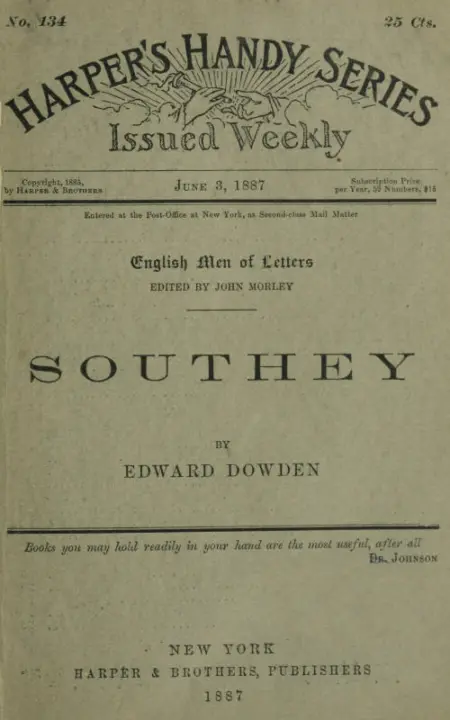
THE CLASSIC COLLECTION · 1885
"Southey" by Edward Dowden is a biographical account written in the late 19th century. The work delves into the life of Robert Southey, one of the prominent poets of the Romantic era and the poet laureate of England. The biography captures Southey's literary journey, influences, and personal experiences, emphasizing his dedication to literature and his role within the cultural tapestry of his time. At the start of the narrative, Dowden introduces readers to Southey's childhood, revealing how deeply entrenched he was in literature from a young age. The opening details Southey's family background, including his father's life as a linen-draper and the influence of his nurturing mother, as well as significant early experiences that shaped his literary aspirations. Through captivating anecdotes, we learn about his initial struggles with education, the personalities who impacted him, and the budding love of poetry that became a defining element of his identity. The beginning sets the stage for a deeper exploration of Southey’s character and contributions to literature in the subsequent chapters.
Introduction adapted from the source catalogue; source summaries may be automatically generated.
Free to read · English · 62,396 words · No account needed
MAKE TIME FOR A GOOD BOOK
On by default. Untick to stop anonymous reading totals. Each page counts after 10 seconds in view. How this works.
Anonymous counting is on unless you have switched it off.
Among the inmates of Greta Hall, to overlook Lord Nelson and Bona Marietta, with their numerous successors, would be a grave delinquency. To be a cat, was to be a privileged member of the little republic to which Southey gave laws. Among the fragments at the end of The Doctor will be found a Chronicle History of the Cattery of Cat’s Eden; and some of Southey’s frolic letters are written as if his whole business in life were that of secretary for feline affairs in Greta Hall. A house, he declared, is never perfectly furnished for enjoyment unless there is in it a child rising three years old and a kitten rising six weeks; “kitten is in the animal world what the rosebud is in the garden.” Lord Nelson, an ugly specimen of the streaked-carroty or Judas-coloured kind, yet withal a good cat, affectionate, vigilant, and brave, was succeeded by Madame Bianchi, a beautiful and singular creature, white, with a fine tabby tail; “her wild eyes were bright, and green as the Duchess de Cadaval’s emerald necklace.” She fled away with her niece Pulcheria on the day when good old Mrs. Wilson died; nor could any allurements induce the pair to domesticate themselves again. For some time a cloud of doom seemed to hang over Cat’s Eden. Ovid and Virgil, Othello the Moor, and Pope Joan perished miserably. At last Fortune, as if to make amends for her unkindness, sent to Greta Hall almost together the never-to-be-enough-praised Rumpelstilzchen (afterwards raised for services against rats to be His Serene Highness the Archduke Rumpelstilzchen), and the equally-to-be-praised Hurly-burlybuss. With whom too soon we must close the catalogue.
The revenue to maintain this household was in the main won by Southey’s pen. “It is a difficult as well as a delicate task,” he wrote in the Quarterly Review, “to advise a youth of ardent mind and aspiring thoughts in the choice of a profession; but a wise man will have no hesitation in exhorting him to choose anything rather than literature. Better that he should seek his fortune before the mast, or with a musket on his shoulder and a knapsack on his back; better that he should follow the plough, or work at the loom or the lathe, or sweat over the anvil, than trust to literature as the only means of his support.” Southey’s own bent towards literature was too strong to be altered. But, while he accepted loyally the burdens of his profession as a man of letters, he knew how stout a back is needed to bear them month after month and year after year. Absolutely dependent on his pen he was at no time. His generous friend Wynn, upon coming of age, allowed him annually 160l., until, in 1807, he was able to procure for Southey a Government pension for literary services amounting, clear of taxes, to nearly the same sum. Southey had as truly as any man the pride of independence, but he had none of its vanity; there was no humiliation in accepting a service from one whom friendship had made as close as a brother. Men, he says, are as much better for the good offices which they receive as for those they bestow; and his own was no niggard hand. Knowing both to give and to take, with him the remembrance that he owed much to others was among the precious possessions of life which bind us to our kind with bonds of sonship, not of slavery. Of the many kindnesses which he received he never forgot one. “Had it not been for your aid,” he writes to Wynn, forty years after their first meeting in Dean’s Yard, “I should have been irretrievably wrecked when I ran upon the shoals, with all sail set, in the very outset of my voyage.” And to another good old friend, who from his own modest station applauded while Southey ran forward in the race:—“Do you suppose, Cottle, that I have forgotten those true and most essential acts of friendship which you showed me when I stood most in need of them? Your house was my house when I had no other. The very money with which I bought my wedding-ring and paid my marriage-fees was supplied by you. It was with your sisters I left Edith during my six months’ absence, and for the six months after my return it was from you that I received, week by week, the little on which we lived, till I was enabled to live by other means. It is not the settling of a cash account that can cancel obligations like these. You are in the habit of preserving your letters, and if you were not, I would entreat you to preserve this, that it might be seen hereafter.... My head throbs and my eyes burn with these recollections. Good-night! my dear old friend and benefactor.”
Your reading position is saved on this browser. Take it to another device with a library code. Reading pages adapt to text, rather than matching a printed edition.
BEHIND THE BOOK
This eBook is for the use of anyone anywhere in the United States and most other parts of the world at no cost and with almost no restrictions whatsoever. You may copy it, give it away or re-use it under the terms of the Project Gutenberg License included with this eBook or online at www.gutenberg.org. If you are not located in the United States, you will have to check the laws of the country where you are located before using this eBook. Read the source licence.
The original source file, including credits and licence, is retained by this library. Request an original-format copy at no charge. Please include the book title and Project Gutenberg identifier #61983.
KEEP YOUR CURIOSITY GOING
John L. Ransom

Herman W. Mudgett

Harriet Monroe
Daniel Dulany Addison
Charles Lanman

Harold Rosher