
An Ambitious Woman: A Novel
Edgar Fawcett
THE CLASSIC COLLECTION · 1912
"Some Reminiscences of Old Victoria" by Edgar Fawcett is a collection of autobiographical essays written in the early 20th century. The text provides an engaging glimpse into the early days of Victoria, British Columbia, as seen through the eyes of the author who lived there in the 19th century. It combines personal anecdotes with historical observations, painting a vivid picture of the city and its pioneering days. The opening of the book offers a preface where Fawcett reflects on his reasons for writing these reminiscences after being ill. He recalls his childhood experiences in San Francisco before his family moved to Victoria in 1859. Fawcett shares fond memories of early life, touching upon significant events and figures of the time, such as his father's business ventures and the vibrant community of pioneers in Victoria. The narrative also includes entertaining anecdotes of his adventures as a young boy, highlighting the spirit, challenges, and social norms of the times, setting the tone for a rich tapestry of historical recollections that will follow in the subsequent chapters.
Introduction adapted from the source catalogue; source summaries may be automatically generated.
Free to read · English · 77,644 words · No account needed
MAKE TIME FOR A GOOD BOOK
On by default. Untick to stop anonymous reading totals. Each page counts after 10 seconds in view. How this works.
Anonymous counting is on unless you have switched it off.
When I look back over my soldiering days the figure that I first remember is Colonel Wolfenden, then a sergeant in the volunteers, and I a full private. It was not, I think, until I was twenty years old and a member for two years, that I remember him, when he was elected captain from sergeant. I might say that the volunteers were a different organization from the militia. You enlisted for a term, the same as in the latter organization, and officers were elected from the company. Uniforms were paid for by each member, the cost being $26 for everything complete. Dues had to be paid also, fifty cents a month, and ammunition for target practice had also to be paid for. It was a good deal like the volunteer firemen of that day, who had to pay dues and buy their uniform.
[Portrait: Colonel Wolfenden.]
If ever there was an enthusiastic volunteer it was Captain Wolfenden, and under the most trying circumstances. In those days (forty-four years ago) soldiering was not as popular as it was when it was merged into the Canadian militia, when uniform was free, ammunition was free and there were no fees to pay. It was therefore hard work to get a company together and keep them together under the circumstances. Captain Wolfenden having the matter at heart did his best, and more than his best, if that were possible, to make a good showing, and he encouraged me to get members and raised me to corporal, and later to sergeant and finally on our merging into the Canadian militia he made me senior sergeant. I must honestly confess I did not think I deserved this at the time, for I was a nervous subject and got rattled at times, but for his sake, who showed a partiality for me, I did my best and was always at drill as he was, no matter what the weather was. It was as captain of volunteers that he joined the Canadian militia, and soon after was appointed colonel in charge, which high position he worked for and earned by faithful service. I think what made us such good friends was our early comradeship in the volunteers. We used to have march-outs to Esquimalt, to Cadboro Bay or to Beacon Hill and back, and to enliven the march would sing songs; those with a good chorus which were joined in by the rest. These days of the past were often talked over by us in later years, while I, to please the Collector of Customs, Mr. Hamly, in 1884, resigned membership in the militia, after eighteen years as a volunteer soldier. Colonel Wolfenden continued on for many years. In conclusion I might add that when I joined the volunteers Captain Laing, then manager of the Bank of British Columbia, was captain. I cannot remember whether Colonel Wolfenden was a member then or not, but it was not long after. Other officers of that time were Adjutant Vinter, Captain Fletcher (P. O. Inspector), Captain Dorman (deputy Inspector), Major Roscoe (hardware merchant), Captain T. L. Wood (Solicitor-General), Captain Drummond (company No. 2), and Chaplain Rev. Thomas Sommerville. Occasionally we went into camp for a month, and generally at Beacon Hill, or at Henley's, at Clover Point. These camps were made very interesting by entertainments being frequently given, and to which our friends were invited. Oh, those were days worth remembering! During the time of the Fenian Raid we were encamped in the trees just about where the bear pits were, and the night sentries were told to keep a strict lookout, and challenge all intruders. This was taken advantage of by some young fellows to play a lark on us. So one night when the camp was asleep, we were all awakened by the sentry's outcry. He happened to be the late Robert Homfray, a rather nervous man. I got up with the rest, and there was the sentry with what he declared was an infernal machine, which had been thrown into the camp by someone who had made off in the darkness. The infernal machine consisted of a bottle filled with what was supposed to be giant powder, and bits of iron or steel, with a fuse sticking out of the neck of the bottle. It was, after careful inspection without much handling, put away till the morning, and then, a more strict examination revealed the contents to be simply small bits of coal to represent giant powder, and genuine steel filings. This was a standing joke against us, and especially Private Homfray, for many a day afterwards. To conclude, finally, I am sure I have the most kindly recollections of my friend of so many years, as have many more to-day, who will bear full testimony to his sterling worth as a soldier, government official and gentleman.
Your reading position is saved on this browser. Take it to another device with a library code. Reading pages adapt to text, rather than matching a printed edition.
Edgar Fawcett
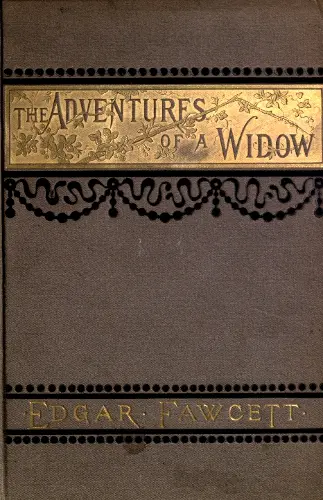
Edgar Fawcett
Frank R. Stockton & Edgar Fawcett & Franklin Fyles & Anna Katharine Green & Henry Harland & Ingersoll Lockwood & Joaquin Miller & Kirk Munroe & Brainard Gardner Smith & Maurice Thompson & A. C. (Andrew Carpenter) Wheeler
BEHIND THE BOOK
This eBook is for the use of anyone anywhere in the United States and most other parts of the world at no cost and with almost no restrictions whatsoever. You may copy it, give it away or re-use it under the terms of the Project Gutenberg License included with this eBook or online at www.gutenberg.org. If you are not located in the United States, you will have to check the laws of the country where you are located before using this eBook. Read the source licence.
The original source file, including credits and licence, is retained by this library. Request an original-format copy at no charge. Please include the book title and Project Gutenberg identifier #26048.
KEEP YOUR CURIOSITY GOING

David Patterson (Spirit) Hatch

David Patterson (Spirit) Hatch

David Patterson (Spirit) Hatch
Cécile Tormay

Moritz Busch
John L. Ransom