THE CLASSIC COLLECTION✦An outlaw’s diary: the CommuneCLASSIC FREE BOOKS
An outlaw’s diary: the Commune
Cécile Tormay
THE CLASSIC COLLECTION · 1909
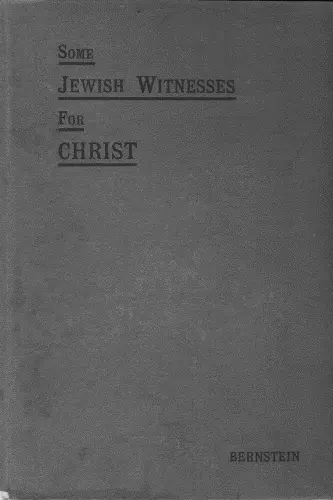
"Some Jewish Witnesses For Christ" by Aaron Bernstein is a historical account written in the early 20th century. The work explores the stories of Jewish individuals who have converted to Christianity throughout various periods, highlighting their contributions and the circumstances surrounding their faith transitions. The author seeks to validate these conversions and present a diverse range of notable figures who have embraced Christian beliefs, effectively showcasing the ongoing dialogue between Judaism and Christianity over centuries. The opening of the book begins with a preface that sets the tone for the discussion at hand, emphasizing the significance of documenting the lives of Jewish converts to Christianity, not only for historical purposes but also for influencing current religious dialogue. Bernstein indicates the broad scope of Jewish converts from the Apostolic age to contemporaneous times, hinting at the rich tapestry of experiences that will be detailed throughout the text. The introduction highlights the early history of Christian missions to the Jews and mentions the pivotal role of Jewish converts in the early Church. As the reader is ushered into the subsequent chapters, a detailed account of various periods and notable converts appears to promise an enlightening exploration of faith and identity.
Introduction adapted from the source catalogue; source summaries may be automatically generated.
Free to read · English · 137,079 words · No account needed
MAKE TIME FOR A GOOD BOOK
On by default. Untick to stop anonymous reading totals. Each page counts after 10 seconds in view. How this works.
Anonymous counting is on unless you have switched it off.
CAPLAN, Rev. W. H., was a native of the Baltic provinces. He was converted to Christianity through the reading of the New Testament, which he received from a friend at home. He then went to London for the purpose of being able the more easily to make a public profession of his faith, and was baptized there about 1876. In 1877 he became assistant to the Rev. Theodore Meyer, of the Presbyterian Mission in Whitechapel. After a few years he studied at King's College, and was ordained to the ministry of the Church of England in 1885. Then he became curate in several churches in England, and finally emigrated to Canada, where he is doing good work in the Canadian Church.
CARLTON, Rev. S. J., a native of Silesia, baptized in the Irish Presbyterian Mission at Hamburg, about 1892. Subsequently he joined the Church of England, studied at Ayerst Hall, Cambridge, was L.J.S. missionary curate at St. Benet's, Stepney, then curate at St. Jude's, Mildmay, 1901-4; St. Peter's, Cricklewood, 1904-6; St. Mary Magdalene, Peckham, 1906-8; and vicar of All Saints, Camberwell, from 1908.
CARRET, Ludwig, a convert who lived at the beginning of the seventeenth century, wrote a Hebrew letter giving an account of the history of his conversion. This letter appeared in the Appendix in Buxtorf's Synagogue Judaica (de le Roi), but not in all editions.
CARO, Pastor F., convert and missionary of the Berlin Society in 1845-8, had the privilege of baptizing a Jewish lady in her ninetieth year, in the presence of all her children, one of whom was the above-named Branis.
CARO, Regierungsrath in Merseburg, is recorded as having rendered the Government good service, especially in the educational department, in the 19th century, and that he was a devoted Christian.
CASPARI, Carl Paul. Norway during the nineteenth century found her most pre-eminent witness for Christ and defender of Christianity in that son of Israel whose name is mentioned above. Carl Paul Caspari was born at Dessau 1814. His parents were orthodox Jews, and his father was a merchant there. In this city, which through Moses Mendelssohn has become so celebrated, the Jewish community influenced many of its citizens in a remarkable manner, on account of their ability and intelligence. They established a Jewish seminary, which was called after Prince Francis, "The Francis School." It gained a great reputation, and even attracted Christian pupils. German services were held in the synagogue, at that period an unheard-of innovation. The religious instruction in the school was given in an enlightened spirit. Caspari imbibed this influence, and when he attended the Gymnasium it obtained complete control over him. In 1834 he went to Leipsig, in order to study Oriental languages. Here he read the Old Testament diligently, but he found in it only the teaching he had formerly received. The New Testament he could not accept. However, he was animated by a strong sense of duty, and he inscribed on his desk the motto, "Thou canst, therefore thou oughtest." Yet he soon became convinced that his will was a very feeble instrument. At this period, Granel, who had formerly been his schoolmate at Dessau, and who afterwards was so well known as the Superintendent of the Saxon Foreign Missions, became Caspari's faithful friend and wise counsellor. Granel persuaded him to carefully read the New Testament. He opened the book at the Acts of the Apostles and read of Paul's persecution by the Jews. He was impressed with the truthfulness of the narrative, and so he concluded to continue his reading. When he reached the Gospels, the words of Christ and the accounts of His wonderful miracles greatly affected him. The thought came to him. "Perhaps Jesus can also help me out of all this misery which I find in my soul," and, as he a year before his death said, "I came to Him as to my living Saviour--just as in the days of His flesh men sought comfort from Him." Pastor Wolf, of Leipsig, and the young theologian, Franz Delitzsch, afterwards the celebrated professor, together with Granel, dealt with him faithfully in this time of struggle, and because the young man was sincere the conflict ended in his victory. At Pentecost, in 1838, he received from the same Pastor Zehme, in Leipsig, who had previously baptized Freidrich Adolph Philippi, Holy Baptism. He now discontinued his former studies and devoted himself to the study of theology, giving especial attention to the Old Testament. After leaving the university he was at first a private scholar, and as such wrote an exposition of the prophecy of Obadiah, and also the first volume of an Arabic grammar, which was translated into several languages, and is in use to-day. He declined a call to the Königsberg university, because he wished to work only in a Lutheran institution. He received a call to such an one in 1847, namely, to the Norwegian university at Christiania, where he displayed his great powers as a theologian. He wrote expositions of many books of the Old Testament, and performed especial service in editing the newly revised Bible in Norwegian, which is now used in the churches of that country. The question of the signification of the Apostles' Creed, which through Grundtvig, had greatly agitated the Northern Evangelical churches, led him in 1858 to a thorough investigation of this ancient Confession of Faith. He decided that the Creed undoubtedly had its formation in the times of the Apostles, that it had become part of the life of the Church, but that the Holy Scriptures alone had been and must remain the standard of belief, and to which all the teachers of the Church from its foundation until Grundtvig had adhered. The Apostles' Creed had not always had this authority, nor is it the direct word of Jesus Christ, but it stands for an expression of the primitive faith, and he who disputes its truth should not be considered a Christian. Caspari received abundant thanks for his labours. The city of Erlangen bestowed upon him the title of "Doctor of Theology." Many philosophical societies elected him to their membership, and Swedish and Norwegian Orders gave him honors. He ever retained true affection for his own Jewish people, and often spoke eloquently in behalf of Jewish missions. In 1865 he became President of the Norwegian Central Committee for Jewish missions, and later a Director of the Lutheran Central Societies at Leipsic. He served with especial diligence at the Students' Missionary Association at Christiania, where a conference was held over Jewish missions. He divided his discourse into four points, including the following questions and answers:
Your reading position is saved on this browser. Take it to another device with a library code. Reading pages adapt to text, rather than matching a printed edition.
BEHIND THE BOOK
This eBook is for the use of anyone anywhere in the United States and most other parts of the world at no cost and with almost no restrictions whatsoever. You may copy it, give it away or re-use it under the terms of the Project Gutenberg License included with this eBook or online at www.gutenberg.org. If you are not located in the United States, you will have to check the laws of the country where you are located before using this eBook. Read the source licence.
The original source file, including credits and licence, is retained by this library. Request an original-format copy at no charge. Please include the book title and Project Gutenberg identifier #37734.
KEEP YOUR CURIOSITY GOING
Cécile Tormay

Moritz Busch
John L. Ransom
Frances Wright
Cécile Tormay

Mabel Potter Daggett