THE CLASSIC COLLECTION✦An outlaw’s diary: the CommuneCLASSIC FREE BOOKS
An outlaw’s diary: the Commune
Cécile Tormay
THE CLASSIC COLLECTION · 1909
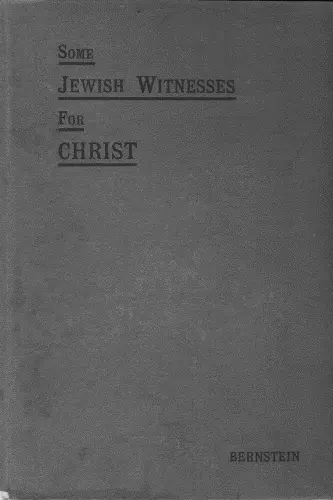
"Some Jewish Witnesses For Christ" by Aaron Bernstein is a historical account written in the early 20th century. The work explores the stories of Jewish individuals who have converted to Christianity throughout various periods, highlighting their contributions and the circumstances surrounding their faith transitions. The author seeks to validate these conversions and present a diverse range of notable figures who have embraced Christian beliefs, effectively showcasing the ongoing dialogue between Judaism and Christianity over centuries. The opening of the book begins with a preface that sets the tone for the discussion at hand, emphasizing the significance of documenting the lives of Jewish converts to Christianity, not only for historical purposes but also for influencing current religious dialogue. Bernstein indicates the broad scope of Jewish converts from the Apostolic age to contemporaneous times, hinting at the rich tapestry of experiences that will be detailed throughout the text. The introduction highlights the early history of Christian missions to the Jews and mentions the pivotal role of Jewish converts in the early Church. As the reader is ushered into the subsequent chapters, a detailed account of various periods and notable converts appears to promise an enlightening exploration of faith and identity.
Introduction adapted from the source catalogue; source summaries may be automatically generated.
Free to read · English · 137,079 words · No account needed
MAKE TIME FOR A GOOD BOOK
On by default. Untick to stop anonymous reading totals. Each page counts after 10 seconds in view. How this works.
Anonymous counting is on unless you have switched it off.
The Apostolic Period began on the day of Pentecost when the disciples who were gathered together were a hundred and twenty in number (Acts i. 15), but were only a section of the 500 brethren who had seen the Lord after His resurrection (I. Cor. xv. 6). On the same day, as the result of St. Peter's first missionary sermon, "there were added unto them about three thousand souls" (Acts ii. 41). A short time afterwards "the number of the disciples multiplied in Jerusalem greatly; and a great company of the priests were obedient to the faith" (Acts vi. 7). This progress continued to such a degree that St. James, after hearing the interesting missionary report of St. Paul, "about the things which God had wrought among the Gentiles by his ministry," said to him, "Thou seest, brother, how many thousands of Jews there are which believe" (Acts xxi. 20). How glad we should have been if we had some account of, at least, the more prominent converts of that period, and knew something of the sufferings that they had to endure for the sake of Christ. Nevertheless, the Acts of the Apostles, though containing much in relation to the progress of the Gospel among Jews and Gentiles, gives but little information with regard to Jewish individual conversions, and mentions only two Jewish Christian martyrs--namely, St. Stephen and James the Elder--and is even silent about the exclusion of Jewish converts from the Temple, which we gather only from the Epistle to the Hebrews. This fact is to us an evidence that St. Luke, the first ecclesiastical historian, had no design to shew to the world the inherent power of the Gospel exemplified by the conversion of many of the very people who had rejected Christ, and it proves the genuineness and authenticity of the Acts of the Apostles and the date commonly assigned, for had it been written later, as some critics maintain, the author would surely have taken the trouble to give his readers some detailed information concerning at least one per cent. of that vast multitude of Jewish converts mentioned by St. James. Such is the method of the ecclesiastical historian in modern as well as in ancient times, as the following two examples will shew: Pastor de le Roi, Jewish missionary historian, has for years not only collected statistics of Jewish converts in various churches, and summed up the whole number as being 224,000 in the nineteenth century, but he has also furnished us with a great deal of information concerning the history of many of these converts. For, as the Rev. W. T. Gidney rightly says, "Jewish converts must be weighed as well as counted." The second example is Hegesippus, who, according to Eusebius, was a Palestinian Hebrew Christian, and lived in Rome about 150 A.D. He is the father of Church history, and wrote a book under the title "Hyponeymata Pente," with the special design to answer the question of the Pharisees, "Have any of the rulers believed in Him?" and to shew that the Gospel made rapid progress among the Jews in the first century in spite of great opposition. Of this opposition the Jewish Liturgy to this day bears witness in the so-called "Blessing against the heretics," which Samuel the Little composed in the Synagogue of Yabne, in the presence of Gamaliel the Elder. Justin Martyr in his Dialogue, Origen in Homily 18, Jerome on Isaiah, complained of it, and it has, alas, been a source of trouble to the Jews at various times throughout the Christian ages. Hegesippus supplies information about a number of Jewish sects, who regarded each other as heretics. It is a pity that the greater part of his book has been lost, and we have only a few fragments in "Euseb. History iv.," and an extract in "Photius Bibliotheca" (page 232). That probably contained detailed information about the more prominent converts in the Apostolic age. Still, the most valuable relic for us is his list of Hebrew Christian bishops in regular succession in the mother Church at Jerusalem. These are as follows: James, the Lord's brother (Gal. i. 19), of whom Hegesippus states that he was martyred while praying in the Temple. Symeon about 62 A.D., Justus I. 64, Zacchæus 112, Tobias 114, Benjamin 116, Justin 118, Matthias 120, Philip 122, Seneca 125, Justus II. 126, Levi 128, Ephres 130, Joseph 132, Jude 133. The shortness of their episcopates probably indicates that it was a time of great tribulation. To this list may perhaps be added Ananias, who baptized Saul of Tarsus at Damascus, and, according to tradition, was subsequently bishop there and suffered martyrdom (See "Schaff. Bible Dictionary"); Crispus, Chief of the Jewish Synagogue (Acts xviii. 8), who, according to tradition ("Constituit Apost." vii. 46), was afterwards Bishop of Ægina; Clement, of Rome, who, according to Bishop Lightfoot, was an Hellenistic Jewish convert or son of a convert. The bishop came to this conclusion, after weighing much the internal evidence of his Epistle to the Corinthians.[1]
Your reading position is saved on this browser. Take it to another device with a library code. Reading pages adapt to text, rather than matching a printed edition.
BEHIND THE BOOK
This eBook is for the use of anyone anywhere in the United States and most other parts of the world at no cost and with almost no restrictions whatsoever. You may copy it, give it away or re-use it under the terms of the Project Gutenberg License included with this eBook or online at www.gutenberg.org. If you are not located in the United States, you will have to check the laws of the country where you are located before using this eBook. Read the source licence.
The original source file, including credits and licence, is retained by this library. Request an original-format copy at no charge. Please include the book title and Project Gutenberg identifier #37734.
KEEP YOUR CURIOSITY GOING
Cécile Tormay

Moritz Busch
John L. Ransom
Frances Wright
Cécile Tormay

Mabel Potter Daggett