THE CLASSIC COLLECTION✦An outlaw’s diary: the CommuneCLASSIC FREE BOOKS
An outlaw’s diary: the Commune
Cécile Tormay
THE CLASSIC COLLECTION · 1909
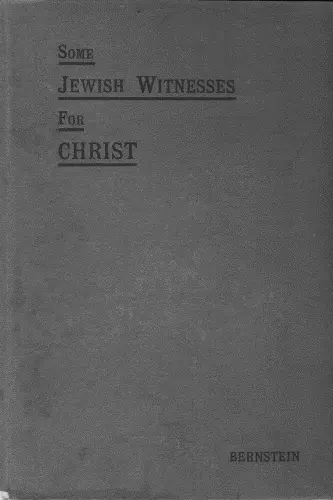
"Some Jewish Witnesses For Christ" by Aaron Bernstein is a historical account written in the early 20th century. The work explores the stories of Jewish individuals who have converted to Christianity throughout various periods, highlighting their contributions and the circumstances surrounding their faith transitions. The author seeks to validate these conversions and present a diverse range of notable figures who have embraced Christian beliefs, effectively showcasing the ongoing dialogue between Judaism and Christianity over centuries. The opening of the book begins with a preface that sets the tone for the discussion at hand, emphasizing the significance of documenting the lives of Jewish converts to Christianity, not only for historical purposes but also for influencing current religious dialogue. Bernstein indicates the broad scope of Jewish converts from the Apostolic age to contemporaneous times, hinting at the rich tapestry of experiences that will be detailed throughout the text. The introduction highlights the early history of Christian missions to the Jews and mentions the pivotal role of Jewish converts in the early Church. As the reader is ushered into the subsequent chapters, a detailed account of various periods and notable converts appears to promise an enlightening exploration of faith and identity.
Introduction adapted from the source catalogue; source summaries may be automatically generated.
Free to read · English · 137,079 words · No account needed
MAKE TIME FOR A GOOD BOOK
On by default. Untick to stop anonymous reading totals. Each page counts after 10 seconds in view. How this works.
Anonymous counting is on unless you have switched it off.
BERNHARDY, Dr. Gottfried, born in Landsburg, 1860, died 1875, embraced Christianity when studying in Berlin. He was a great classical scholar, and wrote as Professor, "Syntax of the Greek Language," Berlin, 1829. "Grundriss der Romischen Literatur," 1830. "Grundlinien der Encyclopædia der Philologie," 1832, &c.
BERNHEIM. We have only his memorial preserved as having been an associate of Rev. J. Neander, and of another proselyte, Bonhome, in the evangelization of the Jews in New York, about 1845.
BERNSTEIN, Rev. Aaron, born in Skalat, Galicia, in 1841, received, as an only son, a good and pious early education, and was when quite young brought under the influence of the wonder Rabbi of the town, with whose grandson he learned Talmud at school. At the age of 17 he was assistant teacher in a town in Moldavia, when the Rev. W. Mayer, L.J.S. missionary at Jassy, appeared one day in the Synagogue and had a discussion with the Jews, on which occasion he received a German tract, entitled "The Righteous shall live by his Faith." This made some impression upon him, but it passed away, as he was too young to understand it all. A few years later he went to Jassy, when he met Mr. Mayer again, who gave him a Hebrew New Testament and the "Old Paths." These were the means under God of leading him eventually to acknowledge the Saviour. He was baptized by Dr. Ewald, together with nine other Jews, on November 22, 1863. After being for a short time in the Operative Jewish Converts' Institution, he went to the United States, and after a year or so of teaching in a school and privately, he entered a missionary college which was established by a German missionary, known later as Bishop Auer of Cape Palmas. He then studied Theology in the General Seminary, New York, was ordained Deacon in Philadelphia in July 1870, and appointed by Bishop Stevens as Rector of St. Paul's, Manheim, Pa. In June, 1871, the L.J.S. sent him as missionary to Jerusalem, where he laboured only about a year and a-half, as he could not stand the climate. Subsequently he laboured in Bucharest, Paris, Liverpool, and Frankfort, but the greater part of his missionary career was in London, with the exception of an interval of three years, in which he was curate in Hertfordshire. Bernstein had the honorary degree of M.A. conferred upon him by Columbia College, New York, in 1873, owing to his taking the Greek Prize at the Seminary in 1870, and later the Faculty of the Seminary gave him B.D. He wrote "Sefer Roshey Hatayvoth," "Anglo-Israel Theory," translated Professor Cassel's "Commentary on the Book of Esther" into English, together with the "Targum Sheni" from the Original and Appendices (T. & T. Clark, Edinburgh, 1888). He published "The City of David," "The Book and the People," and contributed articles to the "Hebrew Christian Witness," "The Scattered Nation," "The Everlasting Nation," "Jews and Christians," "The Jewish Missionary Intelligence," and wrote about a dozen tracts in English, Hebrew and Yiddish, and revised a new edition of the Hebrew Bible in 1895. Editor of the "Kol M'Bhasser" since 1907. Non nobis, Domine, non nobis, sed nomini Tuo da honorem.
Your reading position is saved on this browser. Take it to another device with a library code. Reading pages adapt to text, rather than matching a printed edition.
BEHIND THE BOOK
This eBook is for the use of anyone anywhere in the United States and most other parts of the world at no cost and with almost no restrictions whatsoever. You may copy it, give it away or re-use it under the terms of the Project Gutenberg License included with this eBook or online at www.gutenberg.org. If you are not located in the United States, you will have to check the laws of the country where you are located before using this eBook. Read the source licence.
The original source file, including credits and licence, is retained by this library. Request an original-format copy at no charge. Please include the book title and Project Gutenberg identifier #37734.
KEEP YOUR CURIOSITY GOING
Cécile Tormay

Moritz Busch
John L. Ransom
Frances Wright
Cécile Tormay

Mabel Potter Daggett