THE CLASSIC COLLECTION✦An outlaw’s diary: the CommuneCLASSIC FREE BOOKS
An outlaw’s diary: the Commune
Cécile Tormay
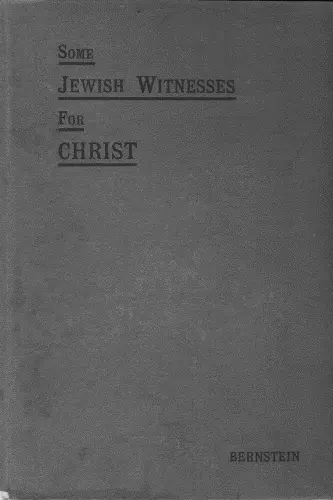
THE CLASSIC COLLECTION · 1909
"Some Jewish Witnesses For Christ" by Aaron Bernstein is a historical account written in the early 20th century. The work explores the stories of Jewish individuals who have converted to Christianity throughout various periods, highlighting their contributions and the circumstances surrounding their faith transitions. The author seeks to validate these conversions and present a diverse range of notable figures who have embraced Christian beliefs, effectively showcasing the ongoing dialogue between Judaism and Christianity over centuries. The opening of the book begins with a preface that sets the tone for the discussion at hand, emphasizing the significance of documenting the lives of Jewish converts to Christianity, not only for historical purposes but also for influencing current religious dialogue. Bernstein indicates the broad scope of Jewish converts from the Apostolic age to contemporaneous times, hinting at the rich tapestry of experiences that will be detailed throughout the text. The introduction highlights the early history of Christian missions to the Jews and mentions the pivotal role of Jewish converts in the early Church. As the reader is ushered into the subsequent chapters, a detailed account of various periods and notable converts appears to promise an enlightening exploration of faith and identity.
Introduction adapted from the source catalogue; source summaries may be automatically generated.
Free to read · English · 137,079 words · No account needed
MAKE TIME FOR A GOOD BOOK
On by default. Untick to stop anonymous reading totals. Each page counts after 10 seconds in view. How this works.
Anonymous counting is on unless you have switched it off.
AUGSBURGER, Emmanuel, baptized by Gottheil at Stuttgart in 1852, a first-fruit of the mission there. Though only a working weaver by trade, he accomplished much good by his voluntary testimony and by his exemplary life. (See Jewish Herald, 1853 and 1886).
AUGUST, Jacob Michael, baptized with his wife and children in Greifswald, Germany, about 1723. He became Lector (reader) of Oriental languages at the University of Leipzig.
AUGUSTI, Friedrich Albert (Joshua), was born at Frankfort-on-the-Oder, 1691. He was the son of Joshua ben Abraham Eschel and Rebecca Pinto, descendants of a Venetian family. When he was only seven years old he shewed already great talents for learning, and delivered a sermonette at a wedding, so that a savant present remarked: "This boy will be a teacher in Israel." But as a precocious child he had to be guarded against mischief. Once he nearly lost his life while bathing. After the death of his father, Augusti, having read a book which described the glory of Jerusalem, felt a great desire to go there, and it soon so happened that a Jerusalem delegate, Aron Bar Jekutiel, arrived at Frankfort, and offered to take him with him. The mother, after some resistance to the boy's entreaties, finally gave her consent and parted with him in sorrow. The two travellers went first to Russia, intending to go by the Black Sea to Constantinople and then to Jerusalem. In the Crimea a band of robbers overtook them at a lonely spot, and Augusti was taken captive, while his companion managed to escape. The robbers brought him to a town and sold him as a slave for three and a-half dollars. After severe trials on board a ship, where he was tempted to embrace Mohammedanism, the slave dealer sold him to a Mohammedan Jew by the name of Ismael Bathmag, who brought him to Smyrna. Here the Jewish community purchased his freedom from slavery for 100 dollars, and after six months sent him home. On his homeward journey he stopped at Kaminice, where he was dangerously ill with cholera. After his recovery he eventually came to Cracow, where he remained four years studying languages. From thence he went to Prague and devoted himself to the study of Jewish theology under Rabbi Gabriel, who conferred upon him the title of Morenu, D.D. He then interpreted the famous grammarian, Binyan Shelomo. Returning to Frankfort, he saw his mother, who desired him to get married and settle down, but he felt impelled to go to Italy in order to study Kabbalistic lore there. While living in Sonderhasen, in 1720, he was maltreated by a gang of robbers, who broke into the house in which he resided, and robbed him and his landlord to the amount of 20,000 dollars. It then so happened that a member of the princely family of Schwarzburg died, when the Court Jew Wallich, in expressing his condolence with the reigning prince, used the expression "der hochselige Prinz" with reference to the deceased. Whereupon the prince charged him with flattery, as he did not think that the Jews believed that a Christian could be saved. Wallich then brought Augusti, who proved from the "Sefer Hasidim" that a pious Christian who keeps the seven Noachian Commandments has a share in the world to come. This incident was in the providence of God the first means in Augusti's conversion. On that occasion Dr. Reinhardt, an evangelical pastor, was present, and they became acquainted with each other. This led later to discussions about the interpretation of Isaiah liii. Augusti, after much searching in Jewish commentaries, was convinced that this chapter speaks of a person and that Jesus is the one in whom it was fulfilled. Before his baptism he made an open confession in the synagogue of his faith in Christ, and he was baptized on Christmas Day, 1722, in the presence of Prince Gunther and the whole court officials. After his baptism he delivered an address on Ps. ix. 2, in which he expressed his thanksgiving for God's wonderful dealing with him. Soon after he began to study theology at the Seminary of Gotha. In 1727, he went to Jena, and afterward to Leipzig. He was appointed Assistant Professor of the Gymnasium at Gotha, in 1729, and in 1734 became minister of the parish of Eschberge, in which position he remained until his death. The famous theologian, Johann Christi Wilhelm Augusti, was his grandson. Augusti published several works in Latin and German, notably "Das Geheimnis des Sambathian." ("The Mystery of the Sambathian," a fabulous river mentioned in the Talmud, which casts stones during six days in the week and rests on the Sabbath.) He also published a work on the Karaites.
Your reading position is saved on this browser. Take it to another device with a library code. Reading pages adapt to text, rather than matching a printed edition.
BEHIND THE BOOK
This eBook is for the use of anyone anywhere in the United States and most other parts of the world at no cost and with almost no restrictions whatsoever. You may copy it, give it away or re-use it under the terms of the Project Gutenberg License included with this eBook or online at www.gutenberg.org. If you are not located in the United States, you will have to check the laws of the country where you are located before using this eBook. Read the source licence.
The original source file, including credits and licence, is retained by this library. Request an original-format copy at no charge. Please include the book title and Project Gutenberg identifier #37734.
KEEP YOUR CURIOSITY GOING
Cécile Tormay

Moritz Busch
John L. Ransom
Frances Wright
Cécile Tormay

Mabel Potter Daggett