THE CLASSIC COLLECTION✦An outlaw’s diary: the CommuneCLASSIC FREE BOOKS
An outlaw’s diary: the Commune
Cécile Tormay
THE CLASSIC COLLECTION · 1909
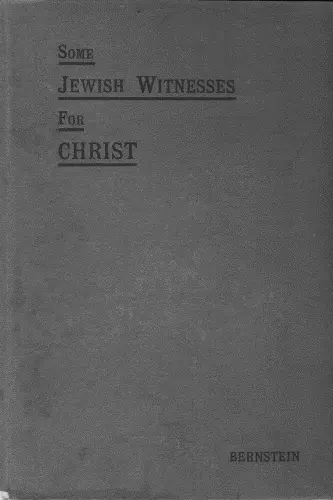
"Some Jewish Witnesses For Christ" by Aaron Bernstein is a historical account written in the early 20th century. The work explores the stories of Jewish individuals who have converted to Christianity throughout various periods, highlighting their contributions and the circumstances surrounding their faith transitions. The author seeks to validate these conversions and present a diverse range of notable figures who have embraced Christian beliefs, effectively showcasing the ongoing dialogue between Judaism and Christianity over centuries. The opening of the book begins with a preface that sets the tone for the discussion at hand, emphasizing the significance of documenting the lives of Jewish converts to Christianity, not only for historical purposes but also for influencing current religious dialogue. Bernstein indicates the broad scope of Jewish converts from the Apostolic age to contemporaneous times, hinting at the rich tapestry of experiences that will be detailed throughout the text. The introduction highlights the early history of Christian missions to the Jews and mentions the pivotal role of Jewish converts in the early Church. As the reader is ushered into the subsequent chapters, a detailed account of various periods and notable converts appears to promise an enlightening exploration of faith and identity.
Introduction adapted from the source catalogue; source summaries may be automatically generated.
Free to read · English · 137,079 words · No account needed
MAKE TIME FOR A GOOD BOOK
On by default. Untick to stop anonymous reading totals. Each page counts after 10 seconds in view. How this works.
Anonymous counting is on unless you have switched it off.
Ugolino Blaisio, an Italian Jewish convert, born about 1700. He is known for his "Thesaurus Antiquitatum" (34 vols., Venice, 1744-69). In this work he reprinted most of the seventeenth century treatises on Jewish antiquities by Bochart, Bonfrère, Buxtrof, Carpzov, Cellarius, Clavering, Deyling, Goodwin, Hottinger, Huet, Lowth, Opitz, Pfeiffer, Prideaux, Reland, Rhenferd, Saubertius, Selden, Sigonius, Spencer, Trigland, Van Til, Wagenseil, and Witsius, besides some from fresh contributors, and translating much himself from the "Midrashim." He also himself translated the treatises Menahoth, and Zebahim (vol. xxi.) Pesahim, Shekalim, Yoma, Succa, Rosh-Hashanah, Tamid, Megilah, Hagigah, Bezah, Moed Katon, Ma'aseroth, Maaser Sheni, Hallah, Orlah, and Bikkurim (vols, xvii.-xix.), besides a part of Maimonides' "Yad-Hazakah," and of Abraham Portaleone's "Shilte ha Gibborim."
Veil, Ludwig Karl de, a native of Metz, whose father and grandfather were rabbis, the latter an author of Hebrew books, embraced the Roman Catholic faith at the age of 17, when he was a teacher of Hebrew in 1655. It is said that Louis XIII., King of France, compelled him to be baptized in Compiègne. At all events, the King and the Queen were his sponsors. He is also called Compiègne, after the town. He became afterwards ordinary Royal professor of Oriental languages in the Sorbonne, Paris. Wagenseil, who made his acquaintance in Paris, praises him for his modesty as well as for his learning and talents. Ludwig de Veil translated the first eight tracts of the "Yad-Hazakah" of Maimonides into Latin, adding notes thereto (Paris, 1662-78); also "Sefer Hakorbanoth," with Abrabanel's introduction to Leviticus (London, 1683). A separate edition of this introduction appeared under the title "Hakdamat Abravenl El Sefer Wayikra" (Amsterdam, 1701).
Veit, Johann Emanuel was born in Ruthenplan, in Bohemia, in 1789, died in Vienna in 1876. He was the son of a rich Jew named Benedict (Boruch). He studied medicine and philosophy first at Prague and then in Vienna, in which city he became professor and director in the Veterinary College in 1819. In the newspaper "Bohemia," he was reported to have given the reason for his conversion in these words:--"I went through the Old Testament, and now I must look into the New." And to Döllinger he once said, "Judaism is the vestibule to the Hall Christianity, and I wanted to pass from the one to the other." Here are some remarks which he made occasionally in letters to friends with reference to his spiritual development and his coming to Christ. Thus he wrote:--"The time past, the near as well as the remote, lies behind me like a series of dissolving views. I am not in the state to give chronological data, I know only that it is a good while ago that a decided direction to the positive belief took me without my exertion." A deeper view is given to us in the following letter:--"You do not know the miserable history of my life, neither the ways by which the Divine Mercy has conducted me, nor the unutterable distress incumbent upon me. Nobody did know me, myself the least, but the Lord has helped me wonderfully. What can the world judge of a poor, contrite old student, full of sinfulness, craving only God's love, who has finally prostrated himself, in great anxiety of heart, at the feet of Jesus, the Crucified, crying, 'O Lord, do not cast away from Thee the poor dog which licks Thy feet, although it stretches still its nostrils to the hideous savours of this world.'" Having such a confession before us, we forbear to search after other influences which may have worked upon his soul. A true Israelite, with the humility of the woman of Samaria, he found in Jesus Christ the peace with God which neither Judaism, the modernised as little as the rabbinical, nor the philosophical systems could give him. Of course, he desired to confess his belief in Jesus Christ as his Saviour and Redeemer by baptism, and this he did on May 4th, 1816, in the Church of St. Carl, Vienna. Eventually Veit was appointed as Cathedral preacher at St. Stephen's and his fervent eloquence drew large crowds to hear him, and many on bended knees cried out for pardon of secret sins. When in 1840 the Damascus blood accusation affair took place, Veit stood up in the pulpit before the whole congregation, lifted up a crucifix, and swore solemnly that this oft repeated accusation had no foundation whatever in fact.
Your reading position is saved on this browser. Take it to another device with a library code. Reading pages adapt to text, rather than matching a printed edition.
BEHIND THE BOOK
This eBook is for the use of anyone anywhere in the United States and most other parts of the world at no cost and with almost no restrictions whatsoever. You may copy it, give it away or re-use it under the terms of the Project Gutenberg License included with this eBook or online at www.gutenberg.org. If you are not located in the United States, you will have to check the laws of the country where you are located before using this eBook. Read the source licence.
The original source file, including credits and licence, is retained by this library. Request an original-format copy at no charge. Please include the book title and Project Gutenberg identifier #37734.
KEEP YOUR CURIOSITY GOING
Cécile Tormay

Moritz Busch
John L. Ransom
Frances Wright
Cécile Tormay

Mabel Potter Daggett