THE CLASSIC COLLECTION✦An outlaw’s diary: the CommuneCLASSIC FREE BOOKS
An outlaw’s diary: the Commune
Cécile Tormay
THE CLASSIC COLLECTION · 1909
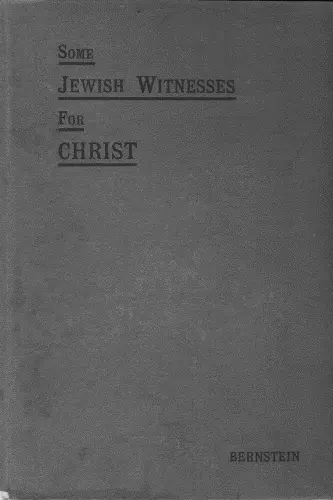
"Some Jewish Witnesses For Christ" by Aaron Bernstein is a historical account written in the early 20th century. The work explores the stories of Jewish individuals who have converted to Christianity throughout various periods, highlighting their contributions and the circumstances surrounding their faith transitions. The author seeks to validate these conversions and present a diverse range of notable figures who have embraced Christian beliefs, effectively showcasing the ongoing dialogue between Judaism and Christianity over centuries. The opening of the book begins with a preface that sets the tone for the discussion at hand, emphasizing the significance of documenting the lives of Jewish converts to Christianity, not only for historical purposes but also for influencing current religious dialogue. Bernstein indicates the broad scope of Jewish converts from the Apostolic age to contemporaneous times, hinting at the rich tapestry of experiences that will be detailed throughout the text. The introduction highlights the early history of Christian missions to the Jews and mentions the pivotal role of Jewish converts in the early Church. As the reader is ushered into the subsequent chapters, a detailed account of various periods and notable converts appears to promise an enlightening exploration of faith and identity.
Introduction adapted from the source catalogue; source summaries may be automatically generated.
Free to read · English · 137,079 words · No account needed
MAKE TIME FOR A GOOD BOOK
On by default. Untick to stop anonymous reading totals. Each page counts after 10 seconds in view. How this works.
Anonymous counting is on unless you have switched it off.
Henekstein, Alfred Freiherr Von, born at Ober Dobling, Austria, 1810, died in Vienna, 1882. He was the son of the banker Joseph Von Henekstein, and embraced Christianity in 1828. Joining the army in the same year, he was gradually promoted, until in 1869 he was appointed Chief of the General Staff. As such he acted under Benedek in the Austro-Prussian war, when the Austrian army, through the blunders of commanding officers, was defeated, and he and his superior were arrested to appear before a court-martial. After some time the court was dismissed without having given judgment. Leaving the army, Henekstein passed the rest of his life in retirement in Vienna.
Hess, Ernst Friedrich, lived in the sixteenth century. He was the author of a controversial book entitled, "Neue Juden-geissel," cited as "Flagellum Judæorum." (Fritzlar, 1589.) (Strack, "Sind die Juden Verbrecher," p. 7.)
Ibn Vives, Juan, grandson of one of the richest Jews of Valencia, was the author of a book entitled, "Veritate Fidei Christianæ." It is asserted in the "Jewish Encyclopædia" that he did this in self-defence, because he was condemned in 1510 for Judaizing, but no proof is given.
Iolante, a converted Jewess, married Dam Luis, brother of Henry, King of Portugal, in the sixteenth century.
Isaac Johann Levita, born in Germany 1515, died at Cologne, 1577. At first he was a rabbi at Wetzler, he was baptized as a Protestant in 1546, but joined the Roman Catholic Church, and was appointed professor of Hebrew at Cologne, which office he held until his death. He wrote a Hebrew grammar in 1556. He also edited Maimonides' work on astrology, and Moses ibn Tibbon's commentary on Aristotle's physics (Cologne, 1555).
Johannes Hispalensis, flourished between 1135 and 1153. He was a native of Toledo, and hence also was called J. (David) Toletanus. He was one of the earliest translators from the Arabic. He translated chiefly astrological and astronomical, but likewise some philosophical, and a few medical, works, such as "Fons Vitæ," and "Epitome Totius Astrologæ."
Johannes Pauli, born about 1455, died at Thann, 1530. He became a distinguished preacher of the Franciscan Order at Oppenheim and Strassburg, at which latter place he took notes of Geiler's Sermons, which he edited at Schlettstadt, 1517. He is known chiefly, however, for his collection of jests under the title, "Schimpf und Ernst" (Thann, 1519). Some of his stories were taken over into the "Hundred Merry Tales" used by Shakespeare.
John, of Capua, an Italian Jewish convert in the thirteenth century. He translated Rabbi Joel's Hebrew version of "Kallilah wa Dimnah," from Arabic into Latin, under the title, "Discetorium Vitæ Humane," and his translation was the source from which that work became so widely spread in almost all European tongues.
Your reading position is saved on this browser. Take it to another device with a library code. Reading pages adapt to text, rather than matching a printed edition.
BEHIND THE BOOK
This eBook is for the use of anyone anywhere in the United States and most other parts of the world at no cost and with almost no restrictions whatsoever. You may copy it, give it away or re-use it under the terms of the Project Gutenberg License included with this eBook or online at www.gutenberg.org. If you are not located in the United States, you will have to check the laws of the country where you are located before using this eBook. Read the source licence.
The original source file, including credits and licence, is retained by this library. Request an original-format copy at no charge. Please include the book title and Project Gutenberg identifier #37734.
KEEP YOUR CURIOSITY GOING
Cécile Tormay

Moritz Busch
John L. Ransom
Frances Wright
Cécile Tormay

Mabel Potter Daggett