THE CLASSIC COLLECTION✦An outlaw’s diary: the CommuneCLASSIC FREE BOOKS
An outlaw’s diary: the Commune
Cécile Tormay
THE CLASSIC COLLECTION · 1909
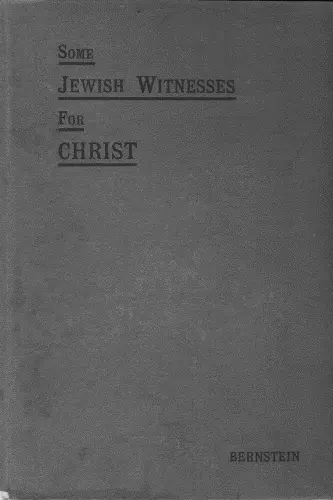
"Some Jewish Witnesses For Christ" by Aaron Bernstein is a historical account written in the early 20th century. The work explores the stories of Jewish individuals who have converted to Christianity throughout various periods, highlighting their contributions and the circumstances surrounding their faith transitions. The author seeks to validate these conversions and present a diverse range of notable figures who have embraced Christian beliefs, effectively showcasing the ongoing dialogue between Judaism and Christianity over centuries. The opening of the book begins with a preface that sets the tone for the discussion at hand, emphasizing the significance of documenting the lives of Jewish converts to Christianity, not only for historical purposes but also for influencing current religious dialogue. Bernstein indicates the broad scope of Jewish converts from the Apostolic age to contemporaneous times, hinting at the rich tapestry of experiences that will be detailed throughout the text. The introduction highlights the early history of Christian missions to the Jews and mentions the pivotal role of Jewish converts in the early Church. As the reader is ushered into the subsequent chapters, a detailed account of various periods and notable converts appears to promise an enlightening exploration of faith and identity.
Introduction adapted from the source catalogue; source summaries may be automatically generated.
Free to read · English · 137,079 words · No account needed
MAKE TIME FOR A GOOD BOOK
On by default. Untick to stop anonymous reading totals. Each page counts after 10 seconds in view. How this works.
Anonymous counting is on unless you have switched it off.
POSNER, Sigismund August (Löbel), was born in 1804, of wealthy parents at Auras in Silesia who gave their children a strict orthodox education; he was well instructed in the Bible. When studying at Berlin, Mr. Lachs, Director of the Deaf and Dumb Institution, sowed in his heart the seed of the Gospel, which took root and led eventually to his conversion, and he was baptized by Pastor Schultze in 1828. His father was at first grieved, but became afterward friendly to him. He studied theology and became a very earnest preacher of the Gospel, so that only decided Christians liked to hear him. He died in 1849. His biography was published by Professor Tholuck for Sunday reading.
RABINOWITZ, Joseph, was born at Resina on the Dniester, September 23, 1837, and died at Kischineff, 1899. He was the son of David ben Ephraim, and belonged to a rabbinic family. On the early death of his mother, her father Nathan Neta took him to be educated at his house. When he was six years of age he could repeat the Song of Solomon by heart. He remained with his grandfather till 1848, when he went to other relations. At the age of thirteen they betrothed him. Being compelled by an imperial ukase to acquire the Russian language, his eyes were opened to a new world of literature, and he began to think for himself. In 1855 Jehiel Hershensohn (Lichtenstein), his future brother-in-law, gave him a L.J.S. New Testament in Hebrew, declaring at the same time that possibly Jesus of Nazareth might be the true Messiah, at which news he was very much surprised. However, the immediate effect was that he left the Chassidim and went back to Orgeyev to his grandfather, and studied the Bible more and Russian law, so that he could act as a solicitor among his people. In 1856, he was married, and was then regarded as an influential citizen of the town, especially when it was seen that he took an active interest in the education of children and that he contributed important articles to the Jewish newspapers, and gave lectures at Kischineff, in which he advocated the principles of reform and progress. In 1878 he wrote an article in the Hebrew paper, "Haboker Or," in which he requested the Rabbis to work for the improvement of the condition of the Russian Jews by teaching them the necessity of becoming gradually an agricultural people, and he showed this by his own example in cultivating his garden himself. Not long afterward persecutions broke out in Russia, and he went to Palestine on a mission of enquiry with a view of establishing a Jewish colony there. But when he arrived in Jerusalem and became acquainted with the sad temporal and spiritual condition of the Jews there, his heart sank within him, and he was about to leave the Holy City in despair, but before doing so he went to the Mount of Olives. There he sat down in deep meditation, and reviewing the sad history of his unfortunate people, the thought came to him as an inspiration: "The key to the Holy Land is in the hands of our brother Jesus." This thought he made then the matter and basis of his future work. Returning to Kischineff, he drew up thirteen theses, the substance of which was that Jesus is the only Saviour of Israel as well as of the whole world. With great courage and enthusiasm he then endeavoured by word and pen to propagate his conviction, and gained in a short time many adherents both at Kischineff and in other towns of Bessarabia. Having in 1885 published his "Symbol of the Israelites of the New Covenant" in seven articles, Professor F. Delitzsch and the Rev. John Wilkinson encouraged him, and in Glasgow an association was formed in 1887 for the support of his movement. Rabinowitz was baptized in Berlin by Professor Mead, of Andover U.S.A., in 1885, and henceforth his mission work took a more decisive but also perhaps a more restrictive character. He was asked by Provost Faltin, pastor of the Lutheran Church at Kischineff, to join that Church, but for good reasons he declined to do so, as neither he nor his adherents who had just come out from the synagogue could worship in a church where there was a crucifix. For still stronger reasons he could not join the Russian Church as he was asked to do by the highest authorities. Consequently he had to build a hall, in which he preached the pure Gospel as long as he lived. The result of this movement was that not only Rabinowitz, and his wife and seven children with his brother and family, and other individual Jews who heard the Gospel from his lips publicly confessed Christ as their Saviour, but also that the attitude of the Jews in general toward the person of our Lord has since then changed for the better.
Your reading position is saved on this browser. Take it to another device with a library code. Reading pages adapt to text, rather than matching a printed edition.
BEHIND THE BOOK
This eBook is for the use of anyone anywhere in the United States and most other parts of the world at no cost and with almost no restrictions whatsoever. You may copy it, give it away or re-use it under the terms of the Project Gutenberg License included with this eBook or online at www.gutenberg.org. If you are not located in the United States, you will have to check the laws of the country where you are located before using this eBook. Read the source licence.
The original source file, including credits and licence, is retained by this library. Request an original-format copy at no charge. Please include the book title and Project Gutenberg identifier #37734.
KEEP YOUR CURIOSITY GOING
Cécile Tormay

Moritz Busch
John L. Ransom
Frances Wright
Cécile Tormay

Mabel Potter Daggett