THE CLASSIC COLLECTION✦An outlaw’s diary: the CommuneCLASSIC FREE BOOKS
An outlaw’s diary: the Commune
Cécile Tormay
THE CLASSIC COLLECTION · 1909
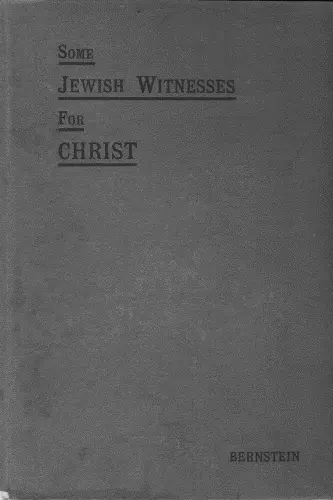
"Some Jewish Witnesses For Christ" by Aaron Bernstein is a historical account written in the early 20th century. The work explores the stories of Jewish individuals who have converted to Christianity throughout various periods, highlighting their contributions and the circumstances surrounding their faith transitions. The author seeks to validate these conversions and present a diverse range of notable figures who have embraced Christian beliefs, effectively showcasing the ongoing dialogue between Judaism and Christianity over centuries. The opening of the book begins with a preface that sets the tone for the discussion at hand, emphasizing the significance of documenting the lives of Jewish converts to Christianity, not only for historical purposes but also for influencing current religious dialogue. Bernstein indicates the broad scope of Jewish converts from the Apostolic age to contemporaneous times, hinting at the rich tapestry of experiences that will be detailed throughout the text. The introduction highlights the early history of Christian missions to the Jews and mentions the pivotal role of Jewish converts in the early Church. As the reader is ushered into the subsequent chapters, a detailed account of various periods and notable converts appears to promise an enlightening exploration of faith and identity.
Introduction adapted from the source catalogue; source summaries may be automatically generated.
Free to read · English · 137,079 words · No account needed
MAKE TIME FOR A GOOD BOOK
On by default. Untick to stop anonymous reading totals. Each page counts after 10 seconds in view. How this works.
Anonymous counting is on unless you have switched it off.
"After taking a hearty leave of the recluse, and my new friend, the Talmud student, I seized my staff and went out into the wide world, a toy for wind and weather. Like a nomad, I wandered uncertain, for a long period, from town to town and from village to village. It was quite late often when I reached a strange place; all the doors and gates were closed, and I turned my steps to the ever open house of God, entered upon a 'Kasche' (a Talmudic question of dispute) with any one of those present, and I immediately felt at home, had my board and lodging, and the pious prayer-men, who came there daily, openly and secretly pressed their charitable gifts into my hand. Thus I was enabled to wander through the whole of Russia to the frontier, which, having no passport, I could not legally cross, and was therefore forced to smuggle myself through by giving a man a rouble to conduct me through a wood which led into Germany. Now that I was in another country, my position became a different one. On reaching the first German town, I asked as usual for the 'Beth-Hamedrash' (Jewish prayer and school-house), but to my greatest dismay no one could give me any information. Only one thing I was aware of, and that was that I could not make myself understood at all. It was evening; the first stars, those companions of my wanderings, began to twinkle in the sky, but into my sad heart no light would enter; there all was dark and dull. Here I was, standing at the corner of a street leaning against a post, a little bundle in my hand, without means, work, knowledge or language; alone, forsaken, not knowing where to turn. A lady passing by stopped and looked at me inquisitively. The sight of a slender little lad, clothed in the long wide Kaftan, with a pale face and sad eyes filled with tears, must have aroused her sympathy. She addressed me, but finding I did not understand a word she said, she gave me a few pence and showed me an inn where I could pass the night. It was certainly a very cheap night's-lodging that I had, but I was obliged to sleep amongst tipsy room-companions, to whom I was much too interesting a personage for them to leave in peace. Some would insist on making a common covering of my long coat; others played incessantly with my long fore-locks, whilst others again were interested in my Arba-Kanfoth (a garment with fringe at the ends) and were continually pulling at them. It was a long, weary night that I passed there, and as soon as the rising sun shone faintly through the dirty window-panes I hastened out, and, being once more alone, allowed my tears to flow. For the first time since my departure home-sickness with all its overwhelming power quite overcame me, and I felt the seriousness of life in its full meaning. However, I soon took courage again, laid my Tephillin (prayer-strap) on and implored the Lord to lend me His assistance and protection, taking a solemn oath that from henceforth I would blindly let myself be guided by Him in all things. With this sacred oath and with the firm conviction that the Lord would carry out all to His glory, I went on my way. With great difficulty and many privations I reached Breslau, where I met a man from Russia, who assisted me in obtaining a place as instructor of the Hebrew language in a Polish Jew's family. After staying there a few months I seemed, curiously enough, to be drawn as by an invisible hand towards Vienna. The money I had earned as a teacher amply sufficed to take me there, and after a lengthy search, I found inexpensive lodgings in a Jewish family. (The head of the family is dead, but the wife still lives here, and her son is now, thanks be to God, a dear believing Protestant Christian.) Here I became acquainted with a Jewish shoemaker, who was the first to give me a New Testament in the Hebrew language to read. The very first sentence in that book was sufficient to draw me to it like a magnet, for there it was written what that Talmud-scholar had briefly told me, written clearly and in full, namely, that the Messiah, who until now had been the object of my prayers, my desires and hopes, had actually been born. On asking him to tell me something more about the book, the shoemaker conducted me to the missionary, Herr E. Weiss, who advised me to go to Pastor Schönberger, preacher at Prague, where I found a very friendly welcome. I passed the winter there, but, as Pastor Schönberger was obliged to be away for a year, he took me to his friend, the Rev. D. A. Hefter, L.J.S. missionary at Frankfort-on-the-Main, who kindly took me under his paternal care.
Your reading position is saved on this browser. Take it to another device with a library code. Reading pages adapt to text, rather than matching a printed edition.
BEHIND THE BOOK
This eBook is for the use of anyone anywhere in the United States and most other parts of the world at no cost and with almost no restrictions whatsoever. You may copy it, give it away or re-use it under the terms of the Project Gutenberg License included with this eBook or online at www.gutenberg.org. If you are not located in the United States, you will have to check the laws of the country where you are located before using this eBook. Read the source licence.
The original source file, including credits and licence, is retained by this library. Request an original-format copy at no charge. Please include the book title and Project Gutenberg identifier #37734.
KEEP YOUR CURIOSITY GOING
Cécile Tormay

Moritz Busch
John L. Ransom
Frances Wright
Cécile Tormay

Mabel Potter Daggett