THE CLASSIC COLLECTION✦An outlaw’s diary: the CommuneCLASSIC FREE BOOKS
An outlaw’s diary: the Commune
Cécile Tormay
THE CLASSIC COLLECTION · 1909
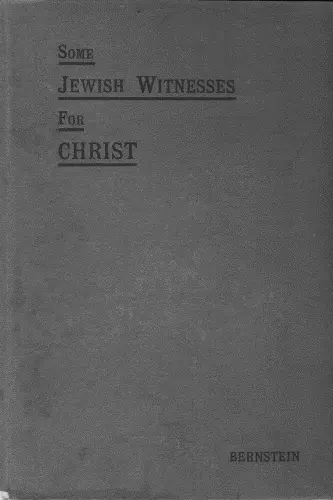
"Some Jewish Witnesses For Christ" by Aaron Bernstein is a historical account written in the early 20th century. The work explores the stories of Jewish individuals who have converted to Christianity throughout various periods, highlighting their contributions and the circumstances surrounding their faith transitions. The author seeks to validate these conversions and present a diverse range of notable figures who have embraced Christian beliefs, effectively showcasing the ongoing dialogue between Judaism and Christianity over centuries. The opening of the book begins with a preface that sets the tone for the discussion at hand, emphasizing the significance of documenting the lives of Jewish converts to Christianity, not only for historical purposes but also for influencing current religious dialogue. Bernstein indicates the broad scope of Jewish converts from the Apostolic age to contemporaneous times, hinting at the rich tapestry of experiences that will be detailed throughout the text. The introduction highlights the early history of Christian missions to the Jews and mentions the pivotal role of Jewish converts in the early Church. As the reader is ushered into the subsequent chapters, a detailed account of various periods and notable converts appears to promise an enlightening exploration of faith and identity.
Introduction adapted from the source catalogue; source summaries may be automatically generated.
Free to read · English · 137,079 words · No account needed
MAKE TIME FOR A GOOD BOOK
On by default. Untick to stop anonymous reading totals. Each page counts after 10 seconds in view. How this works.
Anonymous counting is on unless you have switched it off.
KALKAR, Christian Andreas Herman, born November 27th, 1802, at Stockholm, died at Gladsaxe, February 3rd, 1886. He received his early education from his father, who was a rabbi and a member of the consistorium, and at the schools of Copenhagen, where, in 1818, he became a student of law. In 1823 he embraced the evangelical faith and studied theology, passing his examination in 1826. After being teacher at Oldensee, from 1827 to 1841, he travelled in Spain, and was appointed minister at Gladsaxe and Herloi in 1844. Among Kalkar's many works may be mentioned--"Evangelische Missionsgeschichte," 1857; "Geschichte der Römisch-Katholischen Mission," 1862 (German translation, Erlangen, 1869); "Geschichte der Christlichen Mission unter den Heiden," 1877 (German translation, Gütersloh, 1879); "Die Mission unter den Juden," 1868 (German translation, Hamburg, 1869); "Israel og Kerken," Copenhagen, 1881. From 1871 to 1880 Kalkar was editor of the "Theologisk Tidskrift."
KALORIA, Rev. John B., a native of Jerusalem when he for the first time heard the Gospel from the L.J.S. missionaries. After his conversion he studied at Basel, and was then sent out to Uruguay as pastor and teacher in a German Colony there. About 1887, he assisted Mr. Eppstein in London, and then went to the United States, where he became engaged in Ministerial work, contributing valuable articles to the Jewish Missionary periodical at New York, "The People, the Land and the Book."
KAMERAS, Rev. Nathanael, missionary in Vienna, of the British Society for the Propagation of the Gospel among the Jews. The following is an abridged extract from his autobiography:--
"On the road leading from Russian Lithuania to Russian Poland there stands a large and lonely inn. It was there that I first saw the light of day in the year 1862. A clay-floored entrance divides the rooms of this extensive house into two rows; on one side are the rooms for the strangers, who lodge here over night, the large tap-room, and the small rooms belonging to my parents; on the other, a one-windowed chamber, where our teacher slept, and the hall, a pretty large room, set apart for prayer and study. It contained long narrow tables and forms, an ornamented cupboard on the eastern side, in which the Thora-rollen (law scrolls) were kept, a prayer-desk with a seven-branched brass candelabra and a hanging lamp. The male members of our family, and Jews from the neighbouring villages, assembled there for Divine Service, to which the women listened in an adjoining room. There, too, our teacher instructed my four brothers and myself in the Hebrew language, and in the Talmud. As soon as I was five years of age, my parents, wrapping me up in a Tallith (prayer-mantle), solemnly brought me in there, in order that I might receive the necessary instruction; so that from that moment I devoted myself exclusively to study. Every other occupation, every other employment, every recreation, game, or fun of childhood, all that makes the heart light and the body strong, was banished from my life. I felt like a bird imprisoned in a cage, and debarred the free movement of its limbs; outside, was the world in all its beauty, where numbers of joyous creatures were flying about in the full enjoyment of their individual freedom, whilst I, powerless, clung to the bars. Before my eyes lay a landscape, rich in rural splendour; as far as I could see, village after village, surrounded by fruit-laden trees, presented a most cheerful aspect, and from the window I could watch the Christian children at their play, enjoying the fresh air of freedom in the flowering fields and sprouting meadows. Amidst the songs of birds, the rustling of leaves and the roar of the forest, I caught the sound of happy human voices, whilst I, chained to my books all day and until late at night, was forced to pore over marriage contracts and divorces and other similar things, which would have been better kept from my childish reason. 'Oh, if I were only that poor farm-servant coming home from the fields with the tired horses, or that ragged boy driving his cows home!' Thus I sighed. But all my longings and wishings were useless; I had to go over the same tiresome road that all the Jewish children of orthodox parents must labour through. The master behind me, drove me on with a volume in one hand and the rod in the other; my father drove me, my relations drove me, and thus, without rest or quiet, I was hurried through all those voluminous works that are of no value for practical existence whatever, so that the years of my childhood passed by, joyless and unenjoyed.
Your reading position is saved on this browser. Take it to another device with a library code. Reading pages adapt to text, rather than matching a printed edition.
BEHIND THE BOOK
This eBook is for the use of anyone anywhere in the United States and most other parts of the world at no cost and with almost no restrictions whatsoever. You may copy it, give it away or re-use it under the terms of the Project Gutenberg License included with this eBook or online at www.gutenberg.org. If you are not located in the United States, you will have to check the laws of the country where you are located before using this eBook. Read the source licence.
The original source file, including credits and licence, is retained by this library. Request an original-format copy at no charge. Please include the book title and Project Gutenberg identifier #37734.
KEEP YOUR CURIOSITY GOING
Cécile Tormay

Moritz Busch
John L. Ransom
Frances Wright
Cécile Tormay

Mabel Potter Daggett