THE CLASSIC COLLECTION✦An outlaw’s diary: the CommuneCLASSIC FREE BOOKS
An outlaw’s diary: the Commune
Cécile Tormay
THE CLASSIC COLLECTION · 1909
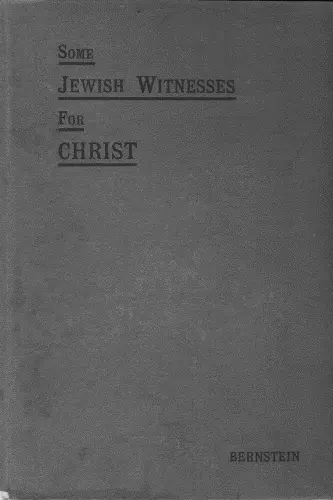
"Some Jewish Witnesses For Christ" by Aaron Bernstein is a historical account written in the early 20th century. The work explores the stories of Jewish individuals who have converted to Christianity throughout various periods, highlighting their contributions and the circumstances surrounding their faith transitions. The author seeks to validate these conversions and present a diverse range of notable figures who have embraced Christian beliefs, effectively showcasing the ongoing dialogue between Judaism and Christianity over centuries. The opening of the book begins with a preface that sets the tone for the discussion at hand, emphasizing the significance of documenting the lives of Jewish converts to Christianity, not only for historical purposes but also for influencing current religious dialogue. Bernstein indicates the broad scope of Jewish converts from the Apostolic age to contemporaneous times, hinting at the rich tapestry of experiences that will be detailed throughout the text. The introduction highlights the early history of Christian missions to the Jews and mentions the pivotal role of Jewish converts in the early Church. As the reader is ushered into the subsequent chapters, a detailed account of various periods and notable converts appears to promise an enlightening exploration of faith and identity.
Introduction adapted from the source catalogue; source summaries may be automatically generated.
Free to read · English · 137,079 words · No account needed
MAKE TIME FOR A GOOD BOOK
On by default. Untick to stop anonymous reading totals. Each page counts after 10 seconds in view. How this works.
Anonymous counting is on unless you have switched it off.
GOLDBERG, Dr. John Benjamin, was one of a number of rabbis and learned men, who were converted to Christianity in Jerusalem in the first half of the nineteenth century. He was baptized in Christ Church, Jerusalem by Nicolayson, in 1843. He had consequently to undergo much persecution and loss of property. In 1847 we find him as a preacher of the Gospel to his brethren in Cairo, and then, on account of illness; he was transferred to Salonica. In 1851 he was appointed as missionary at Constantinople, and from there he went, in 1860, to Smyrna. Goldberg was a most spiritually-minded and lovable man. His latter years he spent in England, and contributed to the "Hebrew Christian Witness," in 1874, two learned and very valuable and extensive articles on "The Language of Christ," and on "The Future Division of the Land of Israel."
GOLDBERG, Johann Peter, missionary to the Jews. We give the following extracts from his life and work, edited by his son-in-law, the Rev. J. A. Hausmeister:--
"It might appear strange that Goldberg should so soon give up his acquired profession and become a teacher; but the fact is, that, from his earliest years, he showed a disposition more for intellectual employment than for business, for the latter he never displayed any great talent. At the same time, he did not conceal his religious, or, rather, anti-Jewish tendencies, as he was always open and straightforward. These were in his case tolerated, because he was respected on account of his learning, and in a few years he was duly appointed as teacher of the whole Jewish community.
"Concerning his conversion, he, in his reminiscences, tells the story thus: 'On New Year's eve, 1803, I and several Jews went, out of curiosity, to the Hall, where the congregation of the Moravian brethren worshipped. Here, I heard, for the first time, of the birth, the destiny, the suffering, death, and the resurrection of our Saviour, and seized by a kind of foreboding feeling, my heart was filled with joy and happiness. Deeply touched, I left that sacred house with the resolve to visit it often, and the impressions of the love of God to men were so forcibly within me, that they also accompanied and refreshed me in my sleep. Yet, alas! this beneficial impression vanished soon, by reason of the implanted prejudices against Christianity, and of the unbelief which had already taken root in me, even in the Scriptures of the Old Testament. But since that night I felt, more and more, a disconsolate emptiness in my heart, though I continued, at a distance, from the way of life.' We hear here the knockings of God on the door of an erring heart, which refused to open itself. How often must the gracious God visit a man, now with love and then with affliction, before He can gain admittance into his soul. But a Jew has still more difficulties to contend against; for the prejudices against Christianity, which he imbibes from his youth, arise from the natural heart as soon as it has come under the influence of the truth. He has to contend not only against the enemy of unbelief, but also against the enemy of superstition, which bars his way in every direction. Though Goldberg was surrounded by various Christians at Neuwied, and came, sometimes, in contact with the Moravian brethren, yet many years passed before he submitted to the Word of God, and found the peace which the world can neither give nor take away. It is very telling for the character of Goldberg that he chose Neuwied for his home. With his former principal at Hamburg, he continued a friendly correspondence, and received from him repeated invitations to return to the situation, where every prospect for his advancement and happiness awaited him. But he was firm, and felt no matrimonial inclinations for the rich merchant's daughter, but rather chose for his partner the daughter of Solomon Rubens, the Jewish butcher at Neuwied. They were married in 1806, and she brought him something better than money--a true and loving heart; which helped him to carry his burden, and was ready with him to cast that burden upon the mighty shoulders of the Saviour, and to participate in his joy and peace. Nevertheless, many a rivulet flows into the Rhine, and the couple had to drink much of the bitter waters of Marah, before they tasted of the cup of salvation. I will only mention a few instances:--
Your reading position is saved on this browser. Take it to another device with a library code. Reading pages adapt to text, rather than matching a printed edition.
BEHIND THE BOOK
This eBook is for the use of anyone anywhere in the United States and most other parts of the world at no cost and with almost no restrictions whatsoever. You may copy it, give it away or re-use it under the terms of the Project Gutenberg License included with this eBook or online at www.gutenberg.org. If you are not located in the United States, you will have to check the laws of the country where you are located before using this eBook. Read the source licence.
The original source file, including credits and licence, is retained by this library. Request an original-format copy at no charge. Please include the book title and Project Gutenberg identifier #37734.
KEEP YOUR CURIOSITY GOING
Cécile Tormay

Moritz Busch
John L. Ransom
Frances Wright
Cécile Tormay

Mabel Potter Daggett