READ · DISCOVER · ENJOYClassic literature · Always free
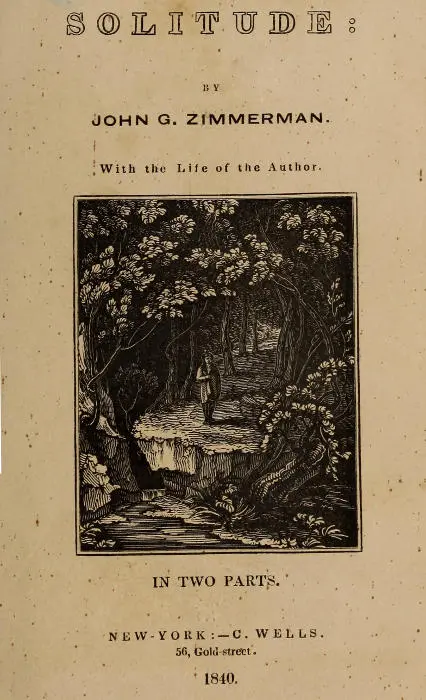
Solitude With the Life of the Author. In Two Parts — digital edition cover

THE CLASSIC COLLECTION · 1799

Solitude With the Life of the Author. In Two Parts

"Solitude" by Johann Georg Zimmermann is a philosophical treatise written in the late 18th century. This work explores the theme of solitude, emphasizing its impact on the human mind and heart while analyzing its benefits and drawbacks. Zimmermann aims to enlighten readers on how occasional retirement can foster happiness, intellectual clarity, and a deeper understanding of oneself and society. At the start of the book, Zimmerman introduces the concept of solitude as an intellectual state where the mind retreats into self-reflection, asserting that true solitude can exist even amidst social gatherings. He observes that modern society often undervalues solitude, mistaking it for misery or isolation, while arguing that it is essential for genuine happiness and intellectual growth. The opening chapters set the stage for a detailed exploration of solitude's influences on human emotions, well-being, and the creative mind, positioning it as a powerful means to achieve true felicity.

Introduction adapted from the source catalogue; source summaries may be automatically generated.

Start reading ↓

Free to read · English · 115,833 words · No account needed

MAKE TIME FOR A GOOD BOOK

Solitude With the Life of the Author. In Two Parts

On by default. Untick to stop anonymous reading totals. Each page counts after 10 seconds in view. How this works.

Anonymous counting is on unless you have switched it off.

Solitude With the Life of the Author. In Two Parts

The Alps in Swisserland are inhabited by a race of men sometimes unsocial, but always good and generous. The hardy and robust characters given to them by the severity of their climate, is softened by pastoral life. It is said by an English writer, that he who has never heard a storm in the Alps, can form no idea of the continuity of the lightning, the rolling and the burst of the thunder which roars round the horizon of these immense mountains; and the people never enjoying better habitations than their own cabins, nor seeing any other country than their own rocks, believe the universe to be an unfinished work, and a scene of unceasing tempest. But the skies do not always lower; the thunder does not incessantly roll, nor the lightnings continually flash; immediately after the most dreadful tempests, the hemisphere clears itself by slow degrees, and becomes serene. The dispositions of the Swiss follow the nature of their climate; kindness succeeds to violence, and generosity to the most brutal fury: this may be easily proved, not only from the records of history, but from recent facts.

General Redin, an inhabitant of the Alps, and a native of the canton of Schwitz, enlisted very early in life into the Swiss Guards, and attained the rank of lieutenant-general in that corps. His long residence at Paris and Versailles, however, had not been able to change his character; he still continued a true Swiss. The new regulation made by the king of France, in the year 1764, relating to this corps, gave great discontent to the canton of Schwitz. The citizens, considering it as an innovation extremely prejudicial to their ancient privileges, threw all the odium of the measures on the lieutenant-general, whose wife, at this period, resided on his estate in the canton, where she endeavored to raise a number of young recruits; but the sound of the French drum had become so disgusting to the ears of the citizens, that they beheld with indignation the white cockade placed in the hats of the deluded peasants. The magistrate apprehensive that this ferment might ultimately cause an insurrection among the people, felt it his duty to forbid madame de Redin to continue her levies. The lady requested he would certify his prohibition in writing; but the magistrate not being disposed to carry matters to this extremity against the court of France, she continued to beat up for the requested number of recruits. The inhabitants of the canton, irritated by this bold defiance of the prohibition, summoned a General Diet, and madame de Redin appeared before the Assembly of Four Thousand. “The drum,” said she, “shall never cease to sound, until you give me such a certificate as may justify my husband to the French court for not completing the number of his men.” The Assembly accordingly granted her the required certificate, and enjoining her to procure the interest and interposition of her husband with the court in favor of her injured country, waited in anxious expectation that his negotiation would produce a favorable issue. Unhappily the court of Versailles rejected all solicitation on the subject, and by this means drove the irritated and impatient inhabitants beyond the bounds of restraint. The leading men of the canton pretended that the new regulation endangered not only their civil liberties, but, what was dearer to them, their religion. The general discontent was at length fomented into popular fury. A General Diet was again assembled, and it was publicly resolved not to furnish the King of France in future with any troops. The treaty of alliance concluded in the year 1713 was torn from the public register, and general de Redin ordered instantly to return from France with the soldiers under his command, upon pain, if he refused, of being irrevocably banished from the republic. The obedient general obtained permission from the king to depart with his regiment from France, and entering Schwitz, the metropolis of the canton, at the head of his troops, with drums beating and colors flying, marched immediately to the church, where he deposited his standards upon the great altar, and falling on his knees, offered up his thanks to God. Rising from the ground, and turning to his affectionate soldiers, who were dissolved in tears, he discharged their arrears of pay, gave them their uniforms and accoutrements, and bid them forever farewell. The fury of the populace, on perceiving within their power the man whom the whole country considered as the perfidious abettor, and traitorous adviser, of the new regulation, by which the court of Versailles had given such a mortal blow to the liberties of the country, greatly increased; and he was ordered to disclose before the General Assembly the origin of that measure, and the means by which it had been carried on, in order that they might learn their relative situation with France, and ascertain the degree of punishment that was due to the offender. Redin, conscious that, under the existing circumstances, eloquence would make no impression on minds so prejudiced against him, contented himself with coolly declaring, in a few words, that the cause of framing a new regulation was publicly known, and that he was as innocent upon the subject as he was ignorant of the cause of his dismission. “The traitor then will not confess!” exclaimed one of the most furious members: “Hang him on the next tree--cut him to pieces.” These menaces were instantly repeated throughout the Assembly; and while the injured soldier continued perfectly tranquil and undismayed, a party of the people, more daring than the rest, jumped upon the tribune, where he stood surrounded by the judges. A young man, his godson, was holding a parapluie over his head, to shelter him from the rain, which at this moment poured down in incessant torrents, when one of the enraged multitude immediately broke the parapluie in pieces with his stick, exclaiming, “Let the traitor be uncovered!” This exclamation conveyed a correspondent indignation into the bosom of the youth, who instantly replied, “My god-father a betrayer of his country! Oh! I was ignorant, I assure you, of the crime alleged against him; but since it is so, let him perish! Where is the rope? I will be first to put it round the traitor’s neck!” The magistrates instantly formed a circle round the general, and with uplifted hands exhorted him to avert the impending danger, by confessing that he had not opposed the measures of France with sufficient zeal, and to offer to the offended people his whole fortune as an atonement for his neglect; representing to him that these were the only means of redeeming his liberty, and perhaps his life. The undaunted soldier, with perfect tranquillity and composure, walked through the surrounding circle to the side of the tribune, and while the whole Assembly anxiously expected to hear an ample confession of his guilt, made a sign of silence with his hand: “Fellow-citizens,” said he, “you are not ignorant that I have been two-and-forty years in the French establishment. You know, and many among you, who were with me in the service, can testify its truth, how often I have faced the enemy, and the manner in which I conducted myself in battle. I considered every engagement as the last day of my life. But here I protest to you, in the presence of that Almighty Being who knows all our hearts, who listens to all our words, and who will hereafter judge all our actions, that I never appeared before an enemy with a mind more pure, a conscience more tranquil, a heart more innocent, than at present I possess; and if it is your pleasure to condemn me because I refuse to confess a treachery of which I have not been guilty, I am now ready to resign my life into your hands.” The dignified demeanor with which the general made this declaration, and the air of truth which accompanied his words, calmed the fury of the Assembly, and saved his life. Both he and his wife, however, immediately quitted the canton; she entering into a convent at Uri, and he retiring to a cavern among the rocks, where he lived two years in solitude. Time, at length, subdued the anger of the people, and softened the general’s sense of their injustice. He returned to the bosom of his country, rewarded its ingratitude by the most signal services, and made every individual recollect and acknowledge the integrity of their magnanimous countryman. To recompense him for the injuries and injustice he had suffered, they elected him bailli, or chief officer of the canton; and afforded him an almost singular instance of their constancy and affection, by successively conferring on him three times this high and important dignity. This is the characteristic disposition of the Swiss who inhabit the Alps; alternately violent and mild: and experiencing, as the extremes of a delighted or vexed imagination happen to prevail, the same vicissitudes as their climate. The rude scenes of greatness which these stupendous mountains and vast deserts afford, render the Swiss violent in sentiment, and rough in manners; while the tranquillity of their fields, and the smiling beauties of their vallies, soften their minds, and render their hearts kind and benevolent.

Your reading position is saved on this browser. Take it to another device with a library code. Reading pages adapt to text, rather than matching a printed edition.

BEHIND THE WORDS

About Johann Georg Zimmermann

Johann Georg Zimmermann (1728–1795). Explore Solitude With the Life of the Author. In Two Parts in this collection. These books span philosophy.

Explore this author’s books →

THE READERS’ VERDICT

How did this story stay with you?

Not rated yet
Your rating for Solitude With the Life of the Author. In Two Parts

Be the first to share your verdict.

One rating per browser, which you can change or remove. A necessary browser identifier remembers your vote. How ratings work

A GOOD STORY DESERVES COMPANY

Pass this book along.

A great read is even better when it’s shared.

SEND A LITTLE INSPIRATION

Share this book

BEHIND THE BOOK

Edition & source details.

Title
Solitude With the Life of the Author. In Two Parts
Author
Johann Georg Zimmermann
First publication (Open Library catalogue match)
1799
Digital edition publisher
Project Gutenberg
Gutenberg release date
2017-11-07
Language
English
Source edition imprint
Not stated in source catalogue
Source identifier
Project Gutenberg #55898
Contributors
No additional named contributors in source metadata

Public-domain source & licence

This eBook is for the use of anyone anywhere in the United States and most other parts of the world at no cost and with almost no restrictions whatsoever. You may copy it, give it away or re-use it under the terms of the Project Gutenberg License included with this eBook or online at www.gutenberg.org. If you are not located in the United States, you will have to check the laws of the country where you are located before using this eBook. Read the source licence.

Full source licence and obtaining an original copy

The original source file, including credits and licence, is retained by this library. Request an original-format copy at no charge. Please include the book title and Project Gutenberg identifier #55898.

the full Project Gutenberg License must appear
prominently whenever any copy of a Project Gutenberg work (any work
on which the phrase “Project Gutenberg” appears, or with which the
phrase “Project Gutenberg” is associated) is accessed, displayed,
performed, viewed, copied or distributed:

This eBook is for the use of anyone anywhere in the United States and most
other parts of the world at no cost and with almost no restrictions
whatsoever. You may copy it, give it away or re-use it under the terms
of the Project Gutenberg™ License included with this eBook or online
at www.gutenberg.org. If you
are not located in the United States, you will have to check the laws
of the country where you are located before using this eBook.

1.E.2. If an individual Project Gutenberg electronic work is
derived from texts not protected by U.S. copyright law (does not
contain a notice indicating that it is posted with permission of the
copyright holder), the work can be copied and distributed to anyone in
the United States without paying any fees or charges. If you are
redistributing or providing access to a work with the phrase “Project
Gutenberg” associated with or appearing on the work, you must comply
either with the requirements of paragraphs 1.E.1 through 1.E.7 or
obtain permission for the use of the work and the Project Gutenberg
trademark as set forth in paragraphs 1.E.8 or 1.E.9.

1.E.3. If an individual Project Gutenberg electronic work is posted
with the permission of the copyright holder, your use and distribution
must comply with both paragraphs 1.E.1 through 1.E.7 and any
additional terms imposed by the copyright holder. Additional terms
will be linked to the Project Gutenberg License for all works
posted with the permission of the copyright holder found at the
beginning of this work.

1.E.4. Do not unlink or detach or remove the full Project Gutenberg
License terms from this work, or any files containing a part of this
work or any other work associated with Project Gutenberg.

1.E.5. Do not copy, display, perform, distribute or redistribute this
electronic work, or any part of this electronic work, without
prominently displaying the sentence set forth in paragraph 1.E.1 with
active links or immediate access to the full terms of the Project
Gutenberg License.

1.E.6. You may convert to and distribute this work in any binary,
compressed, marked up, nonproprietary or proprietary form, including
any word processing or hypertext form. However, if you provide access
to or distribute copies of a Project Gutenberg work in a format
other than “Plain Vanilla ASCII” or other format used in the official
version posted on the official Project Gutenberg website
(www.gutenberg.org), you must, at no additional cost, fee or expense
to the user, provide a copy, a means of exporting a copy, or a means
of obtaining a copy upon request, of the work in its original “Plain
Vanilla ASCII” or other form. Any alternate format must include the
full Project Gutenberg License as specified in paragraph 1.E.1.

1.E.7. Do not charge a fee for access to, viewing, displaying,
performing, copying or distributing any Project Gutenberg works
unless you comply with paragraph 1.E.8 or 1.E.9.

1.E.8. You may charge a reasonable fee for copies of or providing
access to or distributing Project Gutenberg electronic works
provided that:

• You pay a royalty fee of 20% of the gross profits you derive from
the use of Project Gutenberg works calculated using the method
you already use to calculate your applicable taxes. The fee is owed
to the owner of the Project Gutenberg trademark, but he has
agreed to donate royalties under this paragraph to the Project
Gutenberg Literary Archive Foundation. Royalty payments must be paid
within 60 days following each date on which you prepare (or are
legally required to prepare) your periodic tax returns. Royalty
payments should be clearly marked as such and sent to the Project
Gutenberg Literary Archive Foundation at the address specified in
Section 4, “Information about donations to the Project Gutenberg
Literary Archive Foundation.”

• You provide a full refund of any money paid by a user who notifies
you in writing (or by e-mail) within 30 days of receipt that s/he
does not agree to the terms of the full Project Gutenberg™
License. You must require such a user to return or destroy all
copies of the works possessed in a physical medium and discontinue
all use of and all access to other copies of Project Gutenberg™
works.

• You provide, in accordance with paragraph 1.F.3, a full refund of
any money paid for a work or a replacement copy, if a defect in the
electronic work is discovered and reported to you within 90 days of
receipt of the work.

• You comply with all other terms of this agreement for free
distribution of Project Gutenberg™ works.


1.E.9. If you wish to charge a fee or distribute a Project
Gutenberg™ electronic work or group of works on different terms than
are set forth in this agreement, you must obtain permission in writing
from the Project Gutenberg Literary Archive Foundation, the manager of
the Project Gutenberg™ trademark. Contact the Foundation as set
forth in Section 3 below.

1.F.

1.F.1. Project Gutenberg volunteers and employees expend considerable
effort to identify, do copyright research on, transcribe and proofread
works not protected by U.S. copyright law in creating the Project
Gutenberg™ collection. Despite these efforts, Project Gutenberg™
electronic works, and the medium on which they may be stored, may
contain “Defects,” such as, but not limited to, incomplete, inaccurate
or corrupt data, transcription errors, a copyright or other
intellectual property infringement, a defective or damaged disk or
other medium, a computer virus, or computer codes that damage or
cannot be read by your equipment.

1.F.2. LIMITED WARRANTY, DISCLAIMER OF DAMAGES - Except for the “Right
of Replacement or Refund” described in paragraph 1.F.3, the Project
Gutenberg Literary Archive Foundation, the owner of the Project
Gutenberg™ trademark, and any other party distributing a Project
Gutenberg™ electronic work under this agreement, disclaim all
liability to you for damages, costs and expenses, including legal
fees. YOU AGREE THAT YOU HAVE NO REMEDIES FOR NEGLIGENCE, STRICT
LIABILITY, BREACH OF WARRANTY OR BREACH OF CONTRACT EXCEPT THOSE
PROVIDED IN PARAGRAPH 1.F.3. YOU AGREE THAT THE FOUNDATION, THE
TRADEMARK OWNER, AND ANY DISTRIBUTOR UNDER THIS AGREEMENT WILL NOT BE
LIABLE TO YOU FOR ACTUAL, DIRECT, INDIRECT, CONSEQUENTIAL, PUNITIVE OR
INCIDENTAL DAMAGES EVEN IF YOU GIVE NOTICE OF THE POSSIBILITY OF SUCH
DAMAGE.

1.F.3. LIMITED RIGHT OF REPLACEMENT OR REFUND - If you discover a
defect in this electronic work within 90 days of receiving it, you can
receive a refund of the money (if any) you paid for it by sending a
written explanation to the person you received the work from. If you
received the work on a physical medium, you must return the medium
with your written explanation. The person or entity that provided you
with the defective work may elect to provide a replacement copy in
lieu of a refund. If you received the work electronically, the person
or entity providing it to you may choose to give you a second
opportunity to receive the work electronically in lieu of a refund. If
the second copy is also defective, you may demand a refund in writing
without further opportunities to fix the problem.

1.F.4. Except for the limited right of replacement or refund set forth
in paragraph 1.F.3, this work is provided to you ‘AS-IS’, WITH NO
OTHER WARRANTIES OF ANY KIND, EXPRESS OR IMPLIED, INCLUDING BUT NOT
LIMITED TO WARRANTIES OF MERCHANTABILITY OR FITNESS FOR ANY PURPOSE.

1.F.5. Some states do not allow disclaimers of certain implied
warranties or the exclusion or limitation of certain types of
damages. If any disclaimer or limitation set forth in this agreement
violates the law of the state applicable to this agreement, the
agreement shall be interpreted to make the maximum disclaimer or
limitation permitted by the applicable state law. The invalidity or
unenforceability of any provision of this agreement shall not void the
remaining provisions.

1.F.6. INDEMNITY - You agree to indemnify and hold the Foundation, the
trademark owner, any agent or employee of the Foundation, anyone
providing copies of Project Gutenberg™ electronic works in
accordance with this agreement, and any volunteers associated with the
production, promotion and distribution of Project Gutenberg™
electronic works, harmless from all liability, costs and expenses,
including legal fees, that arise directly or indirectly from any of
the following which you do or cause to occur: (a) distribution of this
or any Project Gutenberg work, (b) alteration, modification, or
additions or deletions to any Project Gutenberg work, and (c) any
Defect you cause.

Section 2. Information about the Mission of Project Gutenberg

Project Gutenberg is synonymous with the free distribution of
electronic works in formats readable by the widest variety of
computers including obsolete, old, middle-aged and new computers. It
exists because of the efforts of hundreds of volunteers and donations
from people in all walks of life.

Volunteers and financial support to provide volunteers with the
assistance they need are critical to reaching Project Gutenberg’s
goals and ensuring that the Project Gutenberg collection will
remain freely available for generations to come. In 2001, the Project
Gutenberg Literary Archive Foundation was created to provide a secure
and permanent future for Project Gutenberg and future
generations. To learn more about the Project Gutenberg Literary
Archive Foundation and how your efforts and donations can help, see
Sections 3 and 4 and the Foundation information page at www.gutenberg.org.

Section 3. Information about the Project Gutenberg Literary Archive Foundation

The Project Gutenberg Literary Archive Foundation is a non-profit
501(c)(3) educational corporation organized under the laws of the
state of Mississippi and granted tax exempt status by the Internal
Revenue Service. The Foundation’s EIN or federal tax identification
number is 64-6221541. Contributions to the Project Gutenberg Literary
Archive Foundation are tax deductible to the full extent permitted by
U.S. federal laws and your state’s laws.

The Foundation’s business office is located at 41 Watchung Plaza #516,
Montclair NJ 07042, USA, +1 (862) 621-9288. Email contact links and up
to date contact information can be found at the Foundation’s website
and official page at www.gutenberg.org/contact

Section 4. Information about Donations to the Project Gutenberg
Literary Archive Foundation

Project Gutenberg™ depends upon and cannot survive without widespread
public support and donations to carry out its mission of
increasing the number of public domain and licensed works that can be
freely distributed in machine-readable form accessible by the widest
array of equipment including outdated equipment. Many small donations
($1 to $5,000) are particularly important to maintaining tax exempt
status with the IRS.

The Foundation is committed to complying with the laws regulating
charities and charitable donations in all 50 states of the United
States. Compliance requirements are not uniform and it takes a
considerable effort, much paperwork and many fees to meet and keep up
with these requirements. We do not solicit donations in locations
where we have not received written confirmation of compliance. To SEND
DONATIONS or determine the status of compliance for any particular state
visit www.gutenberg.org/donate.

While we cannot and do not solicit contributions from states where we
have not met the solicitation requirements, we know of no prohibition
against accepting unsolicited donations from donors in such states who
approach us with offers to donate.

International donations are gratefully accepted, but we cannot make
any statements concerning tax treatment of donations received from
outside the United States. U.S. laws alone swamp our small staff.

Please check the Project Gutenberg web pages for current donation
methods and addresses. Donations are accepted in a number of other
ways including checks, online payments and credit card donations. To
donate, please visit: www.gutenberg.org/donate.

Section 5. General Information About Project Gutenberg electronic works

Professor Michael S. Hart was the originator of the Project
Gutenberg concept of a library of electronic works that could be
freely shared with anyone. For forty years, he produced and
distributed Project Gutenberg eBooks with only a loose network of
volunteer support.

Project Gutenberg eBooks are often created from several printed
editions, all of which are confirmed as not protected by copyright in
the U.S. unless a copyright notice is included. Thus, we do not
necessarily keep eBooks in compliance with any particular paper
edition.

Most people start at our website which has the main PG search
facility: www.gutenberg.org.

This website includes information about Project Gutenberg,
including how to make donations to the Project Gutenberg Literary
Archive Foundation, how to help produce our new eBooks, and how to
subscribe to our email newsletter to hear about new eBooks.


KEEP YOUR CURIOSITY GOING

Your next chapter awaits.

Your privacy choices

Reading is always free. You can change these settings at any time.

Book banners link to our books on simonward.net. They do not use advertising cookies or tracking.

Privacy & cookie policy · Reading data and privacy controls