
Last letters from the living dead man
David Patterson (Spirit) Hatch
THE CLASSIC COLLECTION · 1799
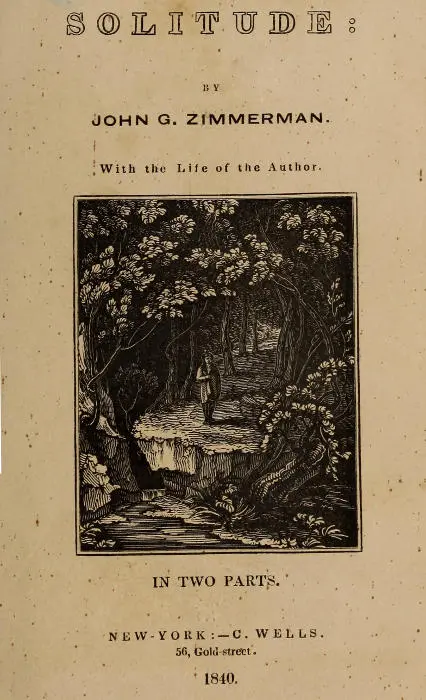
"Solitude" by Johann Georg Zimmermann is a philosophical treatise written in the late 18th century. This work explores the theme of solitude, emphasizing its impact on the human mind and heart while analyzing its benefits and drawbacks. Zimmermann aims to enlighten readers on how occasional retirement can foster happiness, intellectual clarity, and a deeper understanding of oneself and society. At the start of the book, Zimmerman introduces the concept of solitude as an intellectual state where the mind retreats into self-reflection, asserting that true solitude can exist even amidst social gatherings. He observes that modern society often undervalues solitude, mistaking it for misery or isolation, while arguing that it is essential for genuine happiness and intellectual growth. The opening chapters set the stage for a detailed exploration of solitude's influences on human emotions, well-being, and the creative mind, positioning it as a powerful means to achieve true felicity.
Introduction adapted from the source catalogue; source summaries may be automatically generated.
Free to read · English · 115,833 words · No account needed
MAKE TIME FOR A GOOD BOOK
On by default. Untick to stop anonymous reading totals. Each page counts after 10 seconds in view. How this works.
Anonymous counting is on unless you have switched it off.
Solitude not only creates simplicity of manners, but prepares and strengthens the faculties for the toils of busy life. Fostered in the bosom of retirement, the mind becomes more active in the world and its concerns, and retires again into tranquillity to repose itself, and prepare for new conflicts. Pericles, Phocion, and Epaminondas, laid the foundation of all their greatness in solitude, and acquired there rudiments, which all the language of the schools cannot teach--the rudiments of their future lives and actions. Pericles, while preparing his mind for any important object, never appeared in public, but immediately refrained from feasting, assemblies, and every species of entertainment; and during the whole time that he administered the affairs of the republic, he only went once to sup with a friend, and left him at an early hour. Phocion immediately resigned himself to the study of philosophy: not from the ostentatious motive of being called a wise man, but to enable himself to conduct the business of the state with greater resolution and effect. Epaminondas, who had passed his whole life in the delights of literature, and in the improvement of his mind, astonished the Thebans by the military skill and dexterity which he all at once displayed at the battles of Mantinea and Leuctra, in the first of which he rescued his friend Pelopidas: but it was owing to the frugal use he made of his time, to the attention with which he devoted his mind to every pursuit he adopted, and to that solitude which his relinquishment of every public employment afforded him. His countrymen, however, forced him to abandon his retreat, gave him the absolute command of the army; and by his military skill, he saved the republic.
Petrarch, also a character I never contemplate but with increasing sensibility, formed his mind, and rendered it capable of transacting the most complicated political affairs, by the habit he acquired in solitude. He was, indeed, what persons frequently become in solitude, choleric, satirical, and petulant: and has been severely reproached with having drawn the manners of his age with too harsh and sombrous a pencil, particularly the scenes of infamy which were transacted at the court of Avignon, under the pontificate of Clement VI.; but he was a perfect master of the human heart, knew how to manage the passions with uncommon dexterity, and to turn them directly to his purposes. The abbe de Sades, the best historian of his life, says, “he is scarcely known, except as a tender and elegant poet, who loved with ardor, and sung, in all the harmony of verse, the charms of his mistress.” But was this in reality the whole of his character?--Certainly not. Literature, long buried in the ruins of barbarity, owes the highest obligations to his pen; he rescued some of the finest works of antiquity from dust and rottenness; and many of those precious treasures of learning, which have since contributed to delight and instruct mankind, were discovered by his industry, corrected by his learning and sagacity, and multiplied in accurate copies at his expense. He was the great restorer of elegant writing and true taste; and by his own compositions, equal to any that ancient Rome, previous to its subjugation, produced, purified the public mind, reformed the manners of the age, and extirpated the prejudices of the times. Pursuing his studies with unremitting firmness to the hour of his death, his last work surpassed all that had preceded it. But he was not only a tender lover, an elegant poet, and a correct and classical historian, but an able statesman also, to whom the most celebrated sovereigns of his age confided every difficult negotiation, and consulted in their most important concerns. He possessed, in the fourteenth century, a degree of fame, credit, and influence, which no man of the present day, however learned, has ever acquired. Three popes, an emperor, a sovereign of France, a king of Naples, a crowd of cardinals, the greatest princes, and the most illustrious nobility of Italy, cultivated his friendship, and solicited his correspondence. In the several capacities of statesman, minister, and ambassador, he was employed in transacting the greatest affairs, and by that means was enabled to acquire and disclose the most useful and important truths. These high advantages he owed entirely to solitude, with the nature of which as he was better acquainted than any other person, so he cherished it with greater fondness, and resounded its praise with higher energy; and at length preferred his leisure and liberty to all the enjoyments of the world. Love, to which he had consecrated the prime of life, appeared, indeed, for a long time, to enervate his mind; but suddenly abandoning the soft and effeminate style in which he breathed his sighs at Laura’s feet, he addressed kings, emperors, and popes, with manly boldness, and with that confidence which splendid talents and a high reputation always inspires. In an elegant oration, worthy of Demosthenes and Cicero, he endeavored to compose the jarring interests of Italy; and exhorted the contending powers to destroy with their confederated arms, the barbarians, those common enemies of their country, who were ravaging its very bosom, and preying on its vitals. The enterprises of Rienzi, who seemed like an agent sent from heaven to restore the decayed metropolis of the Roman empire to its former splendor, were suggested, encouraged, directed, and supported by his abilities. A timid emperor was roused by his eloquence to invade Italy, and induced to seize upon the reins of government, as successor to the Cesars. The pope, by his advice, removed the holy chair, which had been transported to the borders of the Rhine, and replaced it on the banks of the Tiber; and at a moment even when he confessed, in one of his letters, that his mind was distracted with vexation, his heart torn with love, and his whole soul disgusted with men and measures. Pope Clement VI, confided to his negotiation an affair of great difficulty at the court of Naples, in which he succeeded to the highest satisfaction of his employer. His residence at courts, indeed, had rendered him ambitious, busy, and enterprising; and he candidly acknowledged, that he felt a pleasure on perceiving a hermit, accustomed to dwell only in woods, and to saunter over plains, running through the magnificent palaces of cardinals with a crowd of courtiers in his suite. When John Visconti, archbishop and prince of Milan, and sovereign of Lombardy, who united the finest talents with ambition so insatiable, that it threatened to swallow up all Italy, had the happiness to fix Petrarch in his interests, by inducing him to accept of a seat in his council, the friends of the philosopher whispered one among another, “This stern republican who breathed no sentiments but those of liberty and independence; this untamed bull, who roared so loud at the slightest shadow of the yoke; who could endure no fetters but those of love, and who even felt those too heavy: who has refused the first offices at the court of Rome, because he disdained to wear golden chains; has at length submitted to be shackled by the tyrant of Italy; and this great apostle of solitude, who could no longer live except in the tranquillity of the groves, now contentedly resides amidst the tumults of Milan.” “My friends,” replied Petrarch, “have reason to arraign my conduct. Man has not a greater enemy than himself. I acted against my taste and inclination. Alas! through the whole course of our lives, we do those things which we ought not to have done, and leave undone what most we wish to do.” But Petrarch might have told his friends, “I was willing to convince you how much a mind, long exercised in solitude, can perform when engaged in the business of the world; how much a previous retirement enables a man to transact the affairs of public life with ease, firmness, dignity and effect.”
Your reading position is saved on this browser. Take it to another device with a library code. Reading pages adapt to text, rather than matching a printed edition.
BEHIND THE BOOK
This eBook is for the use of anyone anywhere in the United States and most other parts of the world at no cost and with almost no restrictions whatsoever. You may copy it, give it away or re-use it under the terms of the Project Gutenberg License included with this eBook or online at www.gutenberg.org. If you are not located in the United States, you will have to check the laws of the country where you are located before using this eBook. Read the source licence.
The original source file, including credits and licence, is retained by this library. Request an original-format copy at no charge. Please include the book title and Project Gutenberg identifier #55898.
KEEP YOUR CURIOSITY GOING
David Patterson (Spirit) Hatch
Coulson Kernahan

Ralph Waldo Emerson
Frances Wright

Edwin Abbott Abbott

Joseph Droz