
Last letters from the living dead man
David Patterson (Spirit) Hatch
THE CLASSIC COLLECTION · 1799
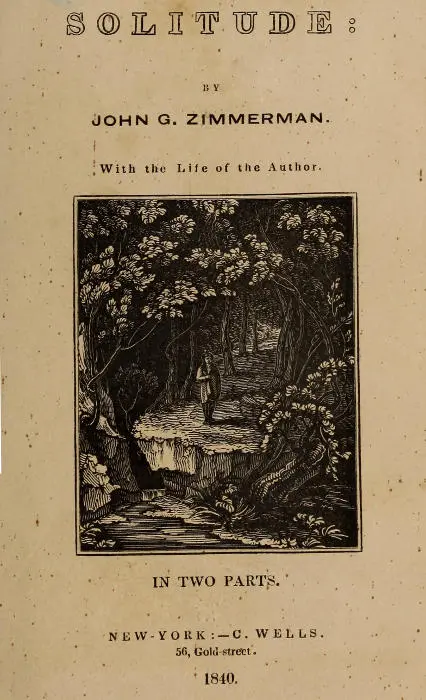
"Solitude" by Johann Georg Zimmermann is a philosophical treatise written in the late 18th century. This work explores the theme of solitude, emphasizing its impact on the human mind and heart while analyzing its benefits and drawbacks. Zimmermann aims to enlighten readers on how occasional retirement can foster happiness, intellectual clarity, and a deeper understanding of oneself and society. At the start of the book, Zimmerman introduces the concept of solitude as an intellectual state where the mind retreats into self-reflection, asserting that true solitude can exist even amidst social gatherings. He observes that modern society often undervalues solitude, mistaking it for misery or isolation, while arguing that it is essential for genuine happiness and intellectual growth. The opening chapters set the stage for a detailed exploration of solitude's influences on human emotions, well-being, and the creative mind, positioning it as a powerful means to achieve true felicity.
Introduction adapted from the source catalogue; source summaries may be automatically generated.
Free to read · English · 115,833 words · No account needed
MAKE TIME FOR A GOOD BOOK
On by default. Untick to stop anonymous reading totals. Each page counts after 10 seconds in view. How this works.
Anonymous counting is on unless you have switched it off.
It is said, by a celebrated German writer, in a poetical personification of solitude, that she holds in one hand a cup of bliss, in which she presents unceasing sweets to the lips of the happy; and in the other grasps an envenomed dagger, which she plants with increasing tortures in the bosom of the wretched; but this must be considered as the language of the muse, and mere flight of poetic fancy; except, indeed, so far as it tends to enforce the idea, that virtue will always be happy, and vice forever miserable; for retirement, while it pours the balm of comfort into the aching bosom of the unfortunate, and offers a cordial, cheering as nectar, to the drooping spirits of the wise and virtuous, only operates as a corrosive, agonizing poison, on the constitutions of the weak and vicious.
It is a gross mistake, to suppose that the pleasures of social life are incompatible with the benefits to be derived from solitude. They may not only be intermingled with, but made mutually to aid and augment each other. Solitude may surely be enjoyed without undergoing an exile from the world; and society may be freely mixed with, without absolutely renouncing the pleasures of retirement. The circumstances of life, indeed, call loudly on every mind to interchange the pursuits of activity and scenes of quietude and repose. The alliance of solitude and society is necessary to the perfection not only of the intellectual character, but to the corporeal constitution of man. To conclude that the duties of life must necessarily be neglected by devoting a portion of our time to solitude, is much more erroneous than to conclude that those duties are not always fulfilled amidst the pleasures or business of society.
Daily observation proves most clearly, that many of the charms, and some of the benefits, of rural retreat, may be enjoyed without retiring to any very considerable distance from the metropolis, the seat of social joys and interested activity. Petrarch, during his residence in the city of Parma, though extremely flattered by the friendship shown him, was glad to steal from public life as often as he could, and to indulge the high delight he naturally felt in wandering through the fields and woods which surrounded the metropolis. One day, led by his love of exercise, he passed the river of Lenza, which is three miles from Parma, and found himself in the territory of Rhegio, in a forest which is called Sylva Plana, or Low Wood: though it is situated upon a hill, from whence are discovered the Alps, and all Cisalpine Gaul. Aged oaks, whose heads seemed to touch the clouds, sheltered the avenues of the forest from the rays of the sun: while the fresh breezes which descended from the neighboring mountains, and the little rivulets which brawled along its skirts, tempered the meridian heats of the day, and preserved to the earth, even in the greatest droughts, a soft verdure, enamelled with the finest flowers. Birds of every kind warbled forth their rural songs from the thick coverts, while deer, and every animal of the chase, sported through the purlieus. In the middle of this beautiful forest nature had formed a romantic theatre, which, from its enchanting decorations, she seemed to have designed for the residence of the muses. The charms of this delightful retreat struck the mind of Petrarch with a sort of inspiration, and revived so strongly his original taste for solitude that on his return to Parma, he endeavored to procure some spot near the environs of the city, to which he might occasionally retire from the fatigues of his archdeaconry, and indulge his mind in the blessings of innocence, and the delights of rural repose. The industry of his inquiries soon furnished him with a small cottage, exactly suited to his wishes, situated at the end of the city, near the abbey of St. Anthony. To this place he fondly and frequently retired, whenever he could escape from the duties of his church, and the invitations of his friends. The superiority of his talents had at this time attracted the attention and applause of mankind; and his engaging manners secured to him the respect and esteem of the nobles of Parma, who besieged him with the most friendly and flattering importunities to partake of their daily parties of pleasure. Petrarch, however, had formed notions of happiness very foreign to those which result from the society of luxurious lords or fashionable females, to whom, in general poetry afforded no delight, nor philosophy instruction; and the companions to whom he could afford neither amusement nor information, were not likely to afford him much satisfaction. The quiet and simple pleasures of retirement were more delightful to his mind than all the elegances and splendors of Parma; but this partiality to retirement did not induce him to renounce the rational society which a few select friends, with whom he had closely connected himself, was occasionally capable of affording him. “So conveniently,” says he, “is this delightful cottage situated, that I enjoy all the advantages of rural retirement, and yet retain within my reach all the pleasures with which this gay and elegant city abounds. The society of a few select friends recreates my mind whenever it is distracted by the anxieties of study, or stagnated by the stilness of solitude; and when I am satiated with the pleasures of the town, I fly with rapture to the sweet repose, and to all the interesting and endearing occupations of this charming retreat. Oh! may the kindness of fortune long indulge me in the enjoyment of this neutral state; this happy alternation of rural tranquillity and convivial solace! a state of felicity to which neither the anchorites of Egypt, nor the philosophers of Greece, ever attained. In this humble abode, let me quietly pass the remainder of my days, unseduced by the charms of greatness, and uninterrupted by the pleasures of the world. Fly, all ye vain delusions and fantastic dreams, from this cottage of content, and seek your native territories, the palaces of princes, and the altars of ambition!” The voice of wisdom and virtue calls aloud on every man to adopt the scheme of happiness which Petrarch so successfully practised. By thus dividing our time between the busy cares and innocent amusements of public life, and the studious and tranquil pleasures of retirement, between the gay pursuits of personal gratifications, and the more noble and elevated exercises of intellect, we may avoid the dangers of contracting, on the one hand, a passion for light and frivolous dissipation, and on the other a joyless disposition to misanthropic severity; and may shun the most, if not all the evil consequences which either solitude or society is capable of producing, which when indulged irrationally, or indiscreetly, in general prove the Scylla or Charybdis of our lives.
Your reading position is saved on this browser. Take it to another device with a library code. Reading pages adapt to text, rather than matching a printed edition.
BEHIND THE BOOK
This eBook is for the use of anyone anywhere in the United States and most other parts of the world at no cost and with almost no restrictions whatsoever. You may copy it, give it away or re-use it under the terms of the Project Gutenberg License included with this eBook or online at www.gutenberg.org. If you are not located in the United States, you will have to check the laws of the country where you are located before using this eBook. Read the source licence.
The original source file, including credits and licence, is retained by this library. Request an original-format copy at no charge. Please include the book title and Project Gutenberg identifier #55898.
KEEP YOUR CURIOSITY GOING
David Patterson (Spirit) Hatch
Coulson Kernahan

Ralph Waldo Emerson
Frances Wright

Edwin Abbott Abbott

Joseph Droz