
Last letters from the living dead man
David Patterson (Spirit) Hatch
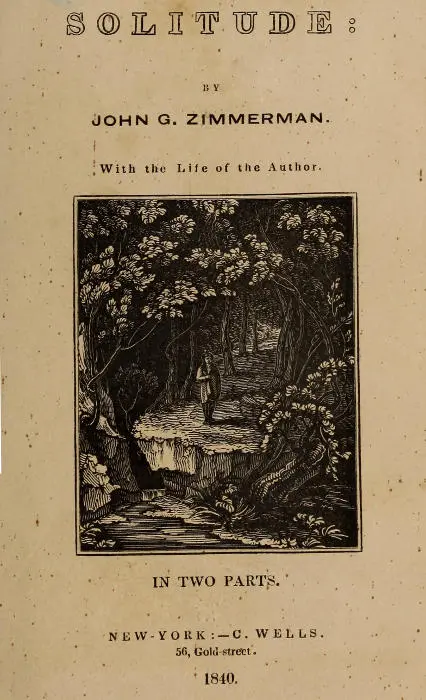
THE CLASSIC COLLECTION · 1799
"Solitude" by Johann Georg Zimmermann is a philosophical treatise written in the late 18th century. This work explores the theme of solitude, emphasizing its impact on the human mind and heart while analyzing its benefits and drawbacks. Zimmermann aims to enlighten readers on how occasional retirement can foster happiness, intellectual clarity, and a deeper understanding of oneself and society. At the start of the book, Zimmerman introduces the concept of solitude as an intellectual state where the mind retreats into self-reflection, asserting that true solitude can exist even amidst social gatherings. He observes that modern society often undervalues solitude, mistaking it for misery or isolation, while arguing that it is essential for genuine happiness and intellectual growth. The opening chapters set the stage for a detailed exploration of solitude's influences on human emotions, well-being, and the creative mind, positioning it as a powerful means to achieve true felicity.
Introduction adapted from the source catalogue; source summaries may be automatically generated.
Free to read · English · 115,833 words · No account needed
MAKE TIME FOR A GOOD BOOK
On by default. Untick to stop anonymous reading totals. Each page counts after 10 seconds in view. How this works.
Anonymous counting is on unless you have switched it off.
Idleness, even in social life, inflicts the severest torments on the soul; destroys the repose of individuals; and, when general, frequently endangers the safety of the state. Timotheus, an Egyptian monk, surnamed the Cat, a short time after the Eutychian Controversy, in the year 457, felt an ambition to fill the episcopal and patriarchal chair. The splenetic restlessness which prevailed among the monks in their several monastic solitudes, seemed to present to his observing eye proper instruments for the execution of his scheme. He was conscious, from his profound knowledge of the human character, that if men who had so long remained in uneasy and dissatisfied indolence, could be provoked to activity, their zeal would be as turbulent as their former life had been lazy and supine; and that their dispositions might be easily turned to the accomplishment of his wishes. The better to effect his purpose, he clothed himself in a white garment, crept silently in the dead of night to the cells of his companions, and, through a tube, which concealed his voice while it magnified the sound of it, hailed every monk by his name. The sound seemed to convey the voice of heaven to the superstitious ears of the awakened auditors; and the sagacious and enterprising trumpeter did not fail to announce himself as an ambassador of heaven, sent in the name of the Almighty to command the monks to assemble immediately, to consult on the most likely mode of deposing the Nestorian heretic Proterus, and of raising the favored and orthodox Timotheus to the episcopal throne. The idea of being thus elected to execute this pious rebellion, roused all the sleeping powers of these solitary and hitherto idle fanatics; they rose tumultuously at the sacred signal; proclaimed him as a heaven elected patriarch; solicited him with friendly violence, not to refuse the promised boon; and burning with all the ardor of expected success, marched, in a few days under the banner of the imposter, to Alexandria, where they inspired the members of other monasteries with their own delusion, and created throughout Egypt the wildest and most tremendous commotions. The populace caught the religious frenzy, and joined in vast numbers the monastic rout. Assisted by this desperate rabble, Timotheus proceeded to the principal church of Alexandria, where he was, by a preconcerted arrangement, pompously received by two deposed bishops, and ordained the metropolitan of the whole Egyptian territory. Proterus was astonished at this sudden irruption, and hurled his anathemas with great art and dexterity against the impious audacity of the obscure monastic who had thus dared to depart from the humility of his station, and to invade with his indolent brethren, the rights of sovereignty; but being well aware of the fury with which this description of men generally act when they are once set in motion, and being informed of the vast multitude by which they had been joined, he thought it prudent to quit his palace, and to retire to the sacred shelter of the church of St. Quirinus. Heathens and barbarians had heretofore respected this venerable sanctuary; but, upon the present occasion, it was incapable of giving safety to its aged refugee. The furious troops of the holy imposter burst with irresistible violence through the walls of this consecrated edifice, and with their daggers drank the blood of the innocent pontiff, even upon that altar, the very sight of which ought to have paralyzed the hand of guilt. His surrounding and numerous friends, particularly six ecclesiastics of great eminence, learning, and piety, shared the fate of their unhappy master, and were found, when the dreadful massacre was over, clinging with fondness, in the arms of death, round his mangled body. But it was necessary for the murderers to calumniate the purity of that life which they had thus violently and injuriously destroyed. They accordingly dragged the corpse of this virtuous patriarch to the most public part of the city, and, after the grossest abuse of his character, and most scandalous misrepresentation of his conduct, hung it on an elevated cross, and exposed it to the brutal insults of the misguided and deluded populace. To complete this unmanly outrage, they at length committed the torn and mangled remains of this excellent prelate to the flames, and hurled his ashes, amidst the most opprobrious and insulting epithets, into the darkened air; exclaiming with horrid imprecations, that the mortal part of such a wretch was not entitled to the right of sepulchre, or even the tears of friends. So furious and undaunted, indeed, were all the oriental monks, when once roused from their monastic lethargy, that even the soldiers of the Greek emperors cautiously avoided meeting them in the field. The fury by which they were actuated was so blind, that the pious Chrysostom, the warmest and most zealous advocate for monastic institutions, trembled at his approach. This celebrated father of the church was born in the year 344, of one of the first families of the city of Antioch, and added new lustre to their fame by his virtues and his eloquence. Having finished his studies with wonderful success, under Libanus, the greatest rhetorician of the age, he devoted himself to the study of the law; but religion having planted itself deeply in his mind, he quitted all secular concerns, and retired into solitude among the mountains in the vicinity of the city, where, in the dreary caves, he devoted two entire years to penitence and prayer. Ill health, however, obliged him to return to Antioch; he began to preach the Word, and was soon followed by a host of disciples. The life of this excellent pastor was an example to his whole flock. He endeavored to drive away the wolves from the folds, and sent missionaries even into Scythia, to convert its inhabitants to Christianity. These missions, and his various charities, required either considerable revenues or the most rigid economy; and the holy patriarch was contented to live in the extremest poverty, that he might have the better opportunity of relieving the sufferings of his fellow creatures. The character and conduct of this virtuous pontiff soon gained him the hearts of his people, and he set himself earnestly to reform the many abuses which at this time prevailed at Constantinople. The severity and vehemence, however, with which he declaimed against the pride, the luxury, and the rapacity of the great; the zeal with which he endeavored to reform the vices and misconduct of the clergy; and the eagerness he discovered for the conversion of heretics, created him a multitude of enemies; and Eutropius, the favorite of the Emperor Arcadius; Gainas, the tyrant to whom he had refused protection for the Arians; Theophilus, of Alexandria, the patron of the Origenists; and the disciples of Arius, whom he banished from Constantinople, entered into a conspiracy against him; and an occasion soon happened, which gave them the opportunity of taking ample vengeance. The intrepid preacher, convinced that while he declaimed against vice in general, the peculiar vices which prevailed in the court of the Empress Eudoxia, and the personal misconduct of the Empress herself, called aloud for his severest animadversions, he took every opportunity of exposing them to the public abhorrence. The resentment of the court encouraged the discontent of the clergy and monks of Constantinople, who had been very severely disciplined by the zeal of the archbishop. He had condemned from the pulpit the domestic females of the clergy of Constantinople, who, under the name of servants or sisters, afforded a perpetual occasion either of sin or scandal. The silent and solitary ascetics, who had secluded themselves from the world, were entitled to the warmest appprobation of Chrysostom; but he despised and stigmatized, as the disgrace of their holy profession, the crowd of degenerate monks, who from some unworthy motives of pleasure or profit, so frequently infested the streets of the metropolis. To the voice of persuasion, the archbishop was obliged to add the lesson of authority; and in his visitation through the Asiatic provinces, he deposed thirteen bishops of Lydia and Phrygia; and declared that a deep corruption of simony and licentiousness had infected the whole episcopal order. These bishops also entered into the confederacy above mentioned, and the excellent Chrysostom was studiously represented as the intolerable tyrant of the eastern church. This ecclesiastical conspiracy was managed by the archbishop of Alexandria, who, by the invitation of Eudoxia, landed at Constantinople with a stout body of Egyptian mariners, to encounter the populace, and a train of dependant bishops, to secure, by their voices, a majority of a synod. The synod was convened in the suburbs of Chalcedon, and was called the Oak; in which Chrysostom, was accused of treason against the empress; rudely arrested, and driven into exile; from whence, however, he was in two days recalled; but, upon a repetition of his imputed offences, was again banished to the remote and desolate town of Cucusus among the ridges of mount Taurus, in the Lesser Armenia. On his way to this place, he was detained by sickness at Cesarea, and at length confined to his bed. The bishop of Cesarea, who had long entertained a secret enmity against him, unmoved by his fallen fortunes and helpless state, stirred up the lazy monks of the surrounding monasteries to vengeance against him. The fury with which they issued from their respective cells was incredible; like the sleeping powder of the present age, they burst into immediate conflagration and explosion at the touch of that hand by which they were fired, and directing their heated animosity against the dying Chrysostom, surrounded his house and threatened, that if he did not immediately depart, they would involve it in flames, and bury him in its ruins. The soldiers of the garrison were called out to protect the life of this virtuous ecclesiastic; and, on their arrival at the scene of action, very courteously requested the enraged monks to be quiet and depart; but the request was treated with contempt and defiance; and it was by the humane resolution of Chrysostom himself that this tumult was quelled; for, rather than the blood of his fellow creatures should be shed on his account, he desired a litter might be procured, into which, in his almost expiring state, he was roughly laid, and, by his departure from the city, escaped the fury which thus assailed his life. It is evident, from these facts, that the irrational solitude of monastic institutions, particularly that which prevailed in the early ages of Christianity in the eastern parts of the converted world, instead of rendering the votaries of it mild, complacent and humane, filled their minds with the wildest notions, and the most uncharitable and acrimonious passions, and fostered in their hearts the most dangerous and destructive vices. It is truly said, by a very elegant writer and profound observer of men and manners, that monastic institutions unavoidably contract and fetter the human mind; that the partial attachment of a monk to the interest of his order, which is often incompatible with that of other citizens, the habit of implicit obedience to the will of a superior, together with the frequent return of the wearisome and frivolous duties of the cloister, debase his faculties, and extinguish that generosity of sentiment and spirit which qualifies men for thinking and feeling justly, with respect to what is proper in life and conduct; and that father Paul of Venice was, perhaps, the only person educated in a cloister, that ever was altogether superior to its prejudices, or who viewed the transactions of men, and reasoned concerning the interests of society, with the enlarged sentiments of a philosopher, with the discernment of a man conversant in affairs, and with the liberality of a gentleman. Depraved, however, as this order of men has ever been, it was to their prayers and masses that all the princes and potentates of more than half the discovered regions of the earth confided their salvation, and expected from their intercession, divine favor from the fountain of all goodness and truth. But the fears which these artful and intriguing ecclesiastics raised in the weak or guilty minds of their contemporaries, instead of being quieted by the conciliatory and comforting doctrines of the gospel of Christ, were converted to the purposes of their own sordid avarice, and made subservient to the enjoyment of their vices, and the advancement of their power. They inculcated the notion, that the surest passport to eternal bliss was to overwhelm them with riches, and to indulge them with extraordinary privileges; and every haughty noble, or despotic sovereign, who was anxious to gratify his own wanton pleasures, and capricious vices, at the expense of his people’s prosperity and happiness, endeavored to reconcile himself to his offended God, by bribing these ambitious and greedy monastics to grant them absolution for their deepest crimes. Their history exhibits, in full view, the melancholy truth, that their hearts were corrupted by the worst passions that disgrace humanity, and that the discipline of the convent was seldom productive of a single virtue. Enthusiasts, indeed, of every description, whose sentiments and feelings are continually at war with the dictates of nature, and who renounce all the pleasing sympathies, gentle endearments, kind connexions, and rational enjoyments of life, are not likely to entertain any great anxiety for the interest or happiness of others, or to feel the least commiseration for their sorrows. Occupied by sordid and selfish pursuits, they must hate and despise a society, to the lively enjoyments of which they look back with such keen regret. When the mind, alas! has numbed its sense of social joys, and become a stranger to the delightful charms of sweet domestic love; when all affection for the world and its concerns has been studiously expelled from the bosom, and no kind feeling or social inclination suffered to fill the vacant heart; when man has separated himself from his species, and has not united his soul with his Creator, he has lost all power of being happy himself, or of communicating happiness to others.
Your reading position is saved on this browser. Take it to another device with a library code. Reading pages adapt to text, rather than matching a printed edition.
BEHIND THE BOOK
This eBook is for the use of anyone anywhere in the United States and most other parts of the world at no cost and with almost no restrictions whatsoever. You may copy it, give it away or re-use it under the terms of the Project Gutenberg License included with this eBook or online at www.gutenberg.org. If you are not located in the United States, you will have to check the laws of the country where you are located before using this eBook. Read the source licence.
The original source file, including credits and licence, is retained by this library. Request an original-format copy at no charge. Please include the book title and Project Gutenberg identifier #55898.
KEEP YOUR CURIOSITY GOING
David Patterson (Spirit) Hatch
Coulson Kernahan

Ralph Waldo Emerson
Frances Wright

Edwin Abbott Abbott

Joseph Droz