READ · DISCOVER · ENJOYClassic literature · Always free
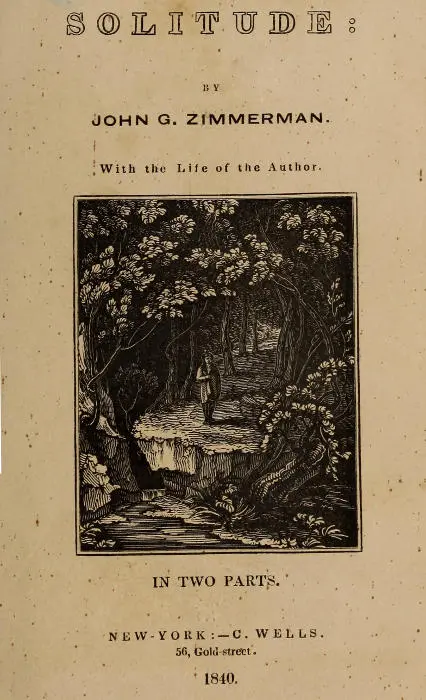
Solitude With the Life of the Author. In Two Parts — digital edition cover

THE CLASSIC COLLECTION · 1799

Solitude With the Life of the Author. In Two Parts

"Solitude" by Johann Georg Zimmermann is a philosophical treatise written in the late 18th century. This work explores the theme of solitude, emphasizing its impact on the human mind and heart while analyzing its benefits and drawbacks. Zimmermann aims to enlighten readers on how occasional retirement can foster happiness, intellectual clarity, and a deeper understanding of oneself and society. At the start of the book, Zimmerman introduces the concept of solitude as an intellectual state where the mind retreats into self-reflection, asserting that true solitude can exist even amidst social gatherings. He observes that modern society often undervalues solitude, mistaking it for misery or isolation, while arguing that it is essential for genuine happiness and intellectual growth. The opening chapters set the stage for a detailed exploration of solitude's influences on human emotions, well-being, and the creative mind, positioning it as a powerful means to achieve true felicity.

Introduction adapted from the source catalogue; source summaries may be automatically generated.

Start reading ↓

Free to read · English · 115,833 words · No account needed

MAKE TIME FOR A GOOD BOOK

Solitude With the Life of the Author. In Two Parts

On by default. Untick to stop anonymous reading totals. Each page counts after 10 seconds in view. How this works.

Anonymous counting is on unless you have switched it off.

Solitude With the Life of the Author. In Two Parts

In the twelfth century, and while Louis the Gross filled the throne of France, was born in the retired village of Palais, in Brittany, the celebrated Peter Abelard. Nature had lavished the highest perfections both on his person and his mind: a liberal education improved to their utmost possible extent the gifts of nature; and he became in a few years the most learned, elegant, and polite gentleman of his age and country. Philosophy and divinity were his favorite studies: and lest the affairs of the world should prevent him from becoming a proficient in them, he surrendered his birthright to his younger brethren, and travelled to Paris, in order to cultivate his mind under that great professor, William des Champeaux. The eminence he attained as a professor, while it procured him the esteem of the rational and discerning, excited the envy of his rivals. But, beside his uncommon merit as a scholar, he possessed a greatness of soul which nothing could subdue. He looked upon riches and grandeur with contempt; and his only ambition was to render his name famous among learned men, and to acquire the reputation of the greatest doctor of his age. But when he had attained his seven and twentieth year of age, all his philosophy could not guard him against the shafts of love. Not far from the place where Abelard read his lectures, lived a canon of the church of Notre Dame, named Fulbert, whose niece, the celebrated Eloisa, had been educated under his own eye with the greatest care and attention. Her person was well proportioned, her features regular, her eyes sparkling, her lips vermilion and well formed, her complexion animated, her air fine, and her aspect sweet and agreeable. She possessed a surprising quickness of wit, an incredible memory, and a considerable share of learning, joined with great humility and tenderness of disposition: and all these accomplishments were attended with something so graceful and moving, that it was impossible for those who saw her not to love her. The eye of Abelard was charmed, and his whole soul intoxicated in the passion of love, the moment he beheld and conversed with this extraordinary woman; and he laid aside all other engagements to attend to his passion. He was deaf to the calls both reason and philosophy, and thought of nothing but her company and conversation. An opportunity, fortunate for his love, but fatal to his happiness, soon occurred. Fulbert, whose affection for his niece was unbounded, willing to improve to the highest degree the excellency of those talents which nature had so bountifully bestowed on her, engaged Abelard as her preceptor, and received him in that character into his house. A mutual passion strongly infused itself into the hearts of both pupil and preceptor. She consented to become his mistress, but, for a long time, refused to become his wife. The secret of their loves could not remain long concealed from the eyes of Fulbert, and the lover was dismissed from his house: but Eloisa flew with rapture to his arms, and was placed under the protection of his sister, where she remained; until, from the cruel vengeance which her uncle exercised on the unfortunate Abelard, she was induced at his request to enter into the convent of Argenteuil, and he into the monastery of St. Gildas. In this cloister, the base of which was washed by the waves of a sea less turbulent than the passions which disturbed his soul, the unfortunate Abelard, endeavored by the exercises of religion and study, to obliterate all remembrance of his love; but his virtue was too feeble for the great attempt. A course of many years, however, had passed in penitence and mortification, without any communication between them, and further time might possibly have calmed in a still greater degree the violence of their feelings; but a letter which Abelard wrote to his friend Philintus, in order to comfort him under some affliction which had befallen him, in which he related his affection for Eloisa with great tenderness, fell into her hands, and induced her to break through the silence which had so long prevailed, by writing to him a letter, the contents of which revived in his mind all the former furies of his passion. Time, absence, solitude, and prayer, had in no degree diminished the amiable tenderness of the still lovely Eloisa, or augmented the fortitude of the unfortunate Abelard. The composing influence of religion seems to have made an earlier impression upon his feelings than it did upon those of Eloisa; but he continually counteracted its effects, by comparing his former felicity with his present torments; and he answered Eloisa’s letter, not as a moral preceptor, or holy confessor, but as a still fond and adoring lover; as a man whose wounded feelings were in some degree alleviated by a recollection of his former joys; and who could only console the sorrows of his mistress, by avowing an equal tenderness, and confessing the anguish with which their separation rent his soul. The walls of Paraclete resounded his sighs less frequently, and re-echoed less fervently with his sorrows, than those of St. Gildas; for his continued solitude, so far from affording him relief, had administered an aggravating medicine to his disease; and afforded that vulture, grief, greater leisure to tear and prey upon his disordered heart. “Religion,” says he, “commands me to pursue virtue since I have nothing to hope for from love; but love still asserts its dominion in my fancy, and entertains itself with past pleasures; memory supplies the place of a mistress. Piety and duty are not always the fruits of retirement. Even in deserts, when the dew of heaven falls not on us, we love what we ought no longer to love. The passions, stirred up by solitude, fill those regions of death and silence; and it is very seldom that what ought to be is truly followed there, and that God only is loved and served.”

Your reading position is saved on this browser. Take it to another device with a library code. Reading pages adapt to text, rather than matching a printed edition.

BEHIND THE WORDS

About Johann Georg Zimmermann

Johann Georg Zimmermann (1728–1795). Explore Solitude With the Life of the Author. In Two Parts in this collection. These books span philosophy.

Explore this author’s books →

THE READERS’ VERDICT

How did this story stay with you?

Not rated yet
Your rating for Solitude With the Life of the Author. In Two Parts

Be the first to share your verdict.

One rating per browser, which you can change or remove. A necessary browser identifier remembers your vote. How ratings work

A GOOD STORY DESERVES COMPANY

Pass this book along.

A great read is even better when it’s shared.

SEND A LITTLE INSPIRATION

Share this book

BEHIND THE BOOK

Edition & source details.

Title
Solitude With the Life of the Author. In Two Parts
Author
Johann Georg Zimmermann
First publication (Open Library catalogue match)
1799
Digital edition publisher
Project Gutenberg
Gutenberg release date
2017-11-07
Language
English
Source edition imprint
Not stated in source catalogue
Source identifier
Project Gutenberg #55898
Contributors
No additional named contributors in source metadata

Public-domain source & licence

This eBook is for the use of anyone anywhere in the United States and most other parts of the world at no cost and with almost no restrictions whatsoever. You may copy it, give it away or re-use it under the terms of the Project Gutenberg License included with this eBook or online at www.gutenberg.org. If you are not located in the United States, you will have to check the laws of the country where you are located before using this eBook. Read the source licence.

Full source licence and obtaining an original copy

The original source file, including credits and licence, is retained by this library. Request an original-format copy at no charge. Please include the book title and Project Gutenberg identifier #55898.

the full Project Gutenberg License must appear
prominently whenever any copy of a Project Gutenberg work (any work
on which the phrase “Project Gutenberg” appears, or with which the
phrase “Project Gutenberg” is associated) is accessed, displayed,
performed, viewed, copied or distributed:

This eBook is for the use of anyone anywhere in the United States and most
other parts of the world at no cost and with almost no restrictions
whatsoever. You may copy it, give it away or re-use it under the terms
of the Project Gutenberg™ License included with this eBook or online
at www.gutenberg.org. If you
are not located in the United States, you will have to check the laws
of the country where you are located before using this eBook.

1.E.2. If an individual Project Gutenberg electronic work is
derived from texts not protected by U.S. copyright law (does not
contain a notice indicating that it is posted with permission of the
copyright holder), the work can be copied and distributed to anyone in
the United States without paying any fees or charges. If you are
redistributing or providing access to a work with the phrase “Project
Gutenberg” associated with or appearing on the work, you must comply
either with the requirements of paragraphs 1.E.1 through 1.E.7 or
obtain permission for the use of the work and the Project Gutenberg
trademark as set forth in paragraphs 1.E.8 or 1.E.9.

1.E.3. If an individual Project Gutenberg electronic work is posted
with the permission of the copyright holder, your use and distribution
must comply with both paragraphs 1.E.1 through 1.E.7 and any
additional terms imposed by the copyright holder. Additional terms
will be linked to the Project Gutenberg License for all works
posted with the permission of the copyright holder found at the
beginning of this work.

1.E.4. Do not unlink or detach or remove the full Project Gutenberg
License terms from this work, or any files containing a part of this
work or any other work associated with Project Gutenberg.

1.E.5. Do not copy, display, perform, distribute or redistribute this
electronic work, or any part of this electronic work, without
prominently displaying the sentence set forth in paragraph 1.E.1 with
active links or immediate access to the full terms of the Project
Gutenberg License.

1.E.6. You may convert to and distribute this work in any binary,
compressed, marked up, nonproprietary or proprietary form, including
any word processing or hypertext form. However, if you provide access
to or distribute copies of a Project Gutenberg work in a format
other than “Plain Vanilla ASCII” or other format used in the official
version posted on the official Project Gutenberg website
(www.gutenberg.org), you must, at no additional cost, fee or expense
to the user, provide a copy, a means of exporting a copy, or a means
of obtaining a copy upon request, of the work in its original “Plain
Vanilla ASCII” or other form. Any alternate format must include the
full Project Gutenberg License as specified in paragraph 1.E.1.

1.E.7. Do not charge a fee for access to, viewing, displaying,
performing, copying or distributing any Project Gutenberg works
unless you comply with paragraph 1.E.8 or 1.E.9.

1.E.8. You may charge a reasonable fee for copies of or providing
access to or distributing Project Gutenberg electronic works
provided that:

• You pay a royalty fee of 20% of the gross profits you derive from
the use of Project Gutenberg works calculated using the method
you already use to calculate your applicable taxes. The fee is owed
to the owner of the Project Gutenberg trademark, but he has
agreed to donate royalties under this paragraph to the Project
Gutenberg Literary Archive Foundation. Royalty payments must be paid
within 60 days following each date on which you prepare (or are
legally required to prepare) your periodic tax returns. Royalty
payments should be clearly marked as such and sent to the Project
Gutenberg Literary Archive Foundation at the address specified in
Section 4, “Information about donations to the Project Gutenberg
Literary Archive Foundation.”

• You provide a full refund of any money paid by a user who notifies
you in writing (or by e-mail) within 30 days of receipt that s/he
does not agree to the terms of the full Project Gutenberg™
License. You must require such a user to return or destroy all
copies of the works possessed in a physical medium and discontinue
all use of and all access to other copies of Project Gutenberg™
works.

• You provide, in accordance with paragraph 1.F.3, a full refund of
any money paid for a work or a replacement copy, if a defect in the
electronic work is discovered and reported to you within 90 days of
receipt of the work.

• You comply with all other terms of this agreement for free
distribution of Project Gutenberg™ works.


1.E.9. If you wish to charge a fee or distribute a Project
Gutenberg™ electronic work or group of works on different terms than
are set forth in this agreement, you must obtain permission in writing
from the Project Gutenberg Literary Archive Foundation, the manager of
the Project Gutenberg™ trademark. Contact the Foundation as set
forth in Section 3 below.

1.F.

1.F.1. Project Gutenberg volunteers and employees expend considerable
effort to identify, do copyright research on, transcribe and proofread
works not protected by U.S. copyright law in creating the Project
Gutenberg™ collection. Despite these efforts, Project Gutenberg™
electronic works, and the medium on which they may be stored, may
contain “Defects,” such as, but not limited to, incomplete, inaccurate
or corrupt data, transcription errors, a copyright or other
intellectual property infringement, a defective or damaged disk or
other medium, a computer virus, or computer codes that damage or
cannot be read by your equipment.

1.F.2. LIMITED WARRANTY, DISCLAIMER OF DAMAGES - Except for the “Right
of Replacement or Refund” described in paragraph 1.F.3, the Project
Gutenberg Literary Archive Foundation, the owner of the Project
Gutenberg™ trademark, and any other party distributing a Project
Gutenberg™ electronic work under this agreement, disclaim all
liability to you for damages, costs and expenses, including legal
fees. YOU AGREE THAT YOU HAVE NO REMEDIES FOR NEGLIGENCE, STRICT
LIABILITY, BREACH OF WARRANTY OR BREACH OF CONTRACT EXCEPT THOSE
PROVIDED IN PARAGRAPH 1.F.3. YOU AGREE THAT THE FOUNDATION, THE
TRADEMARK OWNER, AND ANY DISTRIBUTOR UNDER THIS AGREEMENT WILL NOT BE
LIABLE TO YOU FOR ACTUAL, DIRECT, INDIRECT, CONSEQUENTIAL, PUNITIVE OR
INCIDENTAL DAMAGES EVEN IF YOU GIVE NOTICE OF THE POSSIBILITY OF SUCH
DAMAGE.

1.F.3. LIMITED RIGHT OF REPLACEMENT OR REFUND - If you discover a
defect in this electronic work within 90 days of receiving it, you can
receive a refund of the money (if any) you paid for it by sending a
written explanation to the person you received the work from. If you
received the work on a physical medium, you must return the medium
with your written explanation. The person or entity that provided you
with the defective work may elect to provide a replacement copy in
lieu of a refund. If you received the work electronically, the person
or entity providing it to you may choose to give you a second
opportunity to receive the work electronically in lieu of a refund. If
the second copy is also defective, you may demand a refund in writing
without further opportunities to fix the problem.

1.F.4. Except for the limited right of replacement or refund set forth
in paragraph 1.F.3, this work is provided to you ‘AS-IS’, WITH NO
OTHER WARRANTIES OF ANY KIND, EXPRESS OR IMPLIED, INCLUDING BUT NOT
LIMITED TO WARRANTIES OF MERCHANTABILITY OR FITNESS FOR ANY PURPOSE.

1.F.5. Some states do not allow disclaimers of certain implied
warranties or the exclusion or limitation of certain types of
damages. If any disclaimer or limitation set forth in this agreement
violates the law of the state applicable to this agreement, the
agreement shall be interpreted to make the maximum disclaimer or
limitation permitted by the applicable state law. The invalidity or
unenforceability of any provision of this agreement shall not void the
remaining provisions.

1.F.6. INDEMNITY - You agree to indemnify and hold the Foundation, the
trademark owner, any agent or employee of the Foundation, anyone
providing copies of Project Gutenberg™ electronic works in
accordance with this agreement, and any volunteers associated with the
production, promotion and distribution of Project Gutenberg™
electronic works, harmless from all liability, costs and expenses,
including legal fees, that arise directly or indirectly from any of
the following which you do or cause to occur: (a) distribution of this
or any Project Gutenberg work, (b) alteration, modification, or
additions or deletions to any Project Gutenberg work, and (c) any
Defect you cause.

Section 2. Information about the Mission of Project Gutenberg

Project Gutenberg is synonymous with the free distribution of
electronic works in formats readable by the widest variety of
computers including obsolete, old, middle-aged and new computers. It
exists because of the efforts of hundreds of volunteers and donations
from people in all walks of life.

Volunteers and financial support to provide volunteers with the
assistance they need are critical to reaching Project Gutenberg’s
goals and ensuring that the Project Gutenberg collection will
remain freely available for generations to come. In 2001, the Project
Gutenberg Literary Archive Foundation was created to provide a secure
and permanent future for Project Gutenberg and future
generations. To learn more about the Project Gutenberg Literary
Archive Foundation and how your efforts and donations can help, see
Sections 3 and 4 and the Foundation information page at www.gutenberg.org.

Section 3. Information about the Project Gutenberg Literary Archive Foundation

The Project Gutenberg Literary Archive Foundation is a non-profit
501(c)(3) educational corporation organized under the laws of the
state of Mississippi and granted tax exempt status by the Internal
Revenue Service. The Foundation’s EIN or federal tax identification
number is 64-6221541. Contributions to the Project Gutenberg Literary
Archive Foundation are tax deductible to the full extent permitted by
U.S. federal laws and your state’s laws.

The Foundation’s business office is located at 41 Watchung Plaza #516,
Montclair NJ 07042, USA, +1 (862) 621-9288. Email contact links and up
to date contact information can be found at the Foundation’s website
and official page at www.gutenberg.org/contact

Section 4. Information about Donations to the Project Gutenberg
Literary Archive Foundation

Project Gutenberg™ depends upon and cannot survive without widespread
public support and donations to carry out its mission of
increasing the number of public domain and licensed works that can be
freely distributed in machine-readable form accessible by the widest
array of equipment including outdated equipment. Many small donations
($1 to $5,000) are particularly important to maintaining tax exempt
status with the IRS.

The Foundation is committed to complying with the laws regulating
charities and charitable donations in all 50 states of the United
States. Compliance requirements are not uniform and it takes a
considerable effort, much paperwork and many fees to meet and keep up
with these requirements. We do not solicit donations in locations
where we have not received written confirmation of compliance. To SEND
DONATIONS or determine the status of compliance for any particular state
visit www.gutenberg.org/donate.

While we cannot and do not solicit contributions from states where we
have not met the solicitation requirements, we know of no prohibition
against accepting unsolicited donations from donors in such states who
approach us with offers to donate.

International donations are gratefully accepted, but we cannot make
any statements concerning tax treatment of donations received from
outside the United States. U.S. laws alone swamp our small staff.

Please check the Project Gutenberg web pages for current donation
methods and addresses. Donations are accepted in a number of other
ways including checks, online payments and credit card donations. To
donate, please visit: www.gutenberg.org/donate.

Section 5. General Information About Project Gutenberg electronic works

Professor Michael S. Hart was the originator of the Project
Gutenberg concept of a library of electronic works that could be
freely shared with anyone. For forty years, he produced and
distributed Project Gutenberg eBooks with only a loose network of
volunteer support.

Project Gutenberg eBooks are often created from several printed
editions, all of which are confirmed as not protected by copyright in
the U.S. unless a copyright notice is included. Thus, we do not
necessarily keep eBooks in compliance with any particular paper
edition.

Most people start at our website which has the main PG search
facility: www.gutenberg.org.

This website includes information about Project Gutenberg,
including how to make donations to the Project Gutenberg Literary
Archive Foundation, how to help produce our new eBooks, and how to
subscribe to our email newsletter to hear about new eBooks.


KEEP YOUR CURIOSITY GOING

Your next chapter awaits.

Your privacy choices

Reading is always free. You can change these settings at any time.

Book banners link to our books on simonward.net. They do not use advertising cookies or tracking.

Privacy & cookie policy · Reading data and privacy controls