
Last letters from the living dead man
David Patterson (Spirit) Hatch
THE CLASSIC COLLECTION · 1799
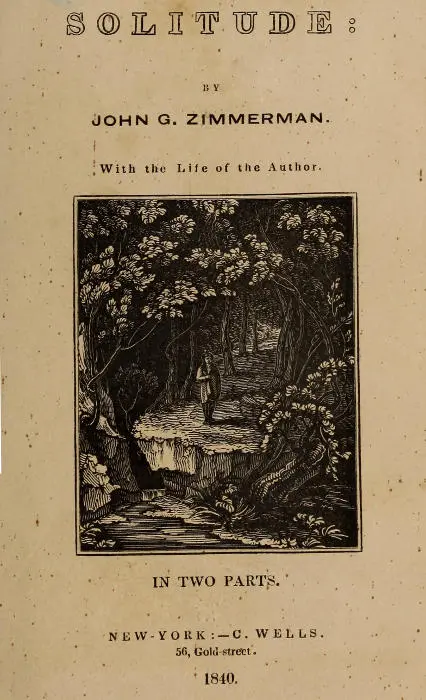
"Solitude" by Johann Georg Zimmermann is a philosophical treatise written in the late 18th century. This work explores the theme of solitude, emphasizing its impact on the human mind and heart while analyzing its benefits and drawbacks. Zimmermann aims to enlighten readers on how occasional retirement can foster happiness, intellectual clarity, and a deeper understanding of oneself and society. At the start of the book, Zimmerman introduces the concept of solitude as an intellectual state where the mind retreats into self-reflection, asserting that true solitude can exist even amidst social gatherings. He observes that modern society often undervalues solitude, mistaking it for misery or isolation, while arguing that it is essential for genuine happiness and intellectual growth. The opening chapters set the stage for a detailed exploration of solitude's influences on human emotions, well-being, and the creative mind, positioning it as a powerful means to achieve true felicity.
Introduction adapted from the source catalogue; source summaries may be automatically generated.
Free to read · English · 115,833 words · No account needed
MAKE TIME FOR A GOOD BOOK
On by default. Untick to stop anonymous reading totals. Each page counts after 10 seconds in view. How this works.
Anonymous counting is on unless you have switched it off.
Blest is the man, as far as earth can bless, Whose measur’d passions reach no wild excess; Who, urged by nature’s voice, her gifts enjoys, Nor other means than nature’s force employs. While warm with youth the sprightly current flows, Each vivid sense with vigorous rapture glows; And when he droops beneath the hand of age, No vicious habit stings with fruitless rage; Gradual his strength and gay sensations cease, While joys tumultuous sink in silent peace.
The extraordinary power which the passions assume, and the improper channel in which they are apt to flow in retired situations, is conspicuous from the greater acrimony with which they are in general tainted in small villages than in large towns. It is true, indeed, that they do not always explode in such situations with the open and daring violence which they exhibit in the metropolis; but lie buried as it were, and mouldering in the bosom with a more malignant flame. To those who only observe the listlessness and languor which distinguish the characters of those who reside in small provincial towns, the slow and uniform rotation of amusements which fills up the leisure of their lives; the confused wildness of their cares; the poor subterfuges to which they are continually resorting, in order to avoid the clouds of discontent that impend in angry darkness, over their heads; the lagging current of their drooping spirits; the miserable poverty of their intellectual powers; the eagerness with which they strive to raise a card party; the transports they enjoy on the prospect of any new diversion or occasional exhibition; the haste with which they run toward any sudden, unexpected noise that interrupts the deep silence of their situation; and the patient industry with which, from day to day, they watch each other’s conduct, and circulate reports of every action of each other’s lives, will scarcely imagine that any virulence of passion can disturb the bosoms of persons who live in so quiet and seemingly composed a state. But the unoccupied time and barren minds of such characters cause the faintest emotions, and most common desires, to act with all the violence of high and untamed passions. The lowest diversions, a cock fighting, or a pony race, make the bosom of a country ’squire beat with the highest rapture; while the inability to attend the monthly ball fills the minds of his wife and daughter with the keenest anguish. Circumstances, which scarcely make any impression on those who reside in the metropolis, plunge every description of residents in a country village into all the extravagances of joy, or the dejection of sorrow; from the peer to the peasant, from the duchess to the dairy maid, all is rapture and convulsion. Competition is carried on for the humble honors and petty interests of a sequestered town, or miserable hamlet, with as much heat and rancor, as it is for the highest dignities and greatest emoluments of the state. Upon many occasions, indeed, ambition, envy, revenge, and all the disorderly and malignant passions, are felt and exercised with a greater degree of violence and obstinacy amidst the little contentions of claybuilt cottages, than ever prevailed amidst the highest commotions of courts. Plutarch relates that when Cæsar, after his appointment to the government of Spain, came to a little town, as he was passing the Alps, his friends, by way of mirth, took occasion to say, “Can there here be any disputes for offices, any contentions for precedency, or such envy and ambition as we behold among the great in all the transactions of imperial Rome?” The idea betrayed their ignorance of human nature; while the celebrated reply of their great commander, that he would rather be the first man in this little town, than the second even in the imperial city, spoke the language, not of an individual, but of the species; and instructed them that there is no place, however insignificant, in which the same passions do not proportionately prevail. The humble competitors for village honors, however low and subordinate they may be, feel as great anxiety for pre-eminence, as much jealousy of rivals, and as violent envy against superiors, as agitate the bosoms of the most ambitious statesmen in contending for the highest prize of glory, of riches, or of power. The manner, perhaps, in which these inferior candidates exert their passions may be less artful, and the objects of them less noble, but they are certainly not less virulent. “Having,” says Euphelia, who had quitted London, to enjoy the quietude and happiness of a rural village, “been driven by the mere necessity of escaping from absolute inactivity, to make myself more acquainted with the affairs and happiness of this place, I am now no longer a stranger to rural conversation and employments; but am far from discerning in them more innocence or wisdom than in the sentiments or conduct of those with whom I have passed more cheerful and more fashionable hours. It is common to reproach the tea table and the park, with giving opportunities and encouragement to scandal I cannot wholly clear them from the charge, but must, however, observe, in favor of the modish prattlers, that if not by principle, we are at least by accident, less guilty of defamation than the country ladies. For, having greater numbers to observe and censure, we are commonly content to charge them only with their own faults or follies, and seldom give way to malevolence, but such as arises from injury or affront, real or imaginary, offered to ourselves. But in those distant provinces, where the same families inhabit the same houses from age to age, they transmit and recount the faults of a whole succession. I have been informed how every estate in the neighborhood was originally got, and find, if I may credit the accounts given me, that there is not a single acre in the hands of the right owner. I have been told of intrigues between beaus and toasts, that have been now three centuries in their quiet graves; and am often entertained with traditional scandal on persons of whose names there would have been no remembrance, had they not committed somewhat that might disgrace their descendants. If once there happens a quarrel between the principal persons of two families, the malignity is continued without end; and it is common for old maids to fall out about some election in which their grandfathers were competitors. Thus malice and hatred descend here with an inheritance; and it is necessary to be well versed in history, that the various factions of the country may be understood. You cannot expect to be on good terms with families who are resolved to love nothing in common; and in selecting your intimates, you are, perhaps, to consider which party you most favor in the barons’ wars.”
Your reading position is saved on this browser. Take it to another device with a library code. Reading pages adapt to text, rather than matching a printed edition.
BEHIND THE BOOK
This eBook is for the use of anyone anywhere in the United States and most other parts of the world at no cost and with almost no restrictions whatsoever. You may copy it, give it away or re-use it under the terms of the Project Gutenberg License included with this eBook or online at www.gutenberg.org. If you are not located in the United States, you will have to check the laws of the country where you are located before using this eBook. Read the source licence.
The original source file, including credits and licence, is retained by this library. Request an original-format copy at no charge. Please include the book title and Project Gutenberg identifier #55898.
KEEP YOUR CURIOSITY GOING
David Patterson (Spirit) Hatch
Coulson Kernahan

Ralph Waldo Emerson
Frances Wright

Edwin Abbott Abbott

Joseph Droz