
Last letters from the living dead man
David Patterson (Spirit) Hatch
THE CLASSIC COLLECTION · 1799
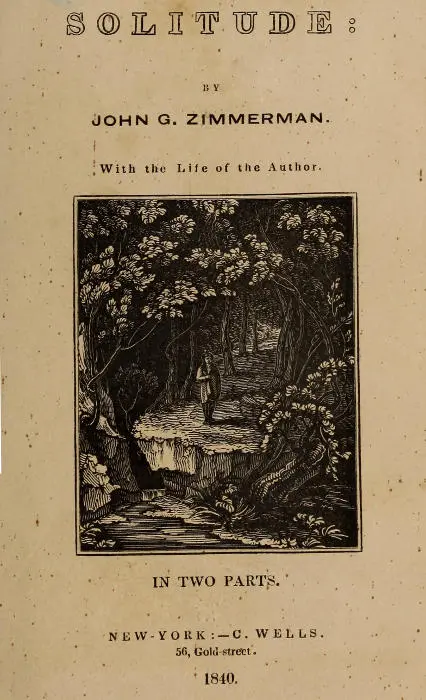
"Solitude" by Johann Georg Zimmermann is a philosophical treatise written in the late 18th century. This work explores the theme of solitude, emphasizing its impact on the human mind and heart while analyzing its benefits and drawbacks. Zimmermann aims to enlighten readers on how occasional retirement can foster happiness, intellectual clarity, and a deeper understanding of oneself and society. At the start of the book, Zimmerman introduces the concept of solitude as an intellectual state where the mind retreats into self-reflection, asserting that true solitude can exist even amidst social gatherings. He observes that modern society often undervalues solitude, mistaking it for misery or isolation, while arguing that it is essential for genuine happiness and intellectual growth. The opening chapters set the stage for a detailed exploration of solitude's influences on human emotions, well-being, and the creative mind, positioning it as a powerful means to achieve true felicity.
Introduction adapted from the source catalogue; source summaries may be automatically generated.
Free to read · English · 115,833 words · No account needed
MAKE TIME FOR A GOOD BOOK
On by default. Untick to stop anonymous reading totals. Each page counts after 10 seconds in view. How this works.
Anonymous counting is on unless you have switched it off.
I could not minister to a mind diseased,
Pluck from the memory a rooted sorrow,
Raze out the written troubles of the brain,
And, with a sweet oblivious antidote,
Cleanse the stuff’d bosom of that perilous stuff
Which weighed upon the heart.
To avoid these painful importunities, I flew from the tasteless scenes with abrupt and angry violence; and confining myself to the solitude of my apartments, passed the lingering day in dreary dejection, musing on the melancholy group from which I had just escaped. But my home did not long afford me an asylum. I was on the ensuing day assailed by a host of hypochondriacs, attended by their respective advisers, who, while my own nervous malady was raging at its full height, stunned me with the various details of their imaginary woes, and excruciated me the whole day with their unfounded ails and tormenting lamentations. The friendly approach of night at length relieved me from their importunities; but my spirits had been exhausted, my feelings so vexed, my patience so tried, and the sensibilities of my mind so aggravated, by the persecution I had endured, that--
“Tir’d nature’s sweet restorer, balmly sleep,”
fled from my eyes; and I lay restless upon my couch, alive only to my miseries, in a state of anguish more insupportable than my bitterest enemies would, I hope, have inflicted on me. About noon, on the ensuing day, while I was endeavoring to procure on the sofa a short repose, the princess Orlow, accompanied by two other very agreeable Russian ladies, whose company and conversation it was both my pride and my pleasure frequently to enjoy, suddenly entered my apartment, to inquire after my health, of the state of which they had received an account only a few hours before; but such was the petulance of temper into which my disordered mind had betrayed me, that I immediately rose, and with uncivil vehemence, requested they would not disturb me. The fair intruders instantly left the room. About an hour afterward, and while I was reflecting on the impropriety of my conduct, the prince himself honored me with a visit. He placed himself on a chair close by the couch on which I lay, and, with that kind affection which belongs to his character, inquired, with the tenderest and most sympathizing concern, into the cause of my disorder. There was a charm in his kindness and attention that softened, in some degree, the violence of my pains. He continued his visit for some time; and when he was about to leave me, after premising that I knew him too well to suspect that superstition had any influence in his mind, said, “Let me advise you, whenever you find yourself in so waspish and petulant a mood, as you must have been in when you turned the princess and her companions out of the room, to endeavor to check the violence of your temper; and I think you will find it an excellent expedient for this purpose, if, while any friend is kindly inquiring after your health, however averse you may be at the moment to such an inquiry, instead of driving him so uncivilly away, you would employ yourself in a silent mental repetition of the Lord’s prayer: it might prove very salutary, and would certainly be much more satisfactory to your mind.” No advice could be better imagined than this was to divert the emotions of impatience, by creating in the mind new objects of attention, and turning the raging current of distempered thought into a more pure and peaceful channel. Experience, indeed, has enabled me to announce the efficacy and virtue of this expedient. I have frequently, by the practice of it, defeated the fury of petulant passions, and completely subdued many of those absurdities which vex and tease us in the hours of grief and during the sorrows of sickness. Others also to whom I have recommended it, have experienced from it similar effects. The prince, “my guide, philosopher, and friend,” a few weeks after he had given me this wise and salutary advice, consulted me respecting the difficulty he frequently labored under in suppressing the violence of those transports of affection which he bore toward his young and amiable consort, and which, in a previous conversation on philosophic subjects, I had seriously exhorted him to check, under a conviction, that a steady flame is more permanent and pure than a raging fire. He asked me with some concern what expedient I could recommend to him as most likely to control those emotions which happy lovers are so anxious to indulge. “My dear friend,” I replied, “there is no expedient can surpass your own; and whenever the intemperance of passion is in danger of subverting the dictates of reason, repeat the Lord’s prayer, and I have no doubt you will foil its fury.”
Your reading position is saved on this browser. Take it to another device with a library code. Reading pages adapt to text, rather than matching a printed edition.
BEHIND THE BOOK
This eBook is for the use of anyone anywhere in the United States and most other parts of the world at no cost and with almost no restrictions whatsoever. You may copy it, give it away or re-use it under the terms of the Project Gutenberg License included with this eBook or online at www.gutenberg.org. If you are not located in the United States, you will have to check the laws of the country where you are located before using this eBook. Read the source licence.
The original source file, including credits and licence, is retained by this library. Request an original-format copy at no charge. Please include the book title and Project Gutenberg identifier #55898.
KEEP YOUR CURIOSITY GOING
David Patterson (Spirit) Hatch
Coulson Kernahan

Ralph Waldo Emerson
Frances Wright

Edwin Abbott Abbott

Joseph Droz