
Last letters from the living dead man
David Patterson (Spirit) Hatch
THE CLASSIC COLLECTION · 1799
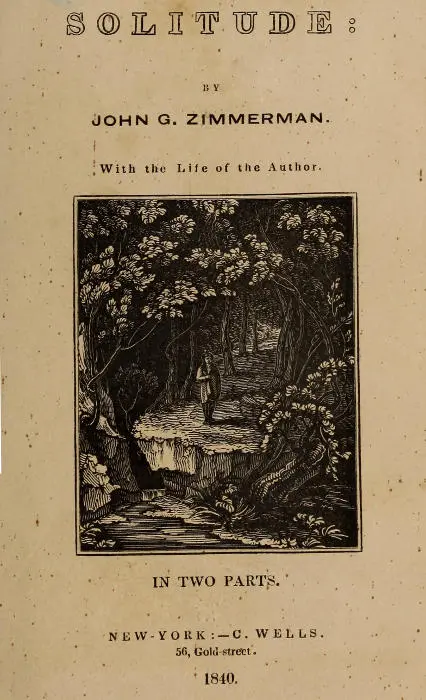
"Solitude" by Johann Georg Zimmermann is a philosophical treatise written in the late 18th century. This work explores the theme of solitude, emphasizing its impact on the human mind and heart while analyzing its benefits and drawbacks. Zimmermann aims to enlighten readers on how occasional retirement can foster happiness, intellectual clarity, and a deeper understanding of oneself and society. At the start of the book, Zimmerman introduces the concept of solitude as an intellectual state where the mind retreats into self-reflection, asserting that true solitude can exist even amidst social gatherings. He observes that modern society often undervalues solitude, mistaking it for misery or isolation, while arguing that it is essential for genuine happiness and intellectual growth. The opening chapters set the stage for a detailed exploration of solitude's influences on human emotions, well-being, and the creative mind, positioning it as a powerful means to achieve true felicity.
Introduction adapted from the source catalogue; source summaries may be automatically generated.
Free to read · English · 115,833 words · No account needed
MAKE TIME FOR A GOOD BOOK
On by default. Untick to stop anonymous reading totals. Each page counts after 10 seconds in view. How this works.
Anonymous counting is on unless you have switched it off.
The instances of the pernicious influence of a total dereliction of society, may possibly appear to the understandings of the present generation extravagant and incredible; but they are certainly true; and many others of a similar nature might be adduced from the most authentic histories of the times. The species, when prevented from enjoying a free intercourse and rational society with each other, almost change their nature; and the mind, feeding continually on the melancholy musings of the imagination, in the cold and cheerless regions of solitude, engenders humors of the most eccentric cast. Excluded from those social communications which nature enjoins, with the means of gratifying the understanding, amusing the senses, or interesting the affections, fancy roves at large into unknown spheres, and endeavors to find in ideal forms entertainment and delight. Angelic visions, infernal phantoms, amazing prodigies, the delusions of alchemy, the frenzies of philosophy, and the madness of metaphysics, fill the disordered brain. The intellect fastens upon some absurd idea, and fosters it with the fondest affection, until its increasing magnitude subdues the remaining powers of sense and reason. The slightest retrospect into the conduct of the solitary professors of every religious system, proves the lamentable dangers to which they expose their mental faculties, by excluding themselves from the intercourse of rational society. From the prolific womb of solitude sprung all the mysterious ravings and senseless doctrines of the New Platonists. The same cause devoted the monks and anchorites of the Christian church to folly and fanaticism. Fakirs, Bramins, and every other tribe of religious enthusiasts, originated from the same source. By abandoning the pleasures of society, and renouncing the feelings of nature, they sacrificed reason upon the altar of superstition, and supplied its place with ecstatic fancies, and melancholy musings. There is nothing more evident, than that our holy religion, in its original constitution, was set so far apart from all refined speculations, that it seemed in a manner diametrically opposite to them. The great founder of Christianity gave one simple rule of life to all men; but his disciples, anxious to indulge the natural vanity of the human mind, and misled, in some degree, by the false philosophy which at that period overspread the heathen world, introduced various doctrines of salvation, and new schemes of faith. Bigotry, a species of superstition never known before, took place in men’s affections, and armed them with new jealousies against each other: barbarous terms and idioms were every day invented; monstrous definitions imposed, and hostilities, the fiercest imaginable, exercised on each other by the contending parties. Fanaticism, with all the train of visions, prophecies, dreams, charms, miracles, and exorcises, succeeded; and spiritual feats, of the most absurd and ridiculous nature, were performed in monasteries, or up and down, by their mendicant or itinerant priests and ghostly missionaries. Solitude impressed the principles upon which these extravagances were founded, with uncommon force on the imagination; and the mind, working itself into holy fervors and inspirations, give birth to new extravagances. The causes which operated on the minds of men to produce such ridiculous effects, acted with double force on the ardent temper, warm imagination, and excessive sensibility of the female world. That which was mere fantasy with the one sex, became frenzy with the other. Women, indeed, are, according to the opinion of Plato, the nurses of fanaticism; and their favorite theme is that which has been dignified by the appellation of a sublime passion for poetry: an ardent, refined love of heaven; but which, in fact, is only the natural effects of the heart, swollen intumescently by an unreined, prolific, and too ardent imagination. Instances of this kind are discoverable in all the accounts that have been published of the holy fervors of these penitents, particularly in those of Catherine of Sienna, of Joan of Cambray, of Angelina of Foligny, of Matilda of Saxony, of Maria of the Incarnation, of Mary Magdalen of Pazzio, of Gertrude of Saxony, and many others. The celebrated Armelle, who was born in the year 1606, at Campenac, in the diocese of St. Malo, and who died at Vannes in the year 1671, possessed great personal beauty, a quick and lively mind, and an uncommon tenderness of heart. Her parents, who were honest and industrious villagers, placed her as a menial servant in the house of a neighboring gentleman, with whom she lived for five and thirty years in the practice of the most exemplary piety and extraordinary virtue, at least, according to the accounts which he gave from time to time of her conduct. During the time she resided with this gentleman, his groom, finding the kitchen door fastened, had the curiosity to peep through the key-hole, where he discovered the pious maid, in a paroxysm of divine ecstacy, performing the humble office of spitting a capon. The agitation of this holy spirit so affected the mind of the astonished youth, that, it is said by the Ursuline sister who has written the life of this great luminary of French sanctity, under the title of The school for the love of God, he became immediately enamored with the beauties of religion, and renouncing the pomps and vanities of the world, entered into a monastery, at the same time that his holy companion thought proper to withdraw from future observation into the convent of Vannes, where she devoted the remainder of her life, and died, as it is reported, in an excess of divine love. The youthful days of Armelle had been passed in almost total solitude; for her occupation at the house in which she was placed by her parents, was confined entirely to the kitchen, and she had scarcely any other intercourse than with its furniture. It appears, however, from the history of her life, that she was from her childhood excessively fond of reciting an ave or paternoster; and while occupied in tending the flocks, her original employment, amused herself in telling her rosary; “by which means,” says the Ursuline sister, “she made, even in her pastoral state of simplicity and ignorance, such great advances in divine love that, the first moment she was allowed to pay her adoration to the crucifix the fervency of her pious passion burst forth with such ecstacy, that she eagerly snatched the holy object to her arms, and embraced it with a transport so warmly affectionate, that streams of tenderness rushed from her eyes.”
Your reading position is saved on this browser. Take it to another device with a library code. Reading pages adapt to text, rather than matching a printed edition.
BEHIND THE BOOK
This eBook is for the use of anyone anywhere in the United States and most other parts of the world at no cost and with almost no restrictions whatsoever. You may copy it, give it away or re-use it under the terms of the Project Gutenberg License included with this eBook or online at www.gutenberg.org. If you are not located in the United States, you will have to check the laws of the country where you are located before using this eBook. Read the source licence.
The original source file, including credits and licence, is retained by this library. Request an original-format copy at no charge. Please include the book title and Project Gutenberg identifier #55898.
KEEP YOUR CURIOSITY GOING
David Patterson (Spirit) Hatch
Coulson Kernahan

Ralph Waldo Emerson
Frances Wright

Edwin Abbott Abbott

Joseph Droz