
Last letters from the living dead man
David Patterson (Spirit) Hatch
THE CLASSIC COLLECTION · 1799
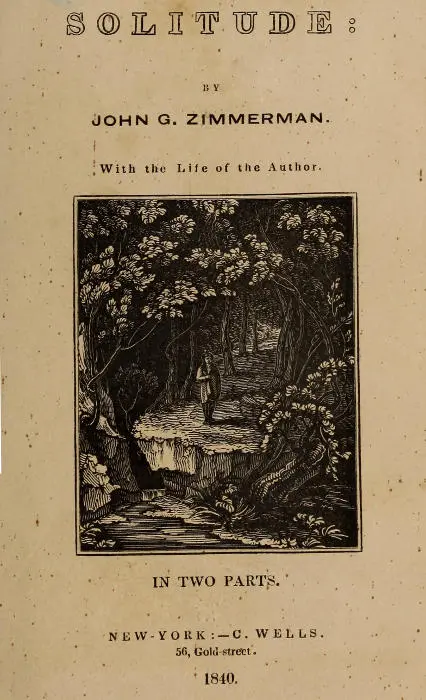
"Solitude" by Johann Georg Zimmermann is a philosophical treatise written in the late 18th century. This work explores the theme of solitude, emphasizing its impact on the human mind and heart while analyzing its benefits and drawbacks. Zimmermann aims to enlighten readers on how occasional retirement can foster happiness, intellectual clarity, and a deeper understanding of oneself and society. At the start of the book, Zimmerman introduces the concept of solitude as an intellectual state where the mind retreats into self-reflection, asserting that true solitude can exist even amidst social gatherings. He observes that modern society often undervalues solitude, mistaking it for misery or isolation, while arguing that it is essential for genuine happiness and intellectual growth. The opening chapters set the stage for a detailed exploration of solitude's influences on human emotions, well-being, and the creative mind, positioning it as a powerful means to achieve true felicity.
Introduction adapted from the source catalogue; source summaries may be automatically generated.
Free to read · English · 115,833 words · No account needed
MAKE TIME FOR A GOOD BOOK
On by default. Untick to stop anonymous reading totals. Each page counts after 10 seconds in view. How this works.
Anonymous counting is on unless you have switched it off.
The conduct of St. Francis, commonly called the holy Francis of Assisi, was in some degree similar; excepting that the madness of this fanatic continued throughout his life, while the delirium of Fothergill lasted but a day. This saint was born at Assisi, in the province of Umbria, in the year 1182. His real name of baptism was John; but, on account of the facility with which he acquired the French language, so necessary at that time in Italy, especially for the business for which he was intended, he was called Francis. He is said to have been born with the figure of a cross on his right shoulder, and to have dreamt that he was designed by heaven to promote the interests of that holy sign. His disposition was naturally mild, his comprehension quick, his feelings acute, his manners easy, his imagination vivid, and his passions inordinately warm. A careless and unrestrained indulgence of the propensities of youth had led him into a variety of vicious habits and libertine extravagances, until the solitude to which a fit of sickness confined him, brought him to a recollection, and forced him to reflect upon the dangerous tendency of his past misconduct. His mind started with horror at the dreadful scene his retrospection presented to his view; and he resolved to quit the company of his former associates, to reform the profligacy of his life, to restore his character, and to save, by penitence and prayer, his guilty soul. These serious reflections wrought so powerfully on his dejected mind, that he fell into an extravagant kind of devotion, more resembling madness than religion. Fixing on a passage in St. Matthew, in which our Saviour desires his apostles to provide neither gold nor silver, nor brass in their purses; nor scrip for their journey; neither two coats, neither shoes, nor yet staves, he was led to consider a voluntary and absolute poverty as the essence of the gospel, and to prescribe this poverty as a sacred rule, both to himself and to the few who followed him. He accordingly wandered through the streets of Assisi, in garments that scarcely concealed his nakedness, in order, as he said, to inure himself to the taunts and ridicule of his former companions, whom he now called the children of sin, and followers of satan. The father of the young saint, supposing, from these extravagances, that the sickness under which he had so long labored had disordered his intellects, prepared to provide him with some proper place of confinement, until time or medical regimen should restore him to his right senses; but the saint, having been informed of his father’s friendly intention, declined his parental care, and quitting his house, sought a sanctuary in the palace of the bishop of Assisi. The diocesan immediately sent to the father of the fugitive, and, after hearing him upon the subject of his right to provide for the safety of his son, he turned calmly to the son and desired him to reply. The son immediately tore off the tattered garments which he then wore, and casting them with scorn and indignation at the feet of his astonished parent exclaimed, “there, take back all your property. You were, indeed, my earthly father; but henceforth I disclaim you; for I own no father but him who is in heaven.” The bishop, either really or affectedly delighted with this unnatural rant of the young enthusiast, threw his own mantle over the saint, and exhorted him to persevere in his holy resolution, and to cherish with increasing ardor, the divine inspiration of his pious mind. The frantic youth, animated by the warm approbation of the bishop proceeded in his religious course, and abandoning the city, retired into the deepest gloom of an adjacent forest, to indulge the fervors of that false enthusiasm which had overpowered his brain. In this retreat a second vision confirmed him in his holy office; and being encouraged by pope Innocent III, and Honorius, he established, in the year 1209, the Order of Saint Francis. If this ridiculous enthusiast had corrected the extravagances of his overheated imagination, by a cool and temperate exercise of his reason, by studying, like the celebrated physician we have just mentioned, some liberal science, he might, with the talents he possessed, have become a really useful member of society. But these wild shoots, if suffered to grow to any height, cannot afterward be easily eradicated: and even Fothergill, if he had lived like Francis, in an age of superstitious delusion, and had been encouraged to believe the truth of his fanatic conceptions, his temporary frenzy might have continued through life; and his character, instead of being revered as a promoter of an useful science, have been held up by an ignorant multitude to the contempt and ridicule of posterity.
Your reading position is saved on this browser. Take it to another device with a library code. Reading pages adapt to text, rather than matching a printed edition.
BEHIND THE BOOK
This eBook is for the use of anyone anywhere in the United States and most other parts of the world at no cost and with almost no restrictions whatsoever. You may copy it, give it away or re-use it under the terms of the Project Gutenberg License included with this eBook or online at www.gutenberg.org. If you are not located in the United States, you will have to check the laws of the country where you are located before using this eBook. Read the source licence.
The original source file, including credits and licence, is retained by this library. Request an original-format copy at no charge. Please include the book title and Project Gutenberg identifier #55898.
KEEP YOUR CURIOSITY GOING
David Patterson (Spirit) Hatch
Coulson Kernahan

Ralph Waldo Emerson
Frances Wright

Edwin Abbott Abbott

Joseph Droz