
Last letters from the living dead man
David Patterson (Spirit) Hatch
THE CLASSIC COLLECTION · 1799
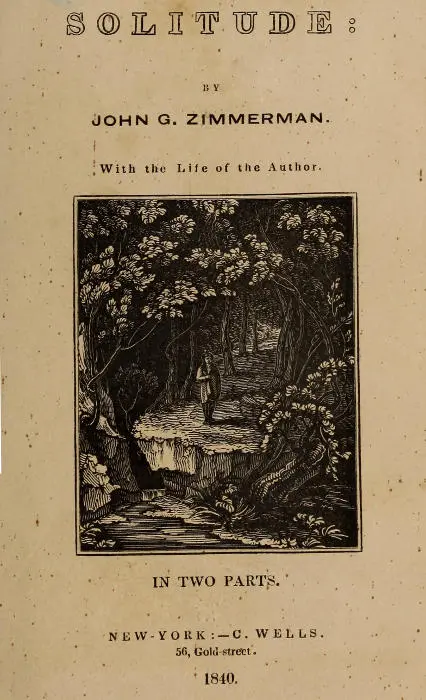
"Solitude" by Johann Georg Zimmermann is a philosophical treatise written in the late 18th century. This work explores the theme of solitude, emphasizing its impact on the human mind and heart while analyzing its benefits and drawbacks. Zimmermann aims to enlighten readers on how occasional retirement can foster happiness, intellectual clarity, and a deeper understanding of oneself and society. At the start of the book, Zimmerman introduces the concept of solitude as an intellectual state where the mind retreats into self-reflection, asserting that true solitude can exist even amidst social gatherings. He observes that modern society often undervalues solitude, mistaking it for misery or isolation, while arguing that it is essential for genuine happiness and intellectual growth. The opening chapters set the stage for a detailed exploration of solitude's influences on human emotions, well-being, and the creative mind, positioning it as a powerful means to achieve true felicity.
Introduction adapted from the source catalogue; source summaries may be automatically generated.
Free to read · English · 115,833 words · No account needed
MAKE TIME FOR A GOOD BOOK
On by default. Untick to stop anonymous reading totals. Each page counts after 10 seconds in view. How this works.
Anonymous counting is on unless you have switched it off.
The growth of fanaticism, whether moral, political, religious, or scientific, is not confined exclusively to any age or country; the seeds of it have been but too plentifully sown in all the regions of the earth; and it is almost equally baneful and injurious in whatever soil they spring. Every bold, turbulent, and intriguing spirit, who has sufficient artifice to inflame the passions of the inconstant multitude, the moment he calls the demon of fanatacism to his aid, becomes troublesome, and frequently dangerous, to the government under which he lives. Even the affectation of this powerful but pernicious quality, is able to produce fermentations, highly detrimental to the peace of society. In the very metropolis of Great Britain, and among the enlightened inhabitants of that kingdom, Lord George Gordon, in the present age, was enabled, by assuming the hypocritical appearance of piety, and standing forth as a champion of a religious sect, to convulse the nation, and endanger its safety. In the twenty-first year of the reign of his Britannic Majesty, the present powerful and illustrious King George III. an act of parliament was passed to relieve the Roman Catholics residing in England from the penalties and disabilities which had been imposed on them at the revolution. An extension of the same relief to the Catholics of Scotland was also said to be intended by parliament. The report spread an immediate alarm throughout the country; societies were formed for the defence of the Protestant faith; committees appointed, books dispersed, and, in short, every method taken to inflame the zeal of the people. These attempts being totally neglected by government, and but feebly resisted by the more liberal minded in the country, produced all their effects. A furious spirit of bigotry and persecution soon showed itself, and broke out into the most outrageous acts of violence against the Papists at Edinburgh, Glasgow, and elsewhere; but as government did not think it advisable to repress this spirit by force, the just and benevolent intentions of the legislature were laid aside. The successful resistance of the zealots in Scotland to any relaxation of the penal laws against the Papists, seems to have given the first rise to the Protestant Association in England; for about the same time bills were dispersed, and advertisements inserted in the newspapers, inviting those who wished well to the cause to unite under that title; and Lord George Gordon, who had been active at the head of the malcontents in Scotland, was chosen their President. The ferment was suffered to increase during a course of several years. His lordship was a member of the senate, and his extraordinary conduct in the house, and frequent interruption he gave to the business of parliament, as well as the unaccountable manner in which he continually brought in and treated matters relative to religion and the danger of popery, and the caprice with which he divided the house upon questions wherein he stood nearly or entirely alone, were passed over, along with other singularities in his dress and manners, rather as subjects of pleasantry than of serious notice or reprehension. On Monday, the 29th of May, 1780, a meeting was held at Coachmaker’s Hall, pursuant to a public advertisement, in order to consider of the mode of presenting a petition to the House of Commons. Lord George Gordon took the chair; and, after a long inflammatory harangue, in which he endeavoured to persuade his hearers of the rapid and alarming progress that popery was making in the kingdom, he proceeded to observe, that the only way to stop it, was going in a firm, manly, and resolute manner to the house and showing their representatives that they were determined to preserve their religious freedom with their lives; that, for his part, he would run all hazards with the people; and if the people were too lukewarm to run all hazards with him, when their conscience and their country called them forth, they might get another president, for that he would tell them candidly, he was not a lukewarm man himself; and that, if they meant to spend their time in mock debate, and idle opposition, they might get another leader. This speech was received with the loudest applause, and his lordship then moved the following resolution: “That the whole body of the Protestant Association do attend in St. George’s Fields, on Friday next, at ten o’clock in the morning, to accompany their president to the House of Commons at the delivery of the Protestant petition;” which was carried unanimously. His Lordship then informed them, that if less than twenty thousand of his fellow citizens attended him on that day, he would not present their petition. Accordingly, on Friday, the 2d day of June, 1780, at ten in the forenoon, several thousands assembled at the place appointed, marshalling themselves in ranks, and waiting for their leader, who arrived about an hour afterward, and they all proceeded to the houses of parliament. Here they began to exercise the most arbitrary power over both lords and commons, by obliging almost all the members to put blue cockades on their hats, and call out “no popery!” Some they compelled to take oaths to vote for the repeal of this obnoxious act; others they insulted in the most indecent and insolent manner. They took possession of all the avenues up to the very door of both houses of parliament, which they twice attempted to force open, and committed many outrages on the persons of the members. Nor were they dispersed, or the remaining members able to leave their seats, until a military force arrived. The houses were adjourned to the 19th of June. But so dreadful a spectacle of calamity and horror was never known in any age or country, as that which the metropolis of England exhibited on the evening and the day which succeeded this seditious congregation. These astonishing effects produced by the real or pretended fanaticism of a simple individual, sufficiently display the power of this dangerous quality, when artfully employed to inflame the passions of the unthinking multitude. But it is worthy of observation, that while this incendiary sustained among his followers the character of a pious patriot, of a man without the smallest spot or blemish, of being, in short, the most virtuous guardian of the established religion of the country, he regularly indulged his holy fervors, and sanctified appearances, every evening, in the company of common prostitutes, or professed wantons.
Your reading position is saved on this browser. Take it to another device with a library code. Reading pages adapt to text, rather than matching a printed edition.
BEHIND THE BOOK
This eBook is for the use of anyone anywhere in the United States and most other parts of the world at no cost and with almost no restrictions whatsoever. You may copy it, give it away or re-use it under the terms of the Project Gutenberg License included with this eBook or online at www.gutenberg.org. If you are not located in the United States, you will have to check the laws of the country where you are located before using this eBook. Read the source licence.
The original source file, including credits and licence, is retained by this library. Request an original-format copy at no charge. Please include the book title and Project Gutenberg identifier #55898.
KEEP YOUR CURIOSITY GOING
David Patterson (Spirit) Hatch
Coulson Kernahan

Ralph Waldo Emerson
Frances Wright

Edwin Abbott Abbott

Joseph Droz