
Last letters from the living dead man
David Patterson (Spirit) Hatch
THE CLASSIC COLLECTION · 1799
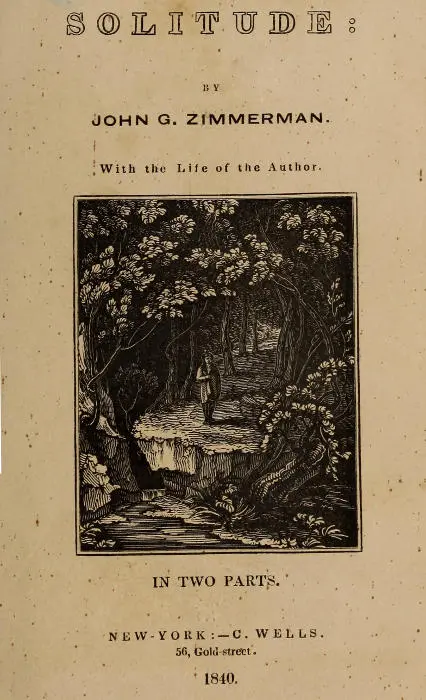
"Solitude" by Johann Georg Zimmermann is a philosophical treatise written in the late 18th century. This work explores the theme of solitude, emphasizing its impact on the human mind and heart while analyzing its benefits and drawbacks. Zimmermann aims to enlighten readers on how occasional retirement can foster happiness, intellectual clarity, and a deeper understanding of oneself and society. At the start of the book, Zimmerman introduces the concept of solitude as an intellectual state where the mind retreats into self-reflection, asserting that true solitude can exist even amidst social gatherings. He observes that modern society often undervalues solitude, mistaking it for misery or isolation, while arguing that it is essential for genuine happiness and intellectual growth. The opening chapters set the stage for a detailed exploration of solitude's influences on human emotions, well-being, and the creative mind, positioning it as a powerful means to achieve true felicity.
Introduction adapted from the source catalogue; source summaries may be automatically generated.
Free to read · English · 115,833 words · No account needed
MAKE TIME FOR A GOOD BOOK
On by default. Untick to stop anonymous reading totals. Each page counts after 10 seconds in view. How this works.
Anonymous counting is on unless you have switched it off.
… The spacious west,
And all the teeming regions of the south,
Hold not a quarry, to the curious flight
Of knowledge, half so tempting, or so fair,
As man to man: nor only where the smiles
Of love invite; nor only where the applause
Of cordial honor turns the attentive eye
On virtue’s graceful deeds; for since the course
Of things external acts in different ways
On human apprehension, as the hand
Of nature tempered to a different frame
Peculiar minds, so haply where the powers
Of fancy neither lessen nor enlarge
The images of things, but paint, in all
Their genuine hues, the features which they wear
In nature, there opinions will be true,
And action right.…
A rational solitude, while it corrects the passions, improves the benevolent dispositions of the heart, increases the energies of the mind, and draws forth its latent powers. The Athenian orator, Callistratus, was to plead in the cause which the city of Oropus had depending; and the expectation of the public was greatly raised, both by the powers of the orator, which were then in the highest repute, and the importance of the trial. Demosthenes, hearing the governors and tutors agree among themselves to attend the trial, with much importunity prevailed on his master to take him to hear the pleaders. The master having some acquaintance with the officer who opened the court, got his young pupil a seat where he could hear the orators without being seen. Callistratus had great success, and his abilities were extremely admired. Demosthenes was fired with the spirit of emulation. When he saw with what distinction the orator was conducted home, and complimented by the people, he was struck still more with the power of that commanding eloquence which would carry all before it. From this time, therefore, he bade adieu to the other studies and exercises in which boys are engaged, and applied himself with great assiduity to declaiming, in hope of being one day numbered among the orators. Satyrus, the player who was an acquaintance of his, and to whom he lamented, after having been for some time called to the bar, “that though he had almost sacrificed his health to his studies, he could gain no favor with the people,” promised to provide him with a remedy, if he would repeat some speech in Euripides or Sophocles. When Demosthenes had finished his recitation, Satyrus pronounced the same speech; and he did it with such propriety of action, and so much in character, that it appeared to the orator quite a different passage; and Demosthenes now understanding how much grace and dignity of action adds to the best oration, quitted the practice of composition, and, building a subterraneous study repaired thither, for two or three months together, to form his action, and exercise his voice; and, by this means formed that strong, impassioned, and irresistible eloquence, which rendered him the glory of Athens, and the admiration of the world. Most of the exalted heroes, both of Greece and Rome, who devoted their attention to arts and to arms, acquired their chief excellency in their respective pursuits, by retiring from public observation, and cultivating their talents in the silence of solitude. St. Jerome, the most learned of all the Latin fathers, and son of the celebrated Eusebius, retired from the persecution of religious fury into an obscure and dreary desert in Syria, where he attained that rich, animated, and sublime style of eloquence, which afterward so essentially contributed to support the rising church, and to enlighten while it dazzled the Christian world. The Druids, or ministers of religion among the ancient Gauls, Britons, and Germans, retired, in the intervals of their sacred functions, into awful forests and consecrated groves, where they passed their time in useful study and pious prayers; and while they acquired a complete knowledge of astrology, geometry, natural philosophy, politics, geography, morals, and religion, rendered themselves happy and revered, and produced, by the wise instruction they were capable of affording to others, but particularly to youth, whose education they superintended, a bright succession of priests, legislators, counsellors, judges, physicians, philosophers, and tutors, to the respective nations in which they resided.
Your reading position is saved on this browser. Take it to another device with a library code. Reading pages adapt to text, rather than matching a printed edition.
BEHIND THE BOOK
This eBook is for the use of anyone anywhere in the United States and most other parts of the world at no cost and with almost no restrictions whatsoever. You may copy it, give it away or re-use it under the terms of the Project Gutenberg License included with this eBook or online at www.gutenberg.org. If you are not located in the United States, you will have to check the laws of the country where you are located before using this eBook. Read the source licence.
The original source file, including credits and licence, is retained by this library. Request an original-format copy at no charge. Please include the book title and Project Gutenberg identifier #55898.
KEEP YOUR CURIOSITY GOING
David Patterson (Spirit) Hatch
Coulson Kernahan

Ralph Waldo Emerson
Frances Wright

Edwin Abbott Abbott

Joseph Droz