
Last letters from the living dead man
David Patterson (Spirit) Hatch
THE CLASSIC COLLECTION · 1799
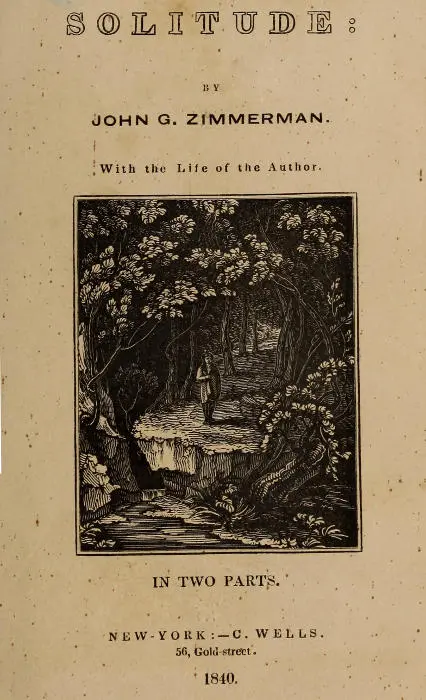
"Solitude" by Johann Georg Zimmermann is a philosophical treatise written in the late 18th century. This work explores the theme of solitude, emphasizing its impact on the human mind and heart while analyzing its benefits and drawbacks. Zimmermann aims to enlighten readers on how occasional retirement can foster happiness, intellectual clarity, and a deeper understanding of oneself and society. At the start of the book, Zimmerman introduces the concept of solitude as an intellectual state where the mind retreats into self-reflection, asserting that true solitude can exist even amidst social gatherings. He observes that modern society often undervalues solitude, mistaking it for misery or isolation, while arguing that it is essential for genuine happiness and intellectual growth. The opening chapters set the stage for a detailed exploration of solitude's influences on human emotions, well-being, and the creative mind, positioning it as a powerful means to achieve true felicity.
Introduction adapted from the source catalogue; source summaries may be automatically generated.
Free to read · English · 115,833 words · No account needed
MAKE TIME FOR A GOOD BOOK
On by default. Untick to stop anonymous reading totals. Each page counts after 10 seconds in view. How this works.
Anonymous counting is on unless you have switched it off.
Neglect the grumblers of an envious age,
Vapid in spleen, or brisk in frothy rage;
Critics, who, ere they understand, defame;
And seeming friends who only do not blame,
And puppet prattlers, whose unconscious throat
Transmits what the pert witling prompts by rote:
Let him neglect this blind and babbling crowd,
To enjoy the favor of the wise and good.
Slander, however, by fixing her talons on the most virtuous characters, generally defeats her own malice, and proclaims their merit. It may, indeed, tend to diminish their inclination for general society, and to render them, in some degree, apprehensive of the danger of even well deserved fame. “Durable fame,” says Petrarch, “is only to be derived from the practice of virtue, and from such works as are worthy of descending from generation to generation. As to praters, gowned gentlemen, that walk in their silks, glitter in their jewels, and are pointed at by the people, all their bravery and pomp, their show of knowledge, and their thundering speeches, last only with their lungs, and then vanish into thin smoke; for the acquisition of wealth, and the desires of ambition, are no witnesses of true desert. I think I shall have fame after my death; and that is a fame from which no profit is derived; but, on the contrary, frequently injures, while alive, the person who is to enjoy it when dead. What procured the destruction of Cicero, Demosthenes, and Zeno, but foul and haggard envy of their fame? What brought the chosen men of the great ship Argos to Colchis, but the fame of that king’s riches? For what else was signified by the Golden Fleece, but the riches seized by these marauders, destitute of true riches, and who were clad with fleeces not their own?” Many, indeed, whose merits have cast a radiance around their characters, have hidden its splendors with the shades of retirement to avoid giving uneasiness to envy; and, by being deprived of that warm and aspiring tribute of applause which they had gloriously and justly earned, have, in some instances at least, indulged too keen a sense of the depravity of mankind. Solon, after having in vain exhorted the Athenians to resist the tyranny of Pisistratus, and save the liberties of that country, on which he had conferred such distinguished services, returned to his own house, and placing his weapons at the street door, exclaimed, as a last effort, “I have done all in my power to save my country and defend its laws!” and then retired from the tumults of public life, to weep in silence over the servility of the Athenians, and the fate of Athens. History affords many illustrious instances, both ancient and modern, of the like kind: for there never was a statesman, who possessed a great mind and manly feelings, that did not, even during the plentitude of his power, occasionally wish to escape from the incorrigible vices which prevail in courts, to the enjoyment of the more innocent pleasures and humble virtues which surround the cottage. Such exalted characters cannot observe, without the highest disgust, and keenest indignation, the virtues of the best, and the services of the bravest men of the nation, blasted by the envious breath of brainless placemen, or the insidious insinuations of female favorites, whose whole time is employed in caressing their monkies and paroquets, or in aspersing the merits of those who boldly seek their fortune by the open and manly road of true desert, and not by the deep, dark, and crooked paths of flattery and intrigue. Can such a man behold the double dealing and deceitful artifices by which the excellency of princes is corrupted, their imaginations dazzled, their discernment blinded, and their minds led astray without feeling uncommon indignation? Certainly not. But however acutely his bosom may feel, or tongue express his sense of such prevailing practices, he must still be forced to see, with even a more contemptuous and painful sensation, that envious rage and jealous asperity, which burst from the cringing crowd of mean and abject courtiers, on hearing the monarch, in the grateful feelings of his heart, applaud the eminent and faithful services of some gallant officer. Dion was the principal statesman at the court of Dionysius, and the deliverer of Sicily. When the younger Dionysius succeeded to the throne of his father, Dion, in the first council that he held, spoke with so much propriety on the existing state of affairs, and on the measures which ought to be taken, that the surrounding courtiers appeared to be mere children in comparison. By the freedom of his counsels he exposed, in a strong light, the slavish principles of those who, through a timorous disingenuity, advised such measures as they thought would please their prince, rather than such as might advance his interest. But what alarmed them most, were the steps he proposed to take with regard to the impending war with Carthage; for he offered either to go in person to Carthage, and settle an honorable peace with the Carthagenians, or, if war should be inevitable, to fit out and maintain fifty gallies at his own expense. Dionysius was pleased with the magnificence of his spirit; but his courtiers felt that it made them appear little; and agreeing that, at all events, Dion was to be crushed, they spared for that purpose no calumny that malice could suggest. They represented to the king that this favorite certainly meant to make himself master by sea, and by that means to obtain the kingdom for his sister’s children. There was, moreover, another and obvious cause of their hatred to him, in the reserve of his manners, and the sobriety of his life. They led the young and ill-educated king through every species of debauchery, and were the shameless panders of his wrong directed passions. Their enmity to Dion, who had no taste for luxurious enjoyments, was a thing of course; and as he refused to partake with them in their vices, they resolved to strip him of his virtues; to which they gave the name of such vices as are supposed to resemble them. His gravity of manners they called pride; his freedom of speech, insolence; his declining to join in their licentiousness, contempt. It is true, there was a natural haughtiness in his deportment and an asperity that was unsociable, and difficult of access; so that it was not to be wondered at if he found no ready admission to the ears of a young king, already spoiled by flattery. Willing to impute the irregularities of Dionysius to ignorance and bad education, Dion endeavored to engage him in a course of liberal studies, and to give him a taste for those sciences which have a tendency to moral improvement. But in this wise and virtuous resolution he was opposed by all the artifices of court intrigue.
Your reading position is saved on this browser. Take it to another device with a library code. Reading pages adapt to text, rather than matching a printed edition.
BEHIND THE BOOK
This eBook is for the use of anyone anywhere in the United States and most other parts of the world at no cost and with almost no restrictions whatsoever. You may copy it, give it away or re-use it under the terms of the Project Gutenberg License included with this eBook or online at www.gutenberg.org. If you are not located in the United States, you will have to check the laws of the country where you are located before using this eBook. Read the source licence.
The original source file, including credits and licence, is retained by this library. Request an original-format copy at no charge. Please include the book title and Project Gutenberg identifier #55898.
KEEP YOUR CURIOSITY GOING
David Patterson (Spirit) Hatch
Coulson Kernahan

Ralph Waldo Emerson
Frances Wright

Edwin Abbott Abbott

Joseph Droz