THE CLASSIC COLLECTION✦Scepticism and animal faithCLASSIC FREE BOOKS
Scepticism and animal faith
George Santayana
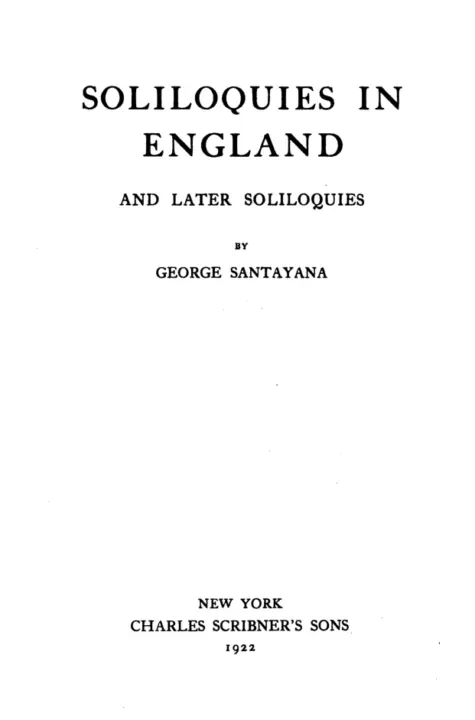
THE CLASSIC COLLECTION · 1922
"Soliloquies in England, and Later Soliloquies" by George Santayana is a philosophical collection of reflective essays written during the early 20th century. The central focus of the work is Santayana's musings and observations on English culture and his personal experiences in England amidst the backdrop of World War I. Through introspective soliloquies, he delves into topics of nature, philosophy, and the complexities of human existence, blending personal narrative with broader cultural commentary. The opening portion of the text introduces readers to the author's background and the context in which the essays were composed. Santayana shares his experiences in England from 1914 to 1918, portraying how the tranquility of nature contrasts sharply with the turmoil of war. He reflects on the significance of his surroundings, the beauty of the English landscape, and the nuanced character of the British people. The prose is rich with imagery and philosophical musings, offering a glimpse into not only the author's emotional state but also his admiration for the cultural and natural elements of England, setting the stage for deeper explorations of liberty, individuality, and the human condition throughout the rest of the collection.
Introduction adapted from the source catalogue; source summaries may be automatically generated.
Free to read · English · 97,788 words · No account needed
MAKE TIME FOR A GOOD BOOK
On by default. Untick to stop anonymous reading totals. Each page counts after 10 seconds in view. How this works.
Anonymous counting is on unless you have switched it off.
"It was all Mrs. Bumble. She would do it," urged Mr.
Bumble; first looking found to ascertain that his partner
had left the room.
"That is no excuse," replied Air. Brownlow. "You were present on the occasion of the destruction of these trinkets, and indeed are the more guilty of the two, in the eye of the law; for the law supposes that your wife acts under your direction."
"If the law supposes that," said Mr. Bumble, squeezing his hat emphatically in both hands, "the law is a ass, a idiot. If that's the eye of the law, the law is a bachelor; and the worst I wish the law is, that his eye may be opened by experience--by experience."
Laying great stress on the repetition of these two words, Mr. Bumble fixed his hat on very tight, and putting his hands in his pockets, followed his helpmate downstairs.
This is high comedy; the irresistible, absurd, intense dream of the old fool, personifying the law in order to convince and to punish it. I can understand that this sort of thing should not be common in English literature, nor much relished; because pure comedy is scornful, merciless, devastating, holding no door open to anything beyond. Cultivated English feeling winces at this brutality, although the common people love it in clowns and in puppet shows; and I think they are right. Dickens, who surely was tender enough, had so irresistible a comic genius that it carried him beyond the gentle humour which most Englishmen possess to the absolute grotesque reality. Squeers, for instance, when he sips the wretched dilution which he has prepared for his starved and shivering little pupils, smacks his lips and cries: "Here's richness!" It is savage comedy; humour would come in if we understood (what Dickens does not tell us) that the little creatures were duly impressed and thought the thin liquid truly delicious. I suspect that English sensibility prefers the humour and wit of Hamlet to the pure comedy of Falstaff; and that even in Aristophanes it seeks consolation in the lyrical poetry for the flaying of human life in the comedy itself. Tastes are free; but we should not deny that in merciless and rollicking comedy life is caught in the act. The most grotesque creatures of Dickens are not exaggerations or mockeries of something other than themselves; they arise because nature generates them, like toadstools; they exist because they can't help it, as we all do. The fact that these perfectly self-justified beings are absurd appears only by comparison, and from outside; circumstances, or the expectations of other people, make them ridiculous and force them to contradict themselves; but in nature it is no crime to be exceptional. Often, but for the savagery of the average man, it would not even be a misfortune. The sleepy fat boy in Pickwick looks foolish; but in himself he is no more foolish, nor less solidly self-justified, than a pumpkin lying on the ground. Toots seems ridiculous; and we laugh heartily at his incoherence, his beautiful waistcoats, and his extreme modesty; but when did anybody more obviously grow into what he is because he couldn't grow otherwise? So with Mr. Pickwick, and Sam Weller, and Mrs. Gamp, and Micawber, and all the rest of this wonderful gallery; they are ridiculous only by accident, and in a context in which they never intended to appear. If Oedipus and Lear and Cleopatra do not seem ridiculous, it is only because tragic reflection has taken them out of the context in which, in real life, they would have figured. If we saw them as facts, and not as emanations of a poet's dream, we should laugh at them till doomsday; what grotesque presumption, what silly whims, what mad contradiction of the simplest realities! Yet we should not laugh at them without feeling how real their griefs were; as real and terrible as the griefs of children and of dreams. But facts, however serious inwardly, are always absurd outwardly; and the just critic of life sees both truths at once, as Cervantes did in Don Quixote. A pompous idealist who does not see the ridiculous in all things is the dupe of his sympathy and abstraction; and a clown, who does not see that these ridiculous creatures are living quite in earnest, is the dupe of his egotism. Dickens saw the absurdity, and understood the life; I think he was a good philosopher.
Your reading position is saved on this browser. Take it to another device with a library code. Reading pages adapt to text, rather than matching a printed edition.
George Santayana

George Santayana

George Santayana
George Santayana
BEHIND THE BOOK
This eBook is for the use of anyone anywhere in the United States and most other parts of the world at no cost and with almost no restrictions whatsoever. You may copy it, give it away or re-use it under the terms of the Project Gutenberg License included with this eBook or online at www.gutenberg.org. If you are not located in the United States, you will have to check the laws of the country where you are located before using this eBook. Read the source licence.
The original source file, including credits and licence, is retained by this library. Request an original-format copy at no charge. Please include the book title and Project Gutenberg identifier #48429.
KEEP YOUR CURIOSITY GOING

David Patterson (Spirit) Hatch

David Patterson (Spirit) Hatch

David Patterson (Spirit) Hatch
Cécile Tormay

Moritz Busch
Coulson Kernahan