THE CLASSIC COLLECTION✦Scepticism and animal faithCLASSIC FREE BOOKS
Scepticism and animal faith
George Santayana
THE CLASSIC COLLECTION · 1922
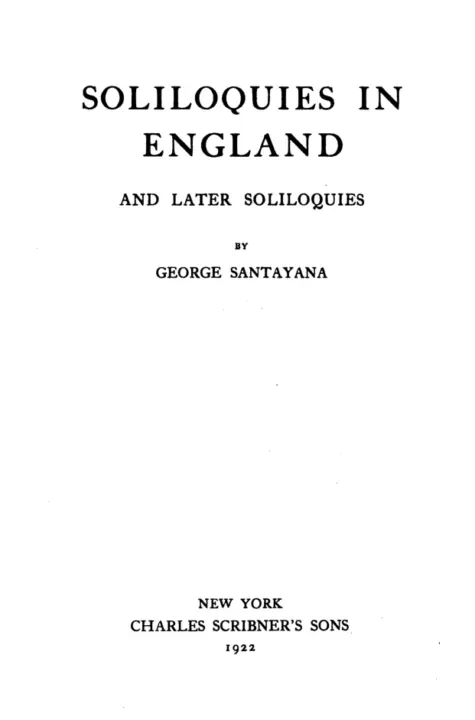
"Soliloquies in England, and Later Soliloquies" by George Santayana is a philosophical collection of reflective essays written during the early 20th century. The central focus of the work is Santayana's musings and observations on English culture and his personal experiences in England amidst the backdrop of World War I. Through introspective soliloquies, he delves into topics of nature, philosophy, and the complexities of human existence, blending personal narrative with broader cultural commentary. The opening portion of the text introduces readers to the author's background and the context in which the essays were composed. Santayana shares his experiences in England from 1914 to 1918, portraying how the tranquility of nature contrasts sharply with the turmoil of war. He reflects on the significance of his surroundings, the beauty of the English landscape, and the nuanced character of the British people. The prose is rich with imagery and philosophical musings, offering a glimpse into not only the author's emotional state but also his admiration for the cultural and natural elements of England, setting the stage for deeper explorations of liberty, individuality, and the human condition throughout the rest of the collection.
Introduction adapted from the source catalogue; source summaries may be automatically generated.
Free to read · English · 97,788 words · No account needed
MAKE TIME FOR A GOOD BOOK
On by default. Untick to stop anonymous reading totals. Each page counts after 10 seconds in view. How this works.
Anonymous counting is on unless you have switched it off.
Having humility, that most liberating of sentiments, having a true vision of human existence and joy in that vision, Dickens had in a superlative degree the gift of humour, of mimicry, of unrestrained farce. He was the perfect comedian. When people say Dickens exaggerates, it seems to me they can have no eyes and no ears. They probably have only notions of what things and people are; they accept them conventionally, at their diplomatic value. Their minds run on in the region of discourse, where there are masks only and no faces, ideas and no facts; they have little sense for those living grimaces that play from moment to moment upon the countenance of the world. The world is a perpetual caricature of itself; at every moment it is the mockery and the contradiction of what it is pretending to be. But as it nevertheless intends all the time to be something different and highly dignified, at the next moment it corrects and checks and tries to cover up the absurd thing it was; so that a conventional world, a world of masks, is superimposed on the reality, and passes in every sphere of human interest for the reality itself. Humour is the perception of this illusion, the fact allowed to pierce here and there through the convention, whilst the convention continues to be maintained, as if we had not observed its absurdity. Pure comedy is more radical, cruder, in a certain sense less human; because comedy throws the convention over altogether, revels for a moment in the fact, and brutally says to the notions of mankind, as if it slapped them in the face, There, take that! That's what you really are I At this the polite world pretends to laugh, not tolerantly as it does at humour, but a little angrily. It does not like to see itself by chance in the glass, without having had time to compose its features for demure self-contemplation. "What a bad mirror," it exclaims; "it must be concave or convex; for surely I never looked like that. Mere caricature, farce, and horse play. Dickens exaggerates; I never was so sentimental as that; I never saw anything so dreadful; I don't believe there were ever any people like Quilp, or Squeers, or Serjeant Buzfuz." But the polite world is lying; there are such people; we are such people ourselves in our true moments, in our veritable impulses; but we are careful to stifle and to hide those moments from ourselves and from the world; to purse and pucker ourselves into the mask of our conventional personality; and so simpering, we profess that it is very coarse and inartistic of Dickens to undo our life's work for us in an instant, and remind us of what we are. And as to other people, though we may allow that considered superficially they are often absurd, we do not wish to dwell on their eccentricities, nor to mimic them. On the contrary, it is good manners to look away quickly, to suppress a smile, and to say to ourselves that the ludicrous figure in the street is not at all comic, but a dull ordinary Christian, and that it is foolish to give any importance to the fact that its hat has blown off, that it has slipped on an orange-peel and unintentionally sat on the pavement, that it has a pimple on its nose, that its one tooth projects over its lower lip, that it is angry with things in general, and that it is looking everywhere for the penny which it holds tightly in its hand. That may fairly represent the moral condition of most of us at most times; but we do not want to think of it; we do not want to see; we gloss the fact over; we console ourselves before we are grieved, and reassert our composure before we have laughed. We are afraid, ashamed, anxious to be spared. What displeases us in Dickens is that he does not spare us; he mimics things to the full; he dilates and exhausts and repeats; he wallows. He is too intent on the passing experience to look over his shoulder, and consider whether we have not already understood, and had enough. He is not thinking of us; he is obeying the impulse of the passion, the person, or the story he is enacting. This faculty, which renders him a consummate comedian, is just what alienated from him a later generation in which people of taste were aesthetes and virtuous people were higher snobs; they wanted a mincing art, and he gave them copious improvization, they wanted analysis and development, and he gave them absolute comedy. I must confess, though the fault is mine and not his, that sometimes his absoluteness is too much for me. When I come to the death of Little Nell, or to What the Waves were always Saying, or even to the incorrigible perversities of the pretty Dora, I skip. I can't take my liquor neat in such draughts, and my inner man says to Dickens, Please don't. But then I am a coward in so many ways! There are so many things in this world that I skip, as I skip the undiluted Dickens! When I reach Dover on a rough day, I wait there until the Channel is smoother; am I not travelling for pleasure? But my prudence does not blind me to the admirable virtue of the sailors that cross in all weathers, nor even to the automatic determination of the sea-sick ladies, who might so easily have followed my example, if they were not the slaves of their railway tickets and of their labelled luggage. They are loyal to their tour, and I to my philosophy. Yet as wrapped in my great-coat and sure of a good dinner, I pace the windy pier and soliloquize, I feel the superiority of the bluff tar, glad of breeze, stretching a firm arm to the unsteady passenger, and watching with a masterful thrill of emotion the home cliffs receding and the foreign coasts ahead. It is only courage (which Dickens had without knowing it) and universal kindness (which he knew he had) that are requisite to nerve us for a true vision of this world. And as some of us are cowards about crossing the Channel, and others about "crossing the bar," so almost everybody is a coward about his own humanity. We do not consent to be absurd, though absurd we are. We have no fundamental humility. We do not wish the moments of our lives to be caught by a quick eye in their grotesque initiative, and to be pilloried in this way before our own eyes. For that reason we don't like Dickens, and don't like comedy, and don't like the truth. Dickens could don the comic mask with innocent courage; he could wear it with a grace, ease, and irresistible vivacity seldom given to men. We must go back for anything like it to the very greatest comic poets, to Shakespeare or to Aristophanes. Who else, for instance, could have penned this:
Your reading position is saved on this browser. Take it to another device with a library code. Reading pages adapt to text, rather than matching a printed edition.
George Santayana

George Santayana

George Santayana
George Santayana
BEHIND THE BOOK
This eBook is for the use of anyone anywhere in the United States and most other parts of the world at no cost and with almost no restrictions whatsoever. You may copy it, give it away or re-use it under the terms of the Project Gutenberg License included with this eBook or online at www.gutenberg.org. If you are not located in the United States, you will have to check the laws of the country where you are located before using this eBook. Read the source licence.
The original source file, including credits and licence, is retained by this library. Request an original-format copy at no charge. Please include the book title and Project Gutenberg identifier #48429.
KEEP YOUR CURIOSITY GOING

David Patterson (Spirit) Hatch

David Patterson (Spirit) Hatch

David Patterson (Spirit) Hatch
Cécile Tormay

Moritz Busch
Coulson Kernahan