THE CLASSIC COLLECTION✦An outlaw’s diary: the CommuneCLASSIC FREE BOOKS
An outlaw’s diary: the Commune
Cécile Tormay
THE CLASSIC COLLECTION · 1864
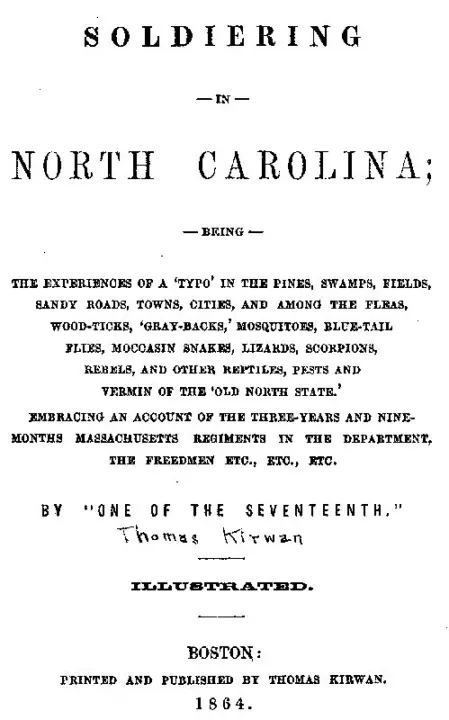
"Soldiering in North Carolina" by Thomas Kirwan is a historical account written in the mid-19th century. The work recounts the experiences of the author, a soldier in the 17th Massachusetts Regiment, as he serves in various capacities during the Civil War in the southern state of North Carolina. The narrative likely focuses on the challenges and adventures faced by Kirwan and his fellow soldiers, offering insights into military life, local conditions, and interactions with both soldiers and local civilians, including freed slaves. At the start of the text, Kirwan introduces himself as a recruit in the 17th Massachusetts Regiment, elaborating on the tumultuous period that leads to their deployment in North Carolina. He describes the process of enlistment, the journey southward, and the initial experiences of camp life, highlighting the discomforts and camaraderie among his fellow soldiers. Through vivid anecdotes, Kirwan paints a picture of wartime realities, including encounters with nature, local inhabitants, and the various challenges soldiers face, from mundane daily routines to the psychological toll of military service amid a conflict-filled environment.
Introduction adapted from the source catalogue; source summaries may be automatically generated.
Free to read · English · 40,980 words · No account needed
MAKE TIME FOR A GOOD BOOK
On by default. Untick to stop anonymous reading totals. Each page counts after 10 seconds in view. How this works.
Anonymous counting is on unless you have switched it off.
"Well, then, let us smash in ze door."
"But we will be heard by the guerillas who may not be far off, and what would we do if a dozen of them should come upon us?"
"Fight, I teenk."
"Fight! What chance would we have against so many?"
"We could fire, and re-treet."
"Yes; but they would probably surround us before we knew it."
"Well--dhan, I suppose we must be tak-en pree-so-neer."
"And would you like that, Charley?"
"I sup-pose if we cannot help it--what you do?" and he shrugged his
shoulders.
"Are you willing to run the risk?"
"Oui--if you say so!"
But believing there might be an easier way of 'breaking and entering,' besides attacking the formidable door before us, I suggested a reconnoitre of the rear, where we found an opening defended only by a few boards nailed crosswise. These were soon ripped off, and, leaving Charley to guard against any surprise from without, I entered, taking his canteen, and proceeded to explore. There was corn in soak, and plenty of empty casks; but no whiskey. At length I lit upon a stone jug nearly full, from which came the smell of whiskey, and, giving Charley to understand I had found the prize, I proceeded to fill both the canteens, after having accomplished which, I thought it would be nothing out of the way to save what I had secured as much as possible, and therefore proceeded to fortify myself with a pull at the jug; but the first mouthful convinced me that the prize I had secured was not whiskey, but water (no doubt, the jug had contained whiskey once, as was evident from the smell). Vexed at my disappointment, I proceeded to examine further, but with no success, and I finally emerged empty-handed as I had entered. Charley was as much disappointed as I, but a shrug and muttered 'sacre' was all the evidence he gave of it. We then broke into the mill; but found nothing there except corn and some empty kegs. We went to a house or barn in the rear, filled with corn, but were equally unsuccessful. There was a house about a mile distant from the mill, and after a consultation, in which it was taken for granted that it must belong to the owner of the distillery, we started for it. Within a quarter of a mile of the house was a grove of young pines, and there we halted and arranged that I should go forward alone, and in case of danger Charley could come up at the proper, time, when I would ask him where he left the rest of the men, and he was to reply--"Waiting in the grove." Fixing on my bayonet, and looking to see if the cap of my piece was all right, I moved for the house, which I reached without molestation or discovery, except by a sentinel dog (not a fierce one), who retreated in good order at my approach. I entered the first door I came to, and proceeded through a bed room into which it opened, to the kitchen or general room of the house. My heavy tread announced a stranger, I suppose, for half a dozen females and as many children came in at once, and seemed transfixed and terrified at the apparition they beheld. Giving assurance that I intended no harm to any of them, I inquired if the master of the house was at home, and if so, where he then was? After a little hesitation, they told me he was in the garden, in front. I went out to him, and he returned my salutation without any exhibition of ill-will. I inquired if guerillas were numerous in the neighborhood, which he denied, saying, however, at length, that there had been 'a right smart' of mounted men in the neighborhood a short time previously. At this juncture Charley came up, and I questioned, and received such answer from him as agreed upon. I inquired about the distillery, but the planter disclaimed its ownership, saying that the man who owned it, lived a 'right smart' distance beyond. Had he any whiskey? No, sir; he hadn't a drop--we might search if we pleased--he had nothing in that line but some peach brandy (spirits), which had been burnt in the distillation, but was just as good, and we were welcome to it. Taking him at his word, we poured into our canteens enough of the spirits to warrant our filling them with water, and still leave a strong drink (I didn't have the heart to take all). We then asked if he had anything to eat, as we were hungry, when his wife immediately set before us a good dish of pork, corn bread, and sweet potatoes, which we did ample justice to. The children became more familiar, and some of the youngest actually came up to us, to share in our meal. They were the finest children I had seen in North Carolina. Thanking our host--for we had nothing better to give in return--we retraced our steps in better spirits, and soon rejoined our struggling and straggling comrades, who had been, and were still, wending along on their weary way.
Your reading position is saved on this browser. Take it to another device with a library code. Reading pages adapt to text, rather than matching a printed edition.
BEHIND THE BOOK
This eBook is for the use of anyone anywhere in the United States and most other parts of the world at no cost and with almost no restrictions whatsoever. You may copy it, give it away or re-use it under the terms of the Project Gutenberg License included with this eBook or online at www.gutenberg.org. If you are not located in the United States, you will have to check the laws of the country where you are located before using this eBook. Read the source licence.
The original source file, including credits and licence, is retained by this library. Request an original-format copy at no charge. Please include the book title and Project Gutenberg identifier #45894.
KEEP YOUR CURIOSITY GOING
Cécile Tormay

Moritz Busch
John L. Ransom
Frances Wright
Cécile Tormay

Mabel Potter Daggett