THE CLASSIC COLLECTION✦An outlaw’s diary: the CommuneCLASSIC FREE BOOKS
An outlaw’s diary: the Commune
Cécile Tormay
THE CLASSIC COLLECTION · 1864
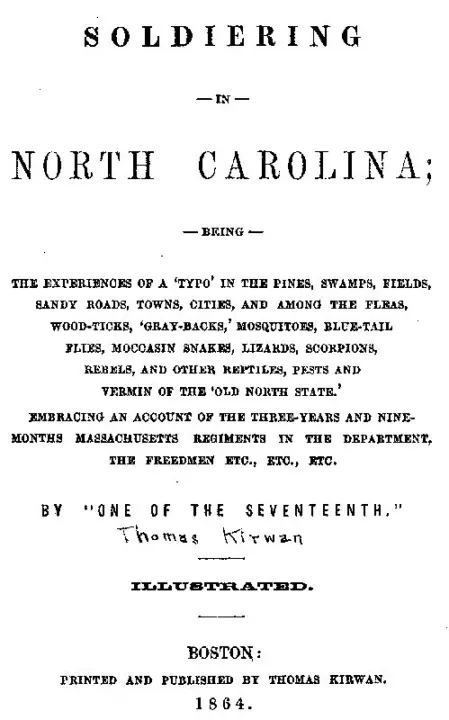
"Soldiering in North Carolina" by Thomas Kirwan is a historical account written in the mid-19th century. The work recounts the experiences of the author, a soldier in the 17th Massachusetts Regiment, as he serves in various capacities during the Civil War in the southern state of North Carolina. The narrative likely focuses on the challenges and adventures faced by Kirwan and his fellow soldiers, offering insights into military life, local conditions, and interactions with both soldiers and local civilians, including freed slaves. At the start of the text, Kirwan introduces himself as a recruit in the 17th Massachusetts Regiment, elaborating on the tumultuous period that leads to their deployment in North Carolina. He describes the process of enlistment, the journey southward, and the initial experiences of camp life, highlighting the discomforts and camaraderie among his fellow soldiers. Through vivid anecdotes, Kirwan paints a picture of wartime realities, including encounters with nature, local inhabitants, and the various challenges soldiers face, from mundane daily routines to the psychological toll of military service amid a conflict-filled environment.
Introduction adapted from the source catalogue; source summaries may be automatically generated.
Free to read · English · 40,980 words · No account needed
MAKE TIME FOR A GOOD BOOK
On by default. Untick to stop anonymous reading totals. Each page counts after 10 seconds in view. How this works.
Anonymous counting is on unless you have switched it off.
The result of our day's work may be summed up in a few words--we beat the rebels from a strong position, took over 500 prisoners, and 11 pieces of artillery.
The battle of Kinston was won on the same day on which the battle of
Fredericksburg was fought.
On Monday morning we were awakened early, and with the 9th New Jersey, took up the advance. Recrossing the bridge, we passed over the battle-field, and here I observed a fine mastiff laying down beside the body of his dead rebel master. I had often read of such things; but I had at last the privilege of seeing for myself that noble instinct of affection which binds so closely the ties between man and the inferior animals.
About two miles on the road to Whitehall (for we had turned off in that direction), I left the ranks, and went into a house at the roadside. A poor widow, with three or four young children, constituted the family. The poor woman seemed terribly frightened, and in a tremulous voice told me her husband had been in the rebel army, and had died at Manassas; that she had to depend for her support, and that of her children, upon the labor of the loom, and that the house she lived in was given her for occupation, free, by a gentleman who owned the plantation on which it stood. She gave me some corn-bread, and I gave her in exchange a few biscuit and some tobacco, for she smoked; and with pity in my heart for the poor woman and her helpless family, I left them, none the worse off for my visit, and rejoined the regiment which had halted for a rest a short distance ahead.
About mid-day, however, I began to feel my legs growing stiff, and being unable to keep up with the regiment, I 'fell out' and straggled--for the first time. Charles Renaud (our late cook, whom I have mentioned before) was in the same boat, and we soon came together, and together trudged on as best we could, rested together, made our coffee together, and together visited many points of interest and attraction on our route, gathering a stray honeycomb here, and a stray piece of corn bread there; but the grand object of our search (which was anything of a spirituous or malt nature we could get hold of--whiskey preferred) could not be found. At length, shortly after mid-day, we came in sight of a really handsome one-story cottage house, evidently the abode of wealth and refinement, and thither we went, but only to find that we had been anticipated; the house deserted by all save a negro, and every thing in the most delightful confusion--drawers pulled out, and their contents scattered about, chairs and furniture broken, and every portable thing of value missing. But we were not disappointed at this, as our object was not plunder, but--whiskey. Bringing the point of my bayonet in close proximity to the darky's breast, I conjured him as he wished for the success of the North, and his own freedom and life, to tell me if he had any whiskey or apple-jack stowed away about the premises. He turned pale (that is, for a darky), his knees smote together, and, with an agonizing appeal to spare his life (which was perfectly unnecessary, inasmuch as I had no notion of confiscating it) and solemn assurances that there was nothing of the kind on the premises, directed me to a distillery, which, he averred, lay in from the road about 'haaf' a mile, on the right hand, just after crossing the second branch. Off we started, and on our way questioned a farmer, who, with horse and team, was requested to accompany the army so that he should not give information to his rebel friends of its whereabouts--Foster having given them the slip--but he stoutly denied all knowledge of its whereabouts, averring that there was nothing of the kind within twenty miles. Somewhat staggered by this information, we were about giving up the search; but depending more upon the darky's word than that of Mr. Secesh, we finally concluded to give the place a trial. We struck off at the point indicated, and followed a rough cart-road, which, a short distance onward, diverged into numerous roads and bridle-paths, to choose between which was no little difficulty. At length we pitched upon one, and having disencumbered ourselves of blankets, overcoats, and haversacks, which we secreted behind a fallen tree, set forward, determined to see the end of that road, at the same time keeping a wary eye in case we should stumble upon a stray guerilla party. Instead of going 'haaf' a mile, we went over two miles before we came in sight of the object of our search, which was just beyond a grist-mill, on the bank of a stream. We knew it to be a distillery by the number of casks and barrels around it, and by the peculiar odor arising from it, borne to our nostrils on the wings of the wind. But all was deserted; the mill and still-house were locked, bolted and barred, and our cautious advance found no opposition from anything animate. We paused before the strongly protected door of the distillery, and I doubted our ability to break the lock.
Your reading position is saved on this browser. Take it to another device with a library code. Reading pages adapt to text, rather than matching a printed edition.
BEHIND THE BOOK
This eBook is for the use of anyone anywhere in the United States and most other parts of the world at no cost and with almost no restrictions whatsoever. You may copy it, give it away or re-use it under the terms of the Project Gutenberg License included with this eBook or online at www.gutenberg.org. If you are not located in the United States, you will have to check the laws of the country where you are located before using this eBook. Read the source licence.
The original source file, including credits and licence, is retained by this library. Request an original-format copy at no charge. Please include the book title and Project Gutenberg identifier #45894.
KEEP YOUR CURIOSITY GOING
Cécile Tormay

Moritz Busch
John L. Ransom
Frances Wright
Cécile Tormay

Mabel Potter Daggett