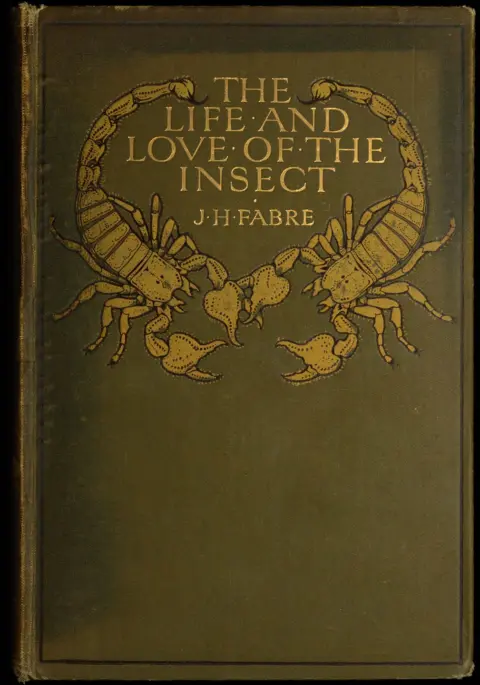
The Life and Love of the Insect
Jean-Henri Fabre
THE CLASSIC COLLECTION · 1911
"Social Life in the Insect World" by Jean-Henri Fabre is a scientific publication written in the early 20th century. The book explores the intricate behaviors and social structures of various insects, notably beginning with a discussion of the famous fable of the Cicada and the Ant. Fabre aims to correct misconceptions about these insects while detailing their life cycles, habits, and interactions within their ecological communities. The opening of the work sets the stage with a critique of the fable of the Cicada and the Ant, highlighting how the traditional narrative misrepresents the relationships between these insects. Fabre discusses the cultural misconceptions surrounding the Cicada as a careless singer who suffers during winter, while in truth, he argues, it is the industrious Ant that seeks sustenance from the Cicada's sweet excretions during hot summer days. Through vivid descriptions and analytical observations, Fabre introduces readers to the fascinating world of insects, advocating for a deeper understanding of their behaviors in contrast to popular fables.
Introduction adapted from the source catalogue; source summaries may be automatically generated.
Free to read · English · 90,842 words · No account needed
MAKE TIME FOR A GOOD BOOK
On by default. Untick to stop anonymous reading totals. Each page counts after 10 seconds in view. How this works.
Anonymous counting is on unless you have switched it off.
Mantis, the Empusa pauperata, 97
Mantis, the Grey, 96
Mantis, the Praying, 68-101
Cannibalism of, 82-5
Courtship, 79-83
Hunter, as, 68-78
Nest of, 86-101
Melolontha fullo, see Pine-chafer
Minotaur, 225
Oak Eggar, the, 202-16, 234-7
Experiments as to sense of smell in males, 208-15
Swarming of males during the mating season, 204-15
Odynerus, 150-1, 172
Osmia tricornis, 173, 175
Pea, ancestry of the, 258-9
Pea-Weevil, see Weevil
Peacock Moth, the Great, 179-201, 234-7
Appearance of, 179
Experiments as to sense of smell in males, 184-97
Invasion of house by males, 180-1
Swarming of males, 181-3
Peacock Moth, the Lesser, 197-201
Phalangist, the, 225
Philanthus aviporus, 150-178
Cocoon of, 168
Diet of, 150-1
Larvae of, 168
Methods of killing and robbing bees, 151-160
Motives of robbery, 163-78
Nest of, 167
Philanthus coronatus, 178
Philanthus raptor, 178
Pine-chafer, the, 317-23
Appearance of, 320
Cry of, 322-3
Habits of, 321
Medical qualities of, supposed, 318-19
Name, origin of Latin, 317-18
Pliny, on the Pine-chafer, 318-19
Saprinidae, victims of arum, 233
Sapromyzon, the, 222
Scarabaeus, see Golden Scarabaeus
Scent in Insects, see Peacock Moth,
Oak Eggar, Bolboceras Gallicus, arum, putrid
Scolia, 171
Sisyphus, legend of, 139
Sisyphus Beetle, the, 136-49
Burrow of, 143
Larva of, 147-9
Mating of, 142-3
Paternal instinct of 142-6
Pellet of, 142-9
Tachytus, 172
Tigno, nest of Mantis, 99-101
Truffle-Beetle, 222
Truffle-Dog, 218-20
Weevil, Acorn, see Elephant-Beetle
Weevil, the Lentil, 291
Weevil, the Haricot, 282-94
Habits of, 291-6
Invasion of, 284
Larvae, 297-9
Weevil, the Pea, 258-81, 295
Description of, 261
Enemy, its chief, 280-1
Habits, 261-5
(Deductions to be drawn from), 273-4
Larvae of, 268-71, 275-6
[Footnote 1: Whether the Cigale is absolutely deaf or not, it is certain that one Cigale would be able to perceive another's cry. The vibrations of the male Cigale's cry would cause a resonance, a vibration, in the body cavities of other male Cigales, and to a lesser extent in the smaller cavities in the bodies of the females. Other sounds would cause a slight shock, if loud enough, but not a perceptible vibration May not this vibration--felt as in a cathedral we feel the vibrations of the organ-pipes in the bones of the chest and head or on the covers of the hymn-book in our hands--serve to keep the insects together, and enable the females to keep within sight of the males? The sight of an insect is in one sense poor--it consists of a kind of mosaic picture, and for one insect to distinguish another clearly the distance between them must not be very great. Certain gregarious birds and fish whose colouring is protective have a habit of showing their white bellies as they swerve on changing their direction. These signals help to keep the flock together. The white scut of the rabbit and of certain deer is a signal for other deer or rabbits to follow a frightened flock. It is obviously to the advantage of the Cigale to follow a gregarious habit, if only for purposes of propagation, for this would be facilitated by the sexes keeping together, and, deaf or otherwise, the vibrations of its cry would enable it to do so. It would be easy to show a priori that the perception of such vibrations must cause the insect pleasure, as they stimulate a nervous structure attuned to the perception or capable of the production of certain complex vibrations. The discord of the cry is caused by the fact that it consists of a number of vibrations of different pitch. Some would set the contents of the male resonating cavities in vibration; others would affect the less regular cavities in the thorax of the female. We might compare the Cigale's cry to a sheep-bell. That it is felt and not heard explains its loudness and its grating quality. A Cigale with the resonating cavities destroyed would possibly be lost. The experiment is worth trying.--[TRANS.]]
Your reading position is saved on this browser. Take it to another device with a library code. Reading pages adapt to text, rather than matching a printed edition.
Jean-Henri Fabre
Jean-Henri Fabre
Jean-Henri Fabre
Jean-Henri Fabre
BEHIND THE BOOK
This eBook is for the use of anyone anywhere in the United States and most other parts of the world at no cost and with almost no restrictions whatsoever. You may copy it, give it away or re-use it under the terms of the Project Gutenberg License included with this eBook or online at www.gutenberg.org. If you are not located in the United States, you will have to check the laws of the country where you are located before using this eBook. Read the source licence.
The original source file, including credits and licence, is retained by this library. Request an original-format copy at no charge. Please include the book title and Project Gutenberg identifier #18350.
KEEP YOUR CURIOSITY GOING

John Muir

Asa Gray
Asa Gray

Florence Nightingale
Elizabeth Robins Pennell
Denison Olmsted