
Tropical nature, and other essays
Alfred Russel Wallace
THE CLASSIC COLLECTION · 1913
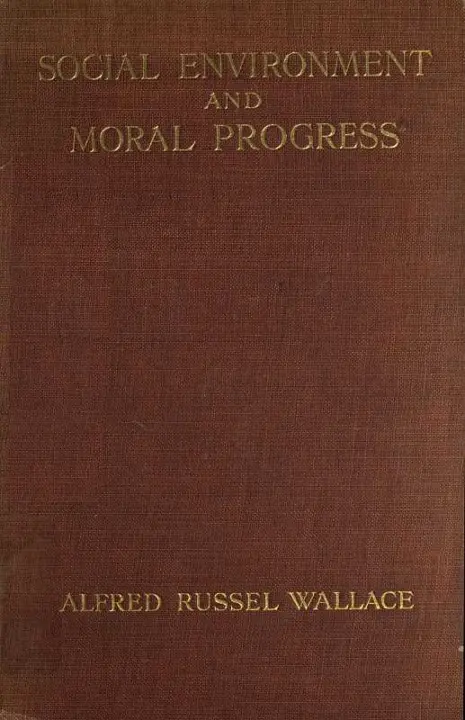
"Social Environment and Moral Progress" by Alfred Russel Wallace is a scientific publication written in the early 20th century. The work explores the complex relationship between morality and the social environment, delving into how morality has evolved and what influences it. The author emphasizes that moral progress is contingent upon the social context in which individuals operate, questioning the inherent understanding of right and wrong across different cultures and epochs. The opening of the text introduces the concept of moral progress, urging readers to consider that standards of morality shift significantly over time and between societies. Wallace critiques the notion that moral understanding is instinctual, pointing out that moral values often reflect societal conventions rather than universally inherent truths. He systematically lays out the groundwork for examining morality's historical foundations, illustrating his argument with historical examples, such as the shifting perceptions surrounding slavery. This sets the tone for a thorough exploration of how humanity’s moral framework is shaped by social conditions, the historical context of these morals, and the need for a careful selection process to foster moral improvement.
Introduction adapted from the source catalogue; source summaries may be automatically generated.
Free to read · English · 30,120 words · No account needed
MAKE TIME FOR A GOOD BOOK
On by default. Untick to stop anonymous reading totals. Each page counts after 10 seconds in view. How this works.
Anonymous counting is on unless you have switched it off.
Darwin and heredity, 103
and natural selection, 87, 93, 125
and transference of selection to mind, 99
and variability, 82
on Tahitians, 32
Darwin's Descent of Man, 93, 125
Origin of Species, 82
theory of Pangenesis, 104
Darwinism and Lamarckism, 78, 81
and variability, 82
objections to, 85, 90
(See also Evolution, Lamarckism, Natural selection, etc.)
Deadly trades, 50
Dell's, J. H., Dawning Grey quoted, 117
Descent of Man, Darwin's, 93, 125
Divine influx into man, 92, 115, 119
Divorce, 74
Dutt, Mr. Romesh, quoted, 9
Dwellings, insanitary, 47
Economic advance, evils of, 150
antagonism, 155
brotherhood, 155
evils, causes of, 154
remedies for, 154
Education, effects of, not hereditary, 111, 114
extension of period of, 143
national system of, needed, 146
of the world, 111
Egypt, astronomy in ancient, 18
civilisation of ancient, 15, 35
intellect in ancient, 16
Eighteenth century, stationary epoch, 40, 122
Elephants, increase of, 85
Environment, laws of heredity and, 103
modified by man, 95
not always responsible for specialisation, 106
remedies, 154
social, and conduct, 6
social, character of, 153
social, during 19th century, 40
social, evils of, causes of, 154
Equality of opportunity, 155
Erman, Prof. Adolf, quoted, 26
Euclid, 34
Eugenics, methods of, 127
science of, established by Sir F. Galton, 127
Eugenists, 149
Evil, origin of, problem of, 118
possible solution of, 119
Evolution, a rational theory, 81
acceptance of, 81
and civilisation, 157
Lamarckism and, 81
Chambers and, 81
Darwin and, 81
exposition of, by Spencer, 81
natural selection and, 77
objections to, 81, 90
variability of species, 8, 82
(See also Darwinism, Lamarckism, Natural selection, etc.)
Factory system, development of, 41
evils of, 41
Fertility, law of diminishing, 144, 147
Fines v. imprisonment, 65
Friendly Isles, natives of, character of, 32
Galton, Sir Francis, 37
eugenic theory of, 127
on laws of increase of population, 127
Galvanising trade, evils of, 51
Gambling, immorality of, 59
in trade, 58
inconsistent attitude to, 59
Stock Exchange, 59
Genius, not cumulative, 37
not necessarily hereditary, 37;
examples, 38
Gothic architecture, 34
Greece, 121
architecture of ancient, 34
Heredity and genius, 37
and "recession to mediocrity," 38
beneficence of law of, 115
Darwin and, 103
importance of subject, 103
Lamarck and, 104
laws of, and environment, 103
misconceptions regarding, 103
of innate characters, 110
Herschel, Sir John, 82
Homer, 8
Hominidæ, 94
Human nature, faculties of, 100
Imprisonment v. fines, 65
India, architecture of ancient, 34
intelligence and morality in ancient, 9, 11, 15
religious conceptions in ancient, 11
Individuation, 142
Infantile mortality, Prof. Petrie on, 140
statistics of, 47, 72
Injustice, social, 155
Innate characters, 104
heredity of, 110
Insanitary dwellings, 47
Intellect in ancient India, 9, 11, 15
permanence of, 15
Intellectual advance not general, 142
Jesus Christ, 116
Justice, administration of, 62
immorality of, 66, 152
Lamarck and evolution, 81
and heredity, 104
Lamarckism, 78, 89
and Darwinism, 78
insufficiency of, as a theory, 80
Land, access to, 155
Language, 28
diversity of, 120
lowest races possess, 31
Law, civil, system, 62
criminal, system, 64
partiality of the, 65
Layard, Sir H., 16
Le Conte, Prof., quoted, 139
Lead glaze trade, evils of, 50
Lead poisoning of workers, 51
Life-destroying trades, 47
Lyell's Principles of Geology quoted, 78
Maha-Bharata, Indian epic, quoted, 8
Malthus, 139
Mammals, classification of, 94
Man, affinity of, with anthropoid apes, 93
and marriage, 133
dignity of, 91
Divine influx into, 92, 115, 119
external differences between, and apes, 93
modifies his environment, 95
moral sense in, 91
nature of, stationary, 102
position of, 91
predominance of mind in, 98
preparation of, for progress, 120
selection transferred to mind in, 99
three great races of, 100
triumph of, over Nature, 95, 150
Your reading position is saved on this browser. Take it to another device with a library code. Reading pages adapt to text, rather than matching a printed edition.
Alfred Russel Wallace
Alfred Russel Wallace

Alfred Russel Wallace
Alfred Russel Wallace
BEHIND THE BOOK
This eBook is for the use of anyone anywhere in the United States and most other parts of the world at no cost and with almost no restrictions whatsoever. You may copy it, give it away or re-use it under the terms of the Project Gutenberg License included with this eBook or online at www.gutenberg.org. If you are not located in the United States, you will have to check the laws of the country where you are located before using this eBook. Read the source licence.
The original source file, including credits and licence, is retained by this library. Request an original-format copy at no charge. Please include the book title and Project Gutenberg identifier #50289.
KEEP YOUR CURIOSITY GOING

David Patterson (Spirit) Hatch
Cécile Tormay

Moritz Busch
Coulson Kernahan
John L. Ransom

Ralph Waldo Emerson