
Tropical nature, and other essays
Alfred Russel Wallace
THE CLASSIC COLLECTION · 1913
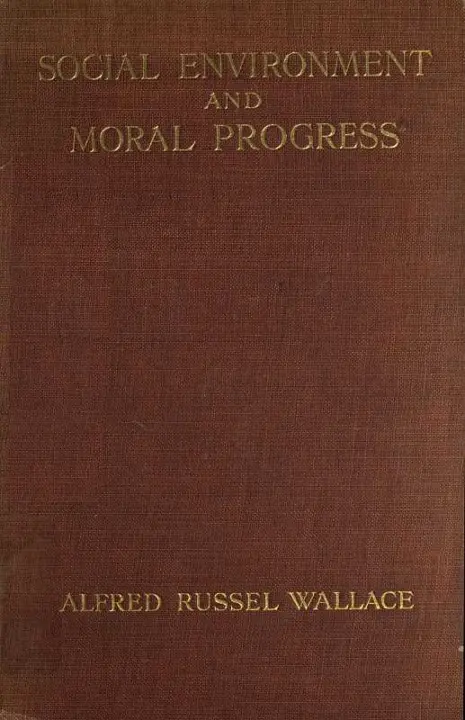
"Social Environment and Moral Progress" by Alfred Russel Wallace is a scientific publication written in the early 20th century. The work explores the complex relationship between morality and the social environment, delving into how morality has evolved and what influences it. The author emphasizes that moral progress is contingent upon the social context in which individuals operate, questioning the inherent understanding of right and wrong across different cultures and epochs. The opening of the text introduces the concept of moral progress, urging readers to consider that standards of morality shift significantly over time and between societies. Wallace critiques the notion that moral understanding is instinctual, pointing out that moral values often reflect societal conventions rather than universally inherent truths. He systematically lays out the groundwork for examining morality's historical foundations, illustrating his argument with historical examples, such as the shifting perceptions surrounding slavery. This sets the tone for a thorough exploration of how humanity’s moral framework is shaped by social conditions, the historical context of these morals, and the need for a careful selection process to foster moral improvement.
Introduction adapted from the source catalogue; source summaries may be automatically generated.
Free to read · English · 30,120 words · No account needed
MAKE TIME FOR A GOOD BOOK
On by default. Untick to stop anonymous reading totals. Each page counts after 10 seconds in view. How this works.
Anonymous counting is on unless you have switched it off.
That is sound moral teaching. We have been doing the Wrong for the past century, and we have reaped, and are reaping, "misery and destruction." It is time that we changed our methods, which are all (as I think I have sufficiently pointed out) fundamentally Wrong, radically Unjust, wholly Immoral.
We have ourselves created an immoral or unmoral Social Environment. To undo its inevitable results we must reverse our course. We must see that all our economic legislation, all our social reforms, are in the very opposite direction to those hitherto adopted, and that they tend in the direction of one or other of the four fundamental remedies I have suggested. In this way only can we hope to change our existing immoral environment into a moral one, and initiate a new era of Moral Progress.
In Chapters XIII to XVI I have shown that the well-established laws of Evolution as they really apply to mankind are all favourable to the advance of true Civilisation and of Morality. Our existing competitive and antagonistic Social System alone neutralises their beneficent operation. That System must therefore be radically changed into one of brotherly co-operation and co-ordination for the equal good of all. To succeed we must make this principle our guide and our pole star in all Social legislation.
Index
Acquired characters, definition of, 104
characters, on the heredity of, 103
Adaptation, 106
Adulteration, 55
Alcoholism, deaths from, 67
in women, 68
statistics of, 68
America, Central, architecture of, 34
Animals, natural selection among, 75
Anthropological Review, 99
Apes, anthropoid, affinity with man, 93
Aquatic forms of life, increase of, 85
Archimedes, 34
Australian aborigines, character of, 33
and Caucasians, 34
Barnardo, Dr., 141
Beaver, 95
Bimana, 94
Brahé, Tycho, 23
Brain as organ of the mind, 94
Bribery, 56
Browning's, Mrs., Cry of the Children, 42
Buddha, 8
Capitalism, 152
Caucasians and Australian aborigines, 34
Causes of economic evils, 154
Chambers's Vestiges of Creation, 81
Character, definition of, 4
difficulty of knowing good from bad, 5
mental faculties and, 5
morality based upon, 5
not cumulative, 37
of savage races, 32
permanence of, 8
public opinion and, 36
selective agency to improve, 36
subject to variation, 36
transmission of, 4, 7, 36
variability and, 82
Characters, acquired, definition of, 104
acquired, heredity of, 103
innate, 104, 110
heredity of, 110
Chemical trades, evils of, 50
Child labour, evils of, 41, 43
Church, the work of the, 118
Civil law system, 62
Civilisation during 18th century, 40
evolution and, 157
of ancient Egypt, 15, 35
of ancient India, 8
of ancient Mesopotamia, 15
Civilisations, ancient, 112
Classical writers, our indebtedness to, 115
Coal mines, accidents in, 43
child labour in, 43
female workers in, 43
insecurity in, 43
who the, belong to, 45
Commercial system, immorality of our, 55
Companies, Limited Liability, 56
Competition, 154
Conduct, character and, 5
environment and, 6
Confucius, 8
Cook, Captain, opinion of, on natives of Friendly Isles, 32
Co-operation, 154, 160
Criminal law system, 64
Cruciferæ family, increase of, 84
Curr, Mr., opinion of, on Australian aborigines, 33
Cutlery trade, evils of, 50
Daily Citizen quoted, 51, 52
Your reading position is saved on this browser. Take it to another device with a library code. Reading pages adapt to text, rather than matching a printed edition.
Alfred Russel Wallace
Alfred Russel Wallace

Alfred Russel Wallace
Alfred Russel Wallace
BEHIND THE BOOK
This eBook is for the use of anyone anywhere in the United States and most other parts of the world at no cost and with almost no restrictions whatsoever. You may copy it, give it away or re-use it under the terms of the Project Gutenberg License included with this eBook or online at www.gutenberg.org. If you are not located in the United States, you will have to check the laws of the country where you are located before using this eBook. Read the source licence.
The original source file, including credits and licence, is retained by this library. Request an original-format copy at no charge. Please include the book title and Project Gutenberg identifier #50289.
KEEP YOUR CURIOSITY GOING

David Patterson (Spirit) Hatch
Cécile Tormay

Moritz Busch
Coulson Kernahan
John L. Ransom

Ralph Waldo Emerson