
The Writing of News A Handbook with Chapters on Newspaper Correspondence and Copy Reading
Charles G. (Charles Griffith) Ross
THE CLASSIC COLLECTION · 1897
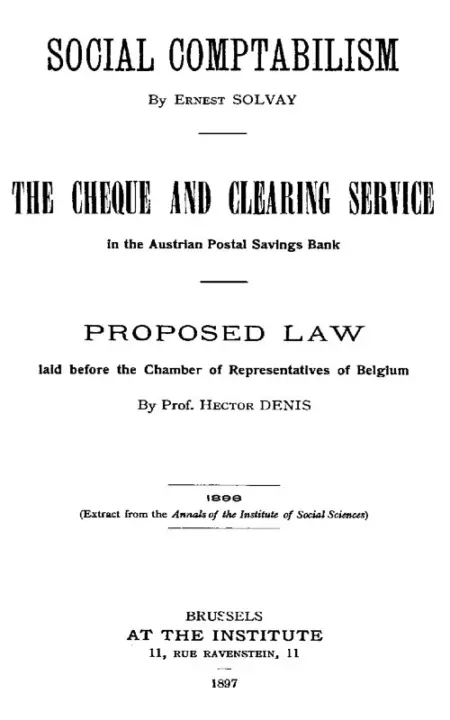
"Social Comptabilism" by Ernest Solvay is a scientific publication written in the late 19th century. The work explores the theoretical foundation of a new economic system that proposes replacing traditional money with a system of bookkeeping transactions, which it claims could offer significant advantages without the disadvantages of currency. The primary focus lies in analyzing how transactions could function without the necessity of money, emphasizing the idea of maintaining records of value and credit through a system referred to as “social comptabilism.” The opening of the work introduces the concept of replacing money with an account-keeping system that theoretically would allow for transactions to be conducted without physical currency. Solvay begins by discussing the role of money in society, arguing that it is mainly beneficial for commercial transactions and is not strictly necessary for all individuals. He posits that if transactions could be recorded legally and efficiently in a bookkeeping manner, money itself could become obsolete. The text outlines the theoretical implications of such a system, suggesting that it could simplify trade and improve economic relations without the complications brought about by the fluctuations of monetary value. The work aims to lay the groundwork for a practical application of these ideas, including examples from existing systems in Austria.
Introduction adapted from the source catalogue; source summaries may be automatically generated.
Free to read · English · 31,761 words · No account needed
MAKE TIME FOR A GOOD BOOK
On by default. Untick to stop anonymous reading totals. Each page counts after 10 seconds in view. How this works.
Anonymous counting is on unless you have switched it off.
Associations of every kind having accounts at the Savings Bank can by the same means gather subscriptions from the members: it is enough to send their members certificates of receipt and deposit; each one makes his payment at the neighbouring post office; the associations receiving, as the merchants, extracts of their accounts.
Assurance societies can in like manner, effect the payment of their insurers' premiums without any formality beyond that of sending to these insurers the empfang erlag scheine. And in like manner subscriptions to journals and all kinds of periodical payments can be received.
Secondly.
Post Office orders issued to the benefit of any person affiliated to the cheque-service can, at his request be placed to the credit of his account. He gives to this end, on forms required by the regulations, an authorisation at his district post office. On its side the Central Office of the Savings Bank puts itself in relation with the post office. Ingenious combinations which are indicated in the instructions reproduced in the appendix to this paper, cause the order to be transmitted to the Money Order Office of the Viennese Post Office, which in paying the amount to the Central Office of the Savings Bank will at the game time inform of this transmission, the person in whose favour the order is made out.
The Post Office Orders only take a very secondary position in the accounts of the cheque and clearing service.
In 1884 their amount rose to 851,514 florins » 1885 to 6,399,576 » » 1886 » 14,197,234 » » 1887 » 17,702,424 » » 1888 » 17,853,284 » » 1889 » 18,967,659 » » 1890 » 22,349,594 » » 1891 » 25,614,771 » » 1892 » 26,271,893 » » 1893 » 27,230,128 » » 1894 » 28,252,117 » » 1895 » 29,241,933 »
It is stated that the progressive movement is at once slower and more regular since 1891, than it was previously.
Thirdly.
The Postal Savings Bank receives in like manner for the benefit of holders of cheque-books, dividend warrants due from the Austrian public funds. It records the amount of them to the credit of the holder's account and receives a fee of 1 kreutzer a piece.
It is the least important of the agencies which feed the credit of the
adherents of the system.
In 1884 the amount received was 3,310 florins
» 1885 44,056 »
» 1886 114,684 »
» 1887 134,588 »
» 1888 147,833 »
» 1889 131,944 »
» 1890 148,104 »
» 1891 167,199 »
» 1892 165,139 »
» 1893 176,524 »
» 1894 223,757 »
» 1895 254,497 »
Fourthly.
The amount of claims to debts and bills rendered payable at the post office can in like manner be placed to the credit of the adherent to the cheque and clearing service in favour of whom these bills have been drawn.
The importance of this agency is more considerable, but its progressive development is said to move at an irregular rate.
Introduced in 1886, it was absolutely insignificant during the first
two years.
1886 17,916 florins
1887 23,370 »
1888 1,013,478 »
1889 1,072,812 »
1890 1,511,822 »
1891 2,303,012 »
1892 2,740,125 »
1893 2,623,893 »
1894 3,001,165 »
1895 4,301,265 »
Fifthly.
Your reading position is saved on this browser. Take it to another device with a library code. Reading pages adapt to text, rather than matching a printed edition.
BEHIND THE BOOK
This eBook is for the use of anyone anywhere in the United States and most other parts of the world at no cost and with almost no restrictions whatsoever. You may copy it, give it away or re-use it under the terms of the Project Gutenberg License included with this eBook or online at www.gutenberg.org. If you are not located in the United States, you will have to check the laws of the country where you are located before using this eBook. Read the source licence.
The original source file, including credits and licence, is retained by this library. Request an original-format copy at no charge. Please include the book title and Project Gutenberg identifier #45824.
KEEP YOUR CURIOSITY GOING
Charles G. (Charles Griffith) Ross
Hannah Webster Foster

Emily Lawless
Edwin Hamlin Carr

Charles De Lano Hine
Andrew Ure