READ · DISCOVER · ENJOYClassic literature · Always free
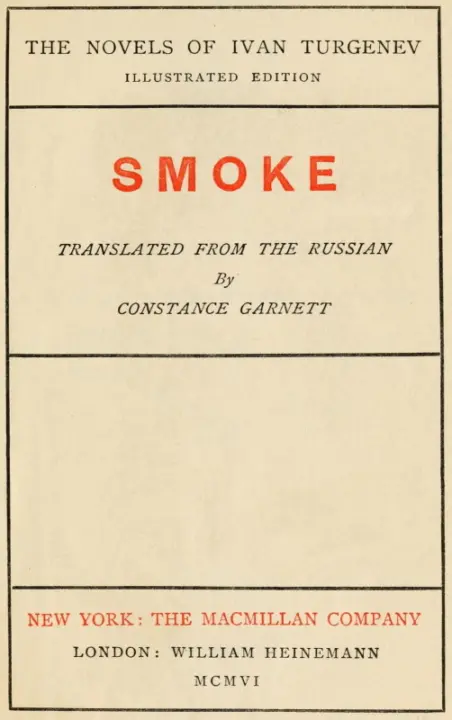
Smoke — digital edition cover

THE CLASSIC COLLECTION · 1867

Smoke

"Smoke" by Ivan Turgenev is a novel published in 1867 that interweaves a passionate love affair with biting social criticism. Set in the German resort town of Baden-Baden, the story follows young Grigory Litvinov, who arrives to meet his fiancée but encounters a mysterious woman from his past. As old feelings resurface, Turgenev satirizes Russian society through sharp portrayals of both conservative aristocrats and radical Slavophiles, offering his vision of Russia's future through pointed political commentary.

Introduction adapted from the source catalogue; source summaries may be automatically generated.

Start reading ↓

Free to read · English · 66,551 words · No account needed

MAKE TIME FOR A GOOD BOOK

Smoke

On by default. Untick to stop anonymous reading totals. Each page counts after 10 seconds in view. How this works.

Anonymous counting is on unless you have switched it off.

Smoke

‘You will see, Praskovya Danilovna,’ said the old prince one day, taking his pipe out of his mouth, ‘our chit of an Irina will give us all a lift in the world yet.’

The princess got angry, and told her husband that he made use of ‘des expressions insupportables’; afterwards, however, she fell to musing over his words, and repeated through her teeth:

‘Well ... and it would be a good thing if we did get a lift.’

Irina enjoyed almost unlimited freedom in her parents’ house; they did not spoil her, they even avoided her a little, but they did not thwart her, and that was all she wanted.... Sometimes--during some too humiliating scene--when some tradesman would come and keep shouting, to be heard over the whole court, that he was sick of coming after his money, or their own servants would begin abusing their masters to their face, with ‘fine princes you are, to be sure; you may whistle for your supper, and go hungry to bed’--Irina would not stir a muscle; she would sit unmoved, an evil smile on her dark face; and her smile alone was more bitter to her parents than any reproaches, and they felt themselves guilty--guilty, though guiltless--towards this being on whom had been bestowed, as it seemed, from her very birth, the right to wealth, to luxury, and to homage.

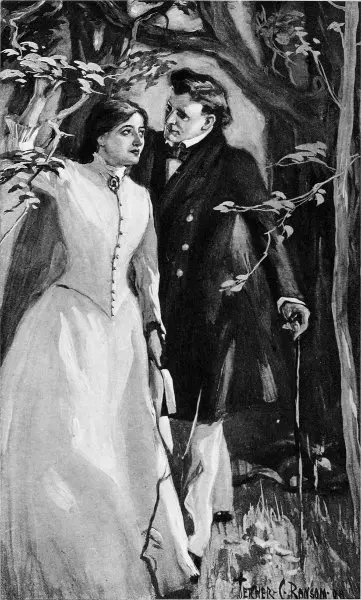
Litvinov fell in love with Irina from the moment he saw her (he was only three years older than she was), but for a long while he failed to obtain not only a response, but even a hearing. Her manner to him was even overcast with a shade of something like hostility; he did in fact wound her pride, and she concealed the wound, and could never forgive it. He was too young and too modest at that time to understand what might be concealed under this hostile, almost contemptuous severity. Often, forgetful of lectures and exercises, he would sit and sit in the Osinins’ cheerless drawing-room, stealthily watching Irina, his heart slowly and painfully throbbing and suffocating him; and she would seem angry or bored, would get up and walk about the room, look coldly at him as though he were a table or chair, shrug her shoulders, and fold her arms. Or for a whole evening, even when talking with Litvinov, she would purposely avoid looking at him, as though denying him even that grace. Or she would at last take up a book and stare at it, not reading, but frowning and biting her lips. Or else she would suddenly ask her father or brother aloud: ‘What’s the German for patience?’ He tried to tear himself away from the enchanted circle in which he suffered and struggled impotently like a bird in a trap; he went away from Moscow for a week. He nearly went out of his mind with misery and dulness; he returned quite thin and ill to the Osinins’.... Strange to say, Irina too had grown perceptibly thinner during those days; her face had grown pale, her cheeks were wan.... But she met him with still greater coldness, with almost malignant indifference; as though he had intensified that secret wound he had dealt at her pride.... She tortured him in this way for two months. Then everything was transformed in one day. It was as though love had broken into flame with the heat, or had dropped down from a storm-cloud. One day--long will he remember that day--he was once more sitting in the Osinins’ drawing-room at the window, and was looking mechanically into the street. There was vexation and weariness in his heart, he despised himself, and yet he could not move from his place.... He thought that if a river ran there under the window, he would throw himself in, with a shudder of fear, but without a regret. Irina placed herself not far from him, and was somehow strangely silent and motionless. For some days now she had not talked to him at all, or to any one else; she kept sitting, leaning on her elbows, as though she were in perplexity, and only rarely she looked slowly round. This cold torture was at last more than Litvinov could bear; he got up, and without saying good-bye, he began to look for his hat. ‘Stay,’ sounded suddenly, in a soft whisper. Litvinov’s heart throbbed, he did not at once recognise Irina’s voice; in that one word, there was a ring of something that had never been in it before. He lifted his head and was stupefied; Irina was looking fondly--yes, fondly at him. ‘Stay,’ she repeated; ‘don’t go. I want to be with you.’ Her voice sank still lower. ‘Don’t go.... I wish it.’ Understanding nothing, not fully conscious what he was doing, he drew near her, stretched out his hands.... She gave him both of hers at once, then smiling, flushing hotly, she turned away, and still smiling, went out of the room. She came back a few minutes later with her youngest sister, looked at him again with the same prolonged tender gaze, and made him sit near her.... At first she could say nothing; she only sighed and blushed; then she began, timidly as it were, to question him about his pursuits, a thing she had never done before. In the evening of the same day, she tried several times to beg his forgiveness for not having done him justice before, assured him she had now become quite different, astonished him by a sudden outburst of republicanism (he had at that time a positive hero-worship for Robespierre, and did not presume to criticise Marat aloud), and only a week later he knew that she loved him. Yes; he long remembered that first day ... but he did not forget those that came after either--those days, when still forcing himself to doubt, afraid to believe in it, he saw clearly, with transports of rapture, almost of dread, bliss un-hoped for coming to life, growing, irresistibly carrying everything before it, reaching him at last. Then followed the radiant moments of first love--moments which are not destined to be, and could not fittingly be, repeated in the same life. Irina became all at once as docile as a lamb, as soft as silk, and boundlessly kind; she began giving lessons to her younger sisters--not on the piano, she was no musician, but in French and English; she read their school-books with them, and looked after the housekeeping; everything was amusing and interesting to her; she would sometimes chatter incessantly, and sometimes sink into speechless tenderness; she made all sorts of plans, and was lost in endless anticipations of what she would do when she was married to Litvinov (they never doubted that their marriage would come to pass), and how together they would ... ‘Work?’ prompted Litvinov.... ‘Yes; work,’ repeated Irina, ‘and read ... but travel before all things.’ She particularly wanted to leave Moscow as soon as possible, and when Litvinov reminded her that he had not yet finished his course of study at the university, she always replied, after a moment’s thought, that it was quite possible to finish his studies at Berlin or ... somewhere or other. Irina was very little reserved in the expression of her feelings, and so her relations with Litvinov did not long remain a secret from the prince and princess. Rejoice they could not; but, taking all circumstances into consideration, they saw no necessity for putting a veto on it at once. Litvinov’s fortune was considerable....

Your reading position is saved on this browser. Take it to another device with a library code. Reading pages adapt to text, rather than matching a printed edition.

More from this author

BEHIND THE WORDS

About Ivan Sergeevich Turgenev

Ivan Sergeevich Turgenev (1818–1883). Explore The diary of a superfluous man, and other stories, First love, and other stories, Smoke and other works in this collection. These books span classic fiction, history, philosophy.
Explore this author’s books →

THE READERS’ VERDICT

How did this story stay with you?

Not rated yet
Your rating for Smoke

Be the first to share your verdict.

One rating per browser, which you can change or remove. A necessary browser identifier remembers your vote. How ratings work

A GOOD STORY DESERVES COMPANY

Pass this book along.

A great read is even better when it’s shared.

SEND A LITTLE INSPIRATION

Share this book

BEHIND THE BOOK

Edition & source details.

Title
Smoke
Author
Ivan Sergeevich Turgenev
Publication year
1867
Digital edition publisher
Project Gutenberg
Gutenberg release date
2012-09-21
Language
English
Source edition imprint
Not stated in source catalogue
Source identifier
Project Gutenberg #40813
Contributors
Constance Garnett (trl)

Public-domain source & licence

This eBook is for the use of anyone anywhere in the United States and most other parts of the world at no cost and with almost no restrictions whatsoever. You may copy it, give it away or re-use it under the terms of the Project Gutenberg License included with this eBook or online at www.gutenberg.org. If you are not located in the United States, you will have to check the laws of the country where you are located before using this eBook. Read the source licence.

Full source licence and obtaining an original copy

The original source file, including credits and licence, is retained by this library. Request an original-format copy at no charge. Please include the book title and Project Gutenberg identifier #40813.

the full Project Gutenberg License must appear
prominently whenever any copy of a Project Gutenberg work (any work
on which the phrase “Project Gutenberg” appears, or with which the
phrase “Project Gutenberg” is associated) is accessed, displayed,
performed, viewed, copied or distributed:

This eBook is for the use of anyone anywhere in the United States and most
other parts of the world at no cost and with almost no restrictions
whatsoever. You may copy it, give it away or re-use it under the terms
of the Project Gutenberg™ License included with this eBook or online
at www.gutenberg.org. If you
are not located in the United States, you will have to check the laws
of the country where you are located before using this eBook.

1.E.2. If an individual Project Gutenberg electronic work is
derived from texts not protected by U.S. copyright law (does not
contain a notice indicating that it is posted with permission of the
copyright holder), the work can be copied and distributed to anyone in
the United States without paying any fees or charges. If you are
redistributing or providing access to a work with the phrase “Project
Gutenberg” associated with or appearing on the work, you must comply
either with the requirements of paragraphs 1.E.1 through 1.E.7 or
obtain permission for the use of the work and the Project Gutenberg
trademark as set forth in paragraphs 1.E.8 or 1.E.9.

1.E.3. If an individual Project Gutenberg electronic work is posted
with the permission of the copyright holder, your use and distribution
must comply with both paragraphs 1.E.1 through 1.E.7 and any
additional terms imposed by the copyright holder. Additional terms
will be linked to the Project Gutenberg License for all works
posted with the permission of the copyright holder found at the
beginning of this work.

1.E.4. Do not unlink or detach or remove the full Project Gutenberg
License terms from this work, or any files containing a part of this
work or any other work associated with Project Gutenberg.

1.E.5. Do not copy, display, perform, distribute or redistribute this
electronic work, or any part of this electronic work, without
prominently displaying the sentence set forth in paragraph 1.E.1 with
active links or immediate access to the full terms of the Project
Gutenberg License.

1.E.6. You may convert to and distribute this work in any binary,
compressed, marked up, nonproprietary or proprietary form, including
any word processing or hypertext form. However, if you provide access
to or distribute copies of a Project Gutenberg work in a format
other than “Plain Vanilla ASCII” or other format used in the official
version posted on the official Project Gutenberg website
(www.gutenberg.org), you must, at no additional cost, fee or expense
to the user, provide a copy, a means of exporting a copy, or a means
of obtaining a copy upon request, of the work in its original “Plain
Vanilla ASCII” or other form. Any alternate format must include the
full Project Gutenberg License as specified in paragraph 1.E.1.

1.E.7. Do not charge a fee for access to, viewing, displaying,
performing, copying or distributing any Project Gutenberg works
unless you comply with paragraph 1.E.8 or 1.E.9.

1.E.8. You may charge a reasonable fee for copies of or providing
access to or distributing Project Gutenberg electronic works
provided that:

• You pay a royalty fee of 20% of the gross profits you derive from
the use of Project Gutenberg works calculated using the method
you already use to calculate your applicable taxes. The fee is owed
to the owner of the Project Gutenberg trademark, but he has
agreed to donate royalties under this paragraph to the Project
Gutenberg Literary Archive Foundation. Royalty payments must be paid
within 60 days following each date on which you prepare (or are
legally required to prepare) your periodic tax returns. Royalty
payments should be clearly marked as such and sent to the Project
Gutenberg Literary Archive Foundation at the address specified in
Section 4, “Information about donations to the Project Gutenberg
Literary Archive Foundation.”

• You provide a full refund of any money paid by a user who notifies
you in writing (or by e-mail) within 30 days of receipt that s/he
does not agree to the terms of the full Project Gutenberg™
License. You must require such a user to return or destroy all
copies of the works possessed in a physical medium and discontinue
all use of and all access to other copies of Project Gutenberg™
works.

• You provide, in accordance with paragraph 1.F.3, a full refund of
any money paid for a work or a replacement copy, if a defect in the
electronic work is discovered and reported to you within 90 days of
receipt of the work.

• You comply with all other terms of this agreement for free
distribution of Project Gutenberg™ works.


1.E.9. If you wish to charge a fee or distribute a Project
Gutenberg™ electronic work or group of works on different terms than
are set forth in this agreement, you must obtain permission in writing
from the Project Gutenberg Literary Archive Foundation, the manager of
the Project Gutenberg™ trademark. Contact the Foundation as set
forth in Section 3 below.

1.F.

1.F.1. Project Gutenberg volunteers and employees expend considerable
effort to identify, do copyright research on, transcribe and proofread
works not protected by U.S. copyright law in creating the Project
Gutenberg™ collection. Despite these efforts, Project Gutenberg™
electronic works, and the medium on which they may be stored, may
contain “Defects,” such as, but not limited to, incomplete, inaccurate
or corrupt data, transcription errors, a copyright or other
intellectual property infringement, a defective or damaged disk or
other medium, a computer virus, or computer codes that damage or
cannot be read by your equipment.

1.F.2. LIMITED WARRANTY, DISCLAIMER OF DAMAGES - Except for the “Right
of Replacement or Refund” described in paragraph 1.F.3, the Project
Gutenberg Literary Archive Foundation, the owner of the Project
Gutenberg™ trademark, and any other party distributing a Project
Gutenberg™ electronic work under this agreement, disclaim all
liability to you for damages, costs and expenses, including legal
fees. YOU AGREE THAT YOU HAVE NO REMEDIES FOR NEGLIGENCE, STRICT
LIABILITY, BREACH OF WARRANTY OR BREACH OF CONTRACT EXCEPT THOSE
PROVIDED IN PARAGRAPH 1.F.3. YOU AGREE THAT THE FOUNDATION, THE
TRADEMARK OWNER, AND ANY DISTRIBUTOR UNDER THIS AGREEMENT WILL NOT BE
LIABLE TO YOU FOR ACTUAL, DIRECT, INDIRECT, CONSEQUENTIAL, PUNITIVE OR
INCIDENTAL DAMAGES EVEN IF YOU GIVE NOTICE OF THE POSSIBILITY OF SUCH
DAMAGE.

1.F.3. LIMITED RIGHT OF REPLACEMENT OR REFUND - If you discover a
defect in this electronic work within 90 days of receiving it, you can
receive a refund of the money (if any) you paid for it by sending a
written explanation to the person you received the work from. If you
received the work on a physical medium, you must return the medium
with your written explanation. The person or entity that provided you
with the defective work may elect to provide a replacement copy in
lieu of a refund. If you received the work electronically, the person
or entity providing it to you may choose to give you a second
opportunity to receive the work electronically in lieu of a refund. If
the second copy is also defective, you may demand a refund in writing
without further opportunities to fix the problem.

1.F.4. Except for the limited right of replacement or refund set forth
in paragraph 1.F.3, this work is provided to you ‘AS-IS’, WITH NO
OTHER WARRANTIES OF ANY KIND, EXPRESS OR IMPLIED, INCLUDING BUT NOT
LIMITED TO WARRANTIES OF MERCHANTABILITY OR FITNESS FOR ANY PURPOSE.

1.F.5. Some states do not allow disclaimers of certain implied
warranties or the exclusion or limitation of certain types of
damages. If any disclaimer or limitation set forth in this agreement
violates the law of the state applicable to this agreement, the
agreement shall be interpreted to make the maximum disclaimer or
limitation permitted by the applicable state law. The invalidity or
unenforceability of any provision of this agreement shall not void the
remaining provisions.

1.F.6. INDEMNITY - You agree to indemnify and hold the Foundation, the
trademark owner, any agent or employee of the Foundation, anyone
providing copies of Project Gutenberg™ electronic works in
accordance with this agreement, and any volunteers associated with the
production, promotion and distribution of Project Gutenberg™
electronic works, harmless from all liability, costs and expenses,
including legal fees, that arise directly or indirectly from any of
the following which you do or cause to occur: (a) distribution of this
or any Project Gutenberg work, (b) alteration, modification, or
additions or deletions to any Project Gutenberg work, and (c) any
Defect you cause.

Section 2. Information about the Mission of Project Gutenberg

Project Gutenberg is synonymous with the free distribution of
electronic works in formats readable by the widest variety of
computers including obsolete, old, middle-aged and new computers. It
exists because of the efforts of hundreds of volunteers and donations
from people in all walks of life.

Volunteers and financial support to provide volunteers with the
assistance they need are critical to reaching Project Gutenberg’s
goals and ensuring that the Project Gutenberg collection will
remain freely available for generations to come. In 2001, the Project
Gutenberg Literary Archive Foundation was created to provide a secure
and permanent future for Project Gutenberg and future
generations. To learn more about the Project Gutenberg Literary
Archive Foundation and how your efforts and donations can help, see
Sections 3 and 4 and the Foundation information page at www.gutenberg.org.

Section 3. Information about the Project Gutenberg Literary Archive Foundation

The Project Gutenberg Literary Archive Foundation is a non-profit
501(c)(3) educational corporation organized under the laws of the
state of Mississippi and granted tax exempt status by the Internal
Revenue Service. The Foundation’s EIN or federal tax identification
number is 64-6221541. Contributions to the Project Gutenberg Literary
Archive Foundation are tax deductible to the full extent permitted by
U.S. federal laws and your state’s laws.

The Foundation’s business office is located at 41 Watchung Plaza #516,
Montclair NJ 07042, USA, +1 (862) 621-9288. Email contact links and up
to date contact information can be found at the Foundation’s website
and official page at www.gutenberg.org/contact

Section 4. Information about Donations to the Project Gutenberg
Literary Archive Foundation

Project Gutenberg™ depends upon and cannot survive without widespread
public support and donations to carry out its mission of
increasing the number of public domain and licensed works that can be
freely distributed in machine-readable form accessible by the widest
array of equipment including outdated equipment. Many small donations
($1 to $5,000) are particularly important to maintaining tax exempt
status with the IRS.

The Foundation is committed to complying with the laws regulating
charities and charitable donations in all 50 states of the United
States. Compliance requirements are not uniform and it takes a
considerable effort, much paperwork and many fees to meet and keep up
with these requirements. We do not solicit donations in locations
where we have not received written confirmation of compliance. To SEND
DONATIONS or determine the status of compliance for any particular state
visit www.gutenberg.org/donate.

While we cannot and do not solicit contributions from states where we
have not met the solicitation requirements, we know of no prohibition
against accepting unsolicited donations from donors in such states who
approach us with offers to donate.

International donations are gratefully accepted, but we cannot make
any statements concerning tax treatment of donations received from
outside the United States. U.S. laws alone swamp our small staff.

Please check the Project Gutenberg web pages for current donation
methods and addresses. Donations are accepted in a number of other
ways including checks, online payments and credit card donations. To
donate, please visit: www.gutenberg.org/donate.

Section 5. General Information About Project Gutenberg electronic works

Professor Michael S. Hart was the originator of the Project
Gutenberg concept of a library of electronic works that could be
freely shared with anyone. For forty years, he produced and
distributed Project Gutenberg eBooks with only a loose network of
volunteer support.

Project Gutenberg eBooks are often created from several printed
editions, all of which are confirmed as not protected by copyright in
the U.S. unless a copyright notice is included. Thus, we do not
necessarily keep eBooks in compliance with any particular paper
edition.

Most people start at our website which has the main PG search
facility: www.gutenberg.org.

This website includes information about Project Gutenberg,
including how to make donations to the Project Gutenberg Literary
Archive Foundation, how to help produce our new eBooks, and how to
subscribe to our email newsletter to hear about new eBooks.


KEEP YOUR CURIOSITY GOING

Your next chapter awaits.