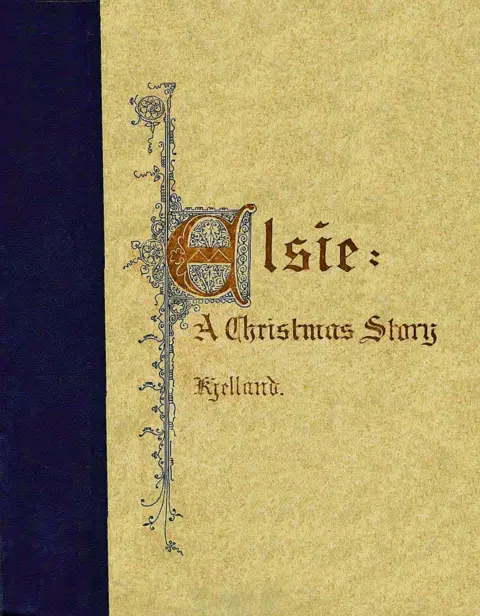
Elsie
Alexander Lange Kielland
THE CLASSIC COLLECTION · 1886
"Skipper Worse" by Alexander Lange Kielland is a novel written in the late 19th century. The story is centered around the character Jacob Worse, an accomplished sailor who returns home after a long voyage to Rio de Janeiro. The novel explores his interactions with the local community, his struggles with his past, and the complexities of societal norms that are intertwined with the religious revival movements prevalent on the Norwegian west coast. The opening of "Skipper Worse" introduces us to the titular character as he navigates his homecoming aboard his vessel, the "Hope of the Family". Upon arrival, he is met with a mixture of joy and tension, particularly with regard to his employer, Consul Garman, who is anxious about the financial state of his business amidst societal and personal losses. The narrative captures the contrast between the lively welcome from the crew's families and the somber relations that Worse has with others, highlighting themes of alienation and ambition. As Worse acclaimed his past achievements, we also glimpse his vulnerabilities and the expectations from the community that may weigh heavily on him as he seeks to find his place amidst changing social dynamics.
Introduction adapted from the source catalogue; source summaries may be automatically generated.
Free to read · English · 53,479 words · No account needed
MAKE TIME FOR A GOOD BOOK
On by default. Untick to stop anonymous reading totals. Each page counts after 10 seconds in view. How this works.
Anonymous counting is on unless you have switched it off.
Nevertheless, the calm, pleasant summer evening was not without its effect upon them. They had again discussed the chief defects of their community, and how desirable it was that some one should take them seriously in hand.
But now the conversation flagged. They stopped and gazed over the fjord, where the fires were being lighted up. Boats rowed about, and song and music reached their ears. Sarah unconsciously heaved a deep sigh, and turned to go back to the town.
Hans Nilsen was about to say something about the sinfulness of the children of this world, but was unable to frame words. He abandoned the attempt, and, before he knew what he was doing, asked her if she was pleased with the letter he had given her when they last separated.
"Oh yes, Hans Nilsen!" she said, turning her face towards him, her
colour heightened. She said no more, and he, too, became quite
confused.
They turned towards the town. At the street door Sarah asked him if he would not come in for a moment. He followed unconsciously, and, when they entered the room, sat down on a chair.
He was glad to rest, he said, for he was weary. The evening rays lit half the room, but the back part was already dark. Sarah went out into the kitchen to see if the door was shut. The servants had gone upstairs, and the house was still and deserted, for it was nearly ten o'clock.
She brought some water and raspberry syrup, and Hans Nilsen, contrary to his custom, took a long draught. He was both tired and thirsty, he said.
Sarah sat at the other end of the sofa, and neither of them spoke. After a minute or two, the silence grew oppressive, and they began to converse again, but soon again lapsed into silence.
"What were you going to say?" inquired Hans Nilsen.
"I--I only asked if you would have some more syrup and water," said she, with some embarrassment.
"No, thank you. I ought to be going."
He got up and walked across the room. His hat lay on the table; but Fennefos moved, as if he hardly knew where he was, towards the window, and looked out on the pale evening sky.
Sarah got up also, and went to the cupboard, which was between the windows, where she began to busy herself with one thing or another.
Observing that she was behind him, he turned round and went back to
his seat.
"It has been fine, warm weather to-day," he said; but his voice was
thick and strange, and, in spite of what he had drunk, his throat was
dry.
Your reading position is saved on this browser. Take it to another device with a library code. Reading pages adapt to text, rather than matching a printed edition.
Alexander Lange Kielland
Alexander Lange Kielland
Alexander Lange Kielland
BEHIND THE BOOK
This eBook is for the use of anyone anywhere in the United States and most other parts of the world at no cost and with almost no restrictions whatsoever. You may copy it, give it away or re-use it under the terms of the Project Gutenberg License included with this eBook or online at www.gutenberg.org. If you are not located in the United States, you will have to check the laws of the country where you are located before using this eBook. Read the source licence.
The original source file, including credits and licence, is retained by this library. Request an original-format copy at no charge. Please include the book title and Project Gutenberg identifier #30530.
KEEP YOUR CURIOSITY GOING
Coulson Kernahan

Maurice Baring
Frances Wright
Cécile Tormay

Frederic Jesup Stimson

W. H. P. (William Henry Pope) Jarvis