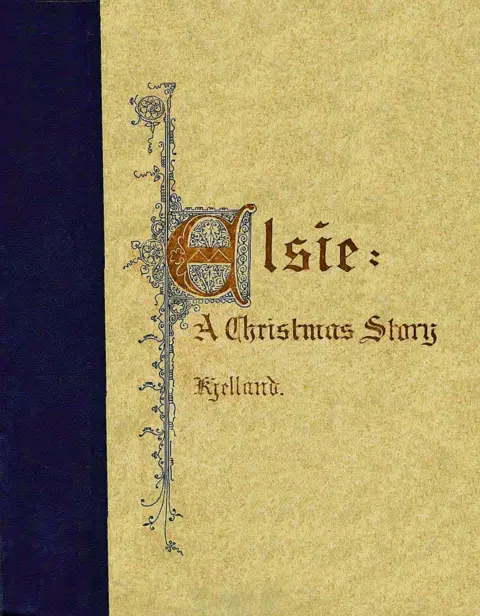
Elsie
Alexander Lange Kielland
THE CLASSIC COLLECTION · 1886
"Skipper Worse" by Alexander Lange Kielland is a novel written in the late 19th century. The story is centered around the character Jacob Worse, an accomplished sailor who returns home after a long voyage to Rio de Janeiro. The novel explores his interactions with the local community, his struggles with his past, and the complexities of societal norms that are intertwined with the religious revival movements prevalent on the Norwegian west coast. The opening of "Skipper Worse" introduces us to the titular character as he navigates his homecoming aboard his vessel, the "Hope of the Family". Upon arrival, he is met with a mixture of joy and tension, particularly with regard to his employer, Consul Garman, who is anxious about the financial state of his business amidst societal and personal losses. The narrative captures the contrast between the lively welcome from the crew's families and the somber relations that Worse has with others, highlighting themes of alienation and ambition. As Worse acclaimed his past achievements, we also glimpse his vulnerabilities and the expectations from the community that may weigh heavily on him as he seeks to find his place amidst changing social dynamics.
Introduction adapted from the source catalogue; source summaries may be automatically generated.
Free to read · English · 53,479 words · No account needed
MAKE TIME FOR A GOOD BOOK
On by default. Untick to stop anonymous reading totals. Each page counts after 10 seconds in view. How this works.
Anonymous counting is on unless you have switched it off.
From his son Romarino, Worse received a very disagreeable letter. This young gentleman pointed out to him the folly of taking a young wife at his advanced age, and, without the least compunction, bewailed the pecuniary loss which it might entail on him, Romarino.
Worse was very angry, and handed the letter to Sarah, who read it, whilst he walked up and down the room, fuming.
"Yes, you cannot expect it otherwise," said Sarah. "The young man was never taught anything better, either by you or by his mother. As you sow, so will you reap. Shall I answer the letter?"
"Yes; I should be very grateful to you, if you would, Sarah," said Jacob Worse. It was a great relief to him.
It was surprising to see how readily Sarah assumed her position, and how completely she changed everything, and put the house in order. It was, in fact, necessary; for there was much waste and mismanagement, as was natural where the head of the house was a man, who was, moreover, often absent from home.
During the first weeks after the marriage, Sarah took no interest in anything. When her half-developed youth, her dawning wishes and hopes were suddenly and unmercifully crushed, a thick cloud seemed to descend upon her, obscuring her life, and leaving no prospect of escape, except by a welcome death.
But one day a new feeling was awakened in her. Returning home from shopping in the town, she found her mother making a clearance in her rooms, placing chairs along the walls, and laying her small books about upon the tables.
As Sarah entered, her mother said, and in a voice not quite so resolute as was her wont: "I think we will hold the meeting here in your rooms; they are larger and lighter than mine."
"Have you asked my husband?"
"My husband!" It was the first time, and there was such a stiffness and determination about these two words, that the widow unconsciously drew herself back.
Sarah quietly collected her mother's small books in a heap, which she placed on a seat by the door, put a couple of chairs back into their proper places, and, without looking up, said: "I cannot have a meeting in my house without having consulted my husband."
"You are quite right, dear Sarah," said Madame Torvestad, in an affectionate tone, but with quivering lips; "and I ought to have thought of it. I hope you will come over to us in the evening."
"If my husband will."
Your reading position is saved on this browser. Take it to another device with a library code. Reading pages adapt to text, rather than matching a printed edition.
Alexander Lange Kielland
Alexander Lange Kielland
Alexander Lange Kielland
BEHIND THE BOOK
This eBook is for the use of anyone anywhere in the United States and most other parts of the world at no cost and with almost no restrictions whatsoever. You may copy it, give it away or re-use it under the terms of the Project Gutenberg License included with this eBook or online at www.gutenberg.org. If you are not located in the United States, you will have to check the laws of the country where you are located before using this eBook. Read the source licence.
The original source file, including credits and licence, is retained by this library. Request an original-format copy at no charge. Please include the book title and Project Gutenberg identifier #30530.
KEEP YOUR CURIOSITY GOING
Coulson Kernahan

Maurice Baring
Frances Wright
Cécile Tormay

Frederic Jesup Stimson

W. H. P. (William Henry Pope) Jarvis